How System Integrators Are Evolving into Super Intelligence
Discover how the shift from System Integrator to Super Intelligence can improve business efficiency, decisions, customer experience, and growth.
For years, SI has been widely understood as System Integrator - a technology partner that connects applications, platforms, infrastructure, and business processes so they can work together.
On this page
That role remains essential. However, as businesses adopt increasingly intelligent technologies, expectations for technology partners are expanding. Companies need more than connected systems; they need ways to turn data into insights, support better decisions, and improve business processes.
This shift brings a new interpretation of SI into the conversation: Super Intelligence.
On September 29, 2026, the White House issued an Executive Order titled “Inaugurating the Era of Super Intelligence,” directing executive departments and agencies, to the extent permitted by law, to use “Super Intelligence” and “SI” in place of “Artificial Intelligence” and “AI” in specified official communications and other non-statutory documents.
For businesses, the more important question is what this shift could mean for the future of System Integrators and the value they deliver.
What Is SI?
Traditionally, SI stands for System Integrator - a company or technology partner that brings different software applications, platforms, databases, and infrastructure together so they can function as a connected environment.
For example, a business may use an enterprise resource planning (ERP) system to manage operations, a customer relationship management (CRM) platform to track customer interactions, and separate applications for finance, inventory, and logistics. A System Integrator helps these systems exchange information and support end-to-end business processes.
Super Intelligence represents a broader vision in which connected technology can do more than exchange information. Intelligent capabilities can help interpret data, recognize patterns, support decisions, and assist with actions across business workflows.
In this article, Super Intelligence is used as a way to describe that evolving direction, rather than as a universally established technical definition.
The distinction is straightforward:
- System Integration connects systems: Applications and data sources work together, reducing information silos and manual processes.
- Intelligence connects information with context: Data from different systems can be analyzed to identify patterns, risks, and opportunities.
- Intelligent capabilities support decisions and actions: Employees can receive relevant recommendations, while suitable workflows can be automated under defined rules and oversight.
Consider a retailer with connected e-commerce, CRM, and inventory systems. Integration can ensure that a purchase updates inventory and customer records. An intelligent capability could go further by identifying a recurring customer preference, detecting a potential stock shortage, and helping the business decide whether to replenish inventory or recommend a relevant product.
The opportunity is not simply to connect more technology. It is to make connected technology more useful to the business.
Why System Integrators Are Evolving
The traditional System Integrator emerged to solve a fundamental business problem: technology fragmentation.
As companies grow, they often accumulate applications across departments. Although each system may perform its intended function, disconnected data and workflows can slow decisions, increase manual work, and make it difficult to understand what is happening across the organization.
System Integrators help address these challenges by creating reliable connections between systems. But integration alone does not automatically tell a business what its data means or which action it should take.
From connecting systems to connecting information
Consider a manufacturing company that collects data from production equipment, maintenance systems, inventory platforms, and customer orders.
A traditional integrated environment can show managers that a machine requires attention, inventory is changing, or customer demand is increasing.
An intelligent layer could analyze these signals together. If an equipment issue coincides with rising demand for a particular product, the system could flag a potential production risk and help managers evaluate maintenance, scheduling, and inventory options.
This illustrates how the role of SI can evolve:
- Connect: Integrate applications, platforms, and data sources.
- Understand: Interpret information in its business context.
- Predict: Identify potential risks and opportunities.
- Recommend: Support employees with relevant next steps.
- Act: Enable approved workflows to respond more efficiently.
The exact capabilities depend on the technology, available data, and level of human oversight. The broader direction, however, is clear: integration provides the foundation, while intelligence can expand what businesses achieve with it.
Integration remains the foundation
This evolution does not make traditional integration obsolete. In fact, intelligent capabilities often depend on it.
If information is inaccurate, outdated, or trapped in disconnected applications, an intelligent solution may produce incomplete or unreliable results. Businesses still need dependable data flows, secure access, well-defined processes, and appropriate governance.
The opportunity for System Integrators is therefore to expand their focus from how systems communicate to how connected systems can help the business perform better.
What Super Intelligence Can Add to the Business
The value of intelligent technology is best understood through the business problems it helps solve. Across industries, connected and intelligent capabilities can support better decisions, improve employee productivity, and create more responsive customer experiences.
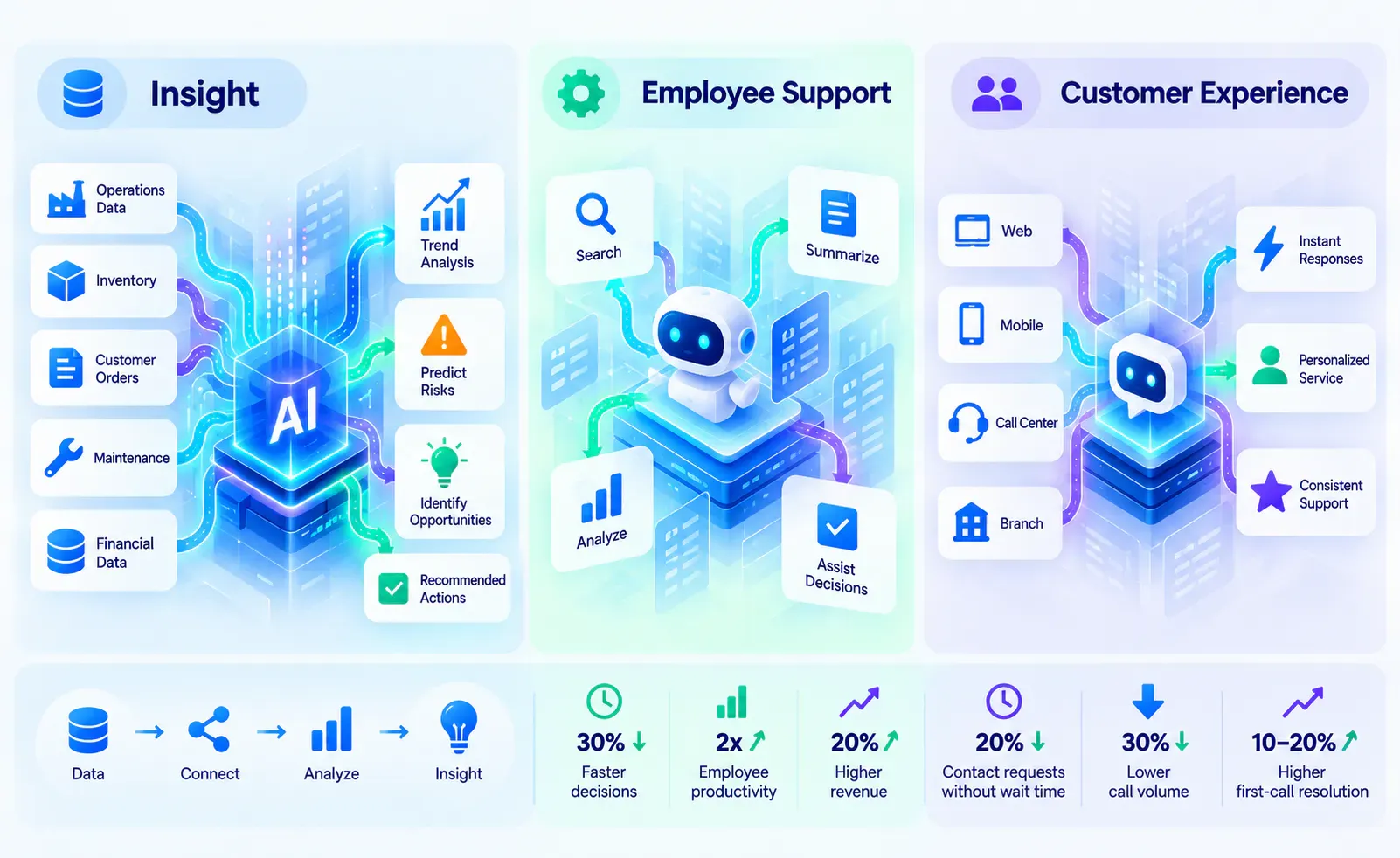
Turning connected data into insight
Most businesses already generate substantial amounts of data through sales transactions, customer interactions, financial records, operational metrics, and market activity.
The challenge is turning that information into useful insight.
For example, an intelligent environment in manufacturing could combine equipment data, maintenance history, inventory levels, and customer demand to identify potential production bottlenecks. Rather than reviewing separate reports, managers could receive a more complete picture of the issue and evaluate possible responses.
The value comes from understanding the relationships between data points, not simply collecting more information.
Supporting employees with intelligent capabilities
Intelligent technology can also reduce the time employees spend searching for, compiling, and organizing information.
McKinsey describes a banking case in which relationship managers previously spent one to three days gathering information from a dozen or more sources to prepare credit-risk memos. A multi-agent system was introduced to gather current data, combine qualitative and quantitative insights, and prepare analysis for human review.
According to McKinsey, the resulting process made credit decisions 30% faster, while relationship-manager productivity more than doubled. Revenue per relationship manager also increased by 20%.
The lesson is not simply that AI can automate research. It is that intelligent capabilities become more useful when they can access relevant information across systems and apply it within an existing business process.
This is where integration expertise becomes particularly important.
Creating more responsive customer experiences
Customer service offers another example of how intelligent capabilities can improve business processes.
In a banking case, McKinsey reports that a customer-facing chatbot eliminated waiting times for about 20% of contact center requests within its first seven weeks of use.
The finding refers to the share of requests for which waiting time was eliminated, not a 20% increase in the number of customers.
The broader opportunity goes beyond deploying a chatbot. A useful customer-service solution may need access to customer history, product information, transaction records, company policies, and service workflows. Connecting these resources helps the solution provide more relevant responses within the context of the customer's needs.
Telecommunications provides another example. McKinsey describes a leading North American telecommunications provider that redesigned customer journeys by combining generative AI with broader process improvements and changes to workforce practices and workflows.
The company reduced total call volume by about 30%, cut average handling time by more than one-quarter, and increased first-call resolution rates by 10 to 20 percentage points.
These results illustrate why businesses should look beyond individual AI features. Meaningful improvements can come from combining intelligent technology with process redesign and better integration across the customer journey.
The New Role of the System Integrator
As technology environments become more intelligent, System Integrators have an opportunity to expand their role from implementing connections to helping businesses build capabilities around their strategic objectives.
From implementation partner to transformation partner
Imagine a distributor whose sales representatives spend hours searching for product specifications, pricing, inventory availability, and previous customer orders before responding to clients.
A traditional integration project could connect the CRM with inventory and product-management systems.
An evolving SI could build on that foundation by helping the distributor introduce an intelligent assistant that retrieves relevant information, interprets the customer's request, and prepares a response for the sales representative to review.
The business value is not the assistant alone. It is the reduction in manual effort and the ability to respond to customers with more relevant information.
This changes the focus from delivering technology to enabling better business performance.
From data access to decision support
Consider a logistics company that integrates order management, warehouse systems, GPS data, and customer-service platforms.
Integration makes information available across the operation. Intelligent capabilities could then analyze order volumes, warehouse capacity, traffic conditions, delivery history, and customer priorities to identify potential delays and help teams evaluate their options.
In this environment, the technology partner helps the business move through four stages:
- Connect: Make relevant systems communicate reliably.
- Analyze: Bring context to information from multiple sources.
- Assist: Help employees evaluate situations and possible actions.
- Optimize: Use operational feedback and measured outcomes to improve workflows.
Human oversight remains important, particularly when decisions affect safety, customer commitments, financial outcomes, or regulatory obligations.
From projects to continuous improvement
Traditional integration projects often have a defined scope and completion date. Requirements are established, systems are connected, testing is performed, and the solution goes live.
Intelligent business environments require a more continuous approach because data, business needs, workflows, and technology change over time.
Technology partners can help organizations identify opportunities to reduce repetitive work, improve access to information, detect operational risks earlier, enhance customer interactions, and measure whether solutions continue to deliver value.
The goal is to move beyond a one-time implementation toward the ongoing improvement of connected business capabilities.
FIX Partner and the Evolution Toward Super Intelligence
The evolution from System Integrator to Super Intelligence creates an opportunity for FIX Partner to take a broader view of technology delivery.
The objective is not simply to implement another tool or connect another application.
It is to help customers turn technology investments into measurable and lasting business value.
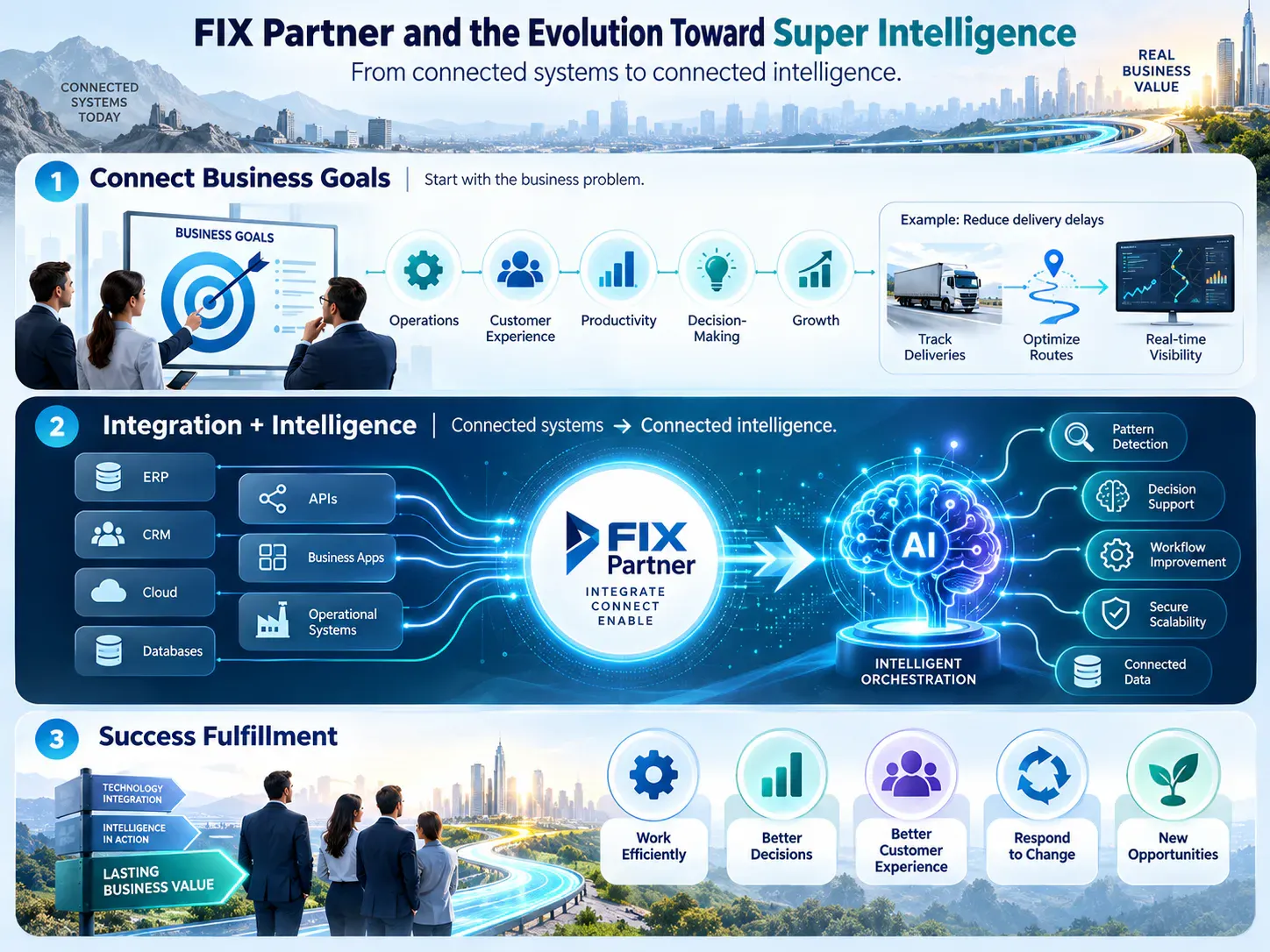
Connecting technology with business objectives
A business does not invest in integration because connecting systems is an end in itself.
It invests because better connectivity can improve operations, customer experiences, employee productivity, decision-making, or growth.
The same principle applies to Super Intelligence.
For example, if a logistics company wants to reduce delivery delays, the starting point should not be an AI feature.
The starting point should be the business problem.
FIX Partner can help connect the relevant operational systems and create the technical foundation needed for intelligent capabilities. From there, intelligence can be applied to identify patterns, support decisions, and improve the workflow.
The technology becomes meaningful because it contributes to a clear business objective.
Combining integration expertise with intelligent capabilities
Super Intelligence does not remove the need for System Integration expertise.
It makes that expertise more important.
ERP systems, CRM platforms, cloud environments, databases, APIs, business applications, and operational systems still contain the information that intelligent solutions need.
The challenge is bringing these components together in a way that is secure, reliable, scalable, and useful for the business.
This is where FIX Partner can help businesses move from connected systems to connected intelligence.
The goal is not to create another isolated AI solution.
It is to build an ecosystem where data, technology, intelligence, and people work together toward meaningful outcomes.
Delivering Success Fulfillment
For FIX Partner, the evolution toward Super Intelligence also reinforces a broader principle: technology should help customers achieve their goals and realize their potential.
Success should therefore be measured beyond implementation.
Businesses can look at whether the solution helps them:
- Work more efficiently by reducing unnecessary manual effort.
- Make better-informed decisions through connected and contextual information.
- Improve customer experiences with faster and more relevant interactions.
- Respond to change with greater visibility and flexibility.
- Create new opportunities through better use of technology and data.
These outcomes turn technology delivery into lasting business value.
Conclusion: The Future of System Integration
The evolution from System Integrator to Super Intelligence does not mean that integration disappears.
It means its purpose can expand.
System Integrators have traditionally connected applications, platforms, and business processes. As intelligent technologies become more capable, the next stage is to connect data, intelligence, decisions, and actions around real business needs.
The examples across banking, telecommunications, retail, manufacturing, and logistics show how this evolution can translate into practical improvements, from faster decisions and greater employee productivity to more responsive customer experiences and more efficient operations. The McKinsey cases illustrate that the strongest results can come when generative AI is combined with workflow redesign, process improvement, and human capabilities rather than deployed as a standalone feature.
For businesses, the opportunity is not simply to adopt Super Intelligence because it represents the next technology trend.
It is to identify where intelligence can solve meaningful problems and then build the integration, data, and process foundations required to make it work.
For System Integrators, this creates a new role: not only connecting systems, but helping businesses turn connected technology into intelligent capabilities.
FIX Partner is ready to help businesses move from connected systems to intelligent business capabilities, creating technology solutions designed around real goals, measurable outcomes, and lasting value.
Written by
Hannah Huynh
Published by
FIX Partner
FIX Partner helps organizations design, build, test, and modernize software products with engineering, AI, data, and QA expertise.
About FIX Partner →Ask FIX Partner
Have a question about this topic?
Leave your details and a short note. Our team can help you identify a practical next step.
Related articles
AI Agent Systems: How Business Software Is Evolving
Hannah HuynhSep 26, 2026
Explore AI agent systems and how they transform business software through intelligent automation, dynamic decision-making, software development, and workflow orchestration.
Read more →
CTOaaS for High-Growth SaaS Startups and Scale-Ups
Hannah HuynhSep 17, 2026
Explore CTOaaS for SaaS Startups to access flexible technology leadership, scale your engineering team, strengthen strategy, and drive sustainable growth.
Read more →
Shift Left, Shift Right, AI Shift: FIX Partner’s Agile QA
Hannah HuynhSep 10, 2026
Explore FIX Partner’s Agile QA with Shift Left, Shift Right, and AI Shift to improve software quality, test automation, and continuous testing.
Read more →