AI Agent Systems: How Business Software Is Evolving
Explore AI agent systems and how they transform business software through intelligent automation, dynamic decision-making, software development, and workflow orchestration.
Software has traditionally been built around a straightforward model: people define requirements, developers write the logic, and applications execute predefined instructions. When business requirements change, teams modify the code, test the changes, and release a new version.
On this page
This approach has powered decades of digital transformation. It remains highly effective for predictable processes where rules, inputs, and expected outputs can be clearly defined.
But many modern business processes are more dynamic. They require software to interpret information, make decisions, use different tools, respond to unexpected conditions, and work toward an outcome rather than simply follow a fixed sequence of instructions.
This is where AI agent systems introduce a different approach.
Instead of using AI only as a feature inside conventional software, AI agent systems can combine reasoning, planning, memory, tools, and execution to work toward a defined objective. An agent can determine what actions are needed, interact with external systems, evaluate the results, and adjust its next steps within the constraints established by its designers.
For businesses, this represents an important shift: from software that primarily executes predefined workflows to software that can help coordinate more dynamic, goal-driven work.
What Are AI Agent Systems?
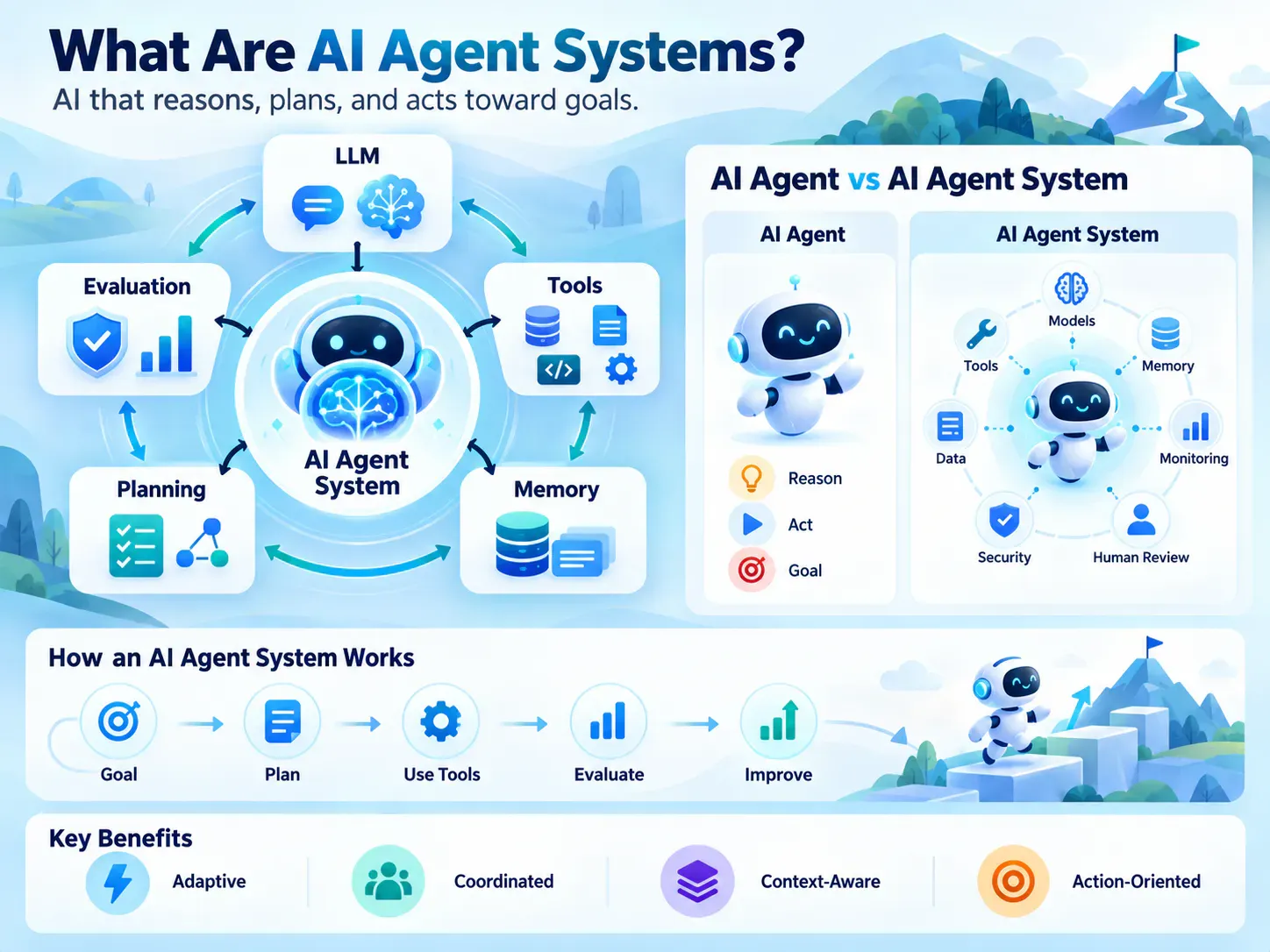
An AI agent system is a software system that uses AI models to reason about objectives and coordinate actions needed to achieve them.
A typical system can combine several core components:
- Large Language Model (LLM): provides reasoning, interpretation, and decision-making capabilities.
- Tools: allow the agent to interact with APIs, databases, files, code interpreters, applications, and other systems.
- Memory: provides access to relevant information from the current task or longer-term context.
- Planning: helps break complex objectives into smaller tasks and determine an appropriate sequence of actions.
- Evaluation: allows the system to assess whether an action or result meets the required criteria.
These components work together to create a system that can respond to changing conditions rather than relying entirely on a fixed decision tree.
AI Agents vs. AI Agent Systems
The terms AI agent and AI agent system are closely related but describe different levels of the architecture.
An AI agent is an individual software actor that can reason and perform actions toward a goal.
An AI agent system is the broader environment around that agent. It can include models, tools, memory, data sources, orchestration, monitoring, evaluation mechanisms, security controls, and human approval processes.
This distinction becomes increasingly important as organizations move from experimenting with individual AI assistants toward deploying AI-driven workflows across the business.
How AI Agent Systems Work
The biggest difference between conventional automation and AI agent systems is how they approach a task.
A traditional workflow might follow:
Input → predefined rules → predefined actions → output
An AI agent system can operate more like:
Goal → planning → tool use → execution → evaluation → next action
For example, consider a software development task.
A developer may provide an agent with a requirement. The system could then:
- Interpret the requirement.
- Inspect the existing codebase.
- Identify relevant files and dependencies.
- Create an implementation plan.
- Modify the required components.
- Run tests.
- Analyze failures.
- Make additional changes.
- Run validation again.
- Present the result for human review.
The exact sequence does not need to be completely hard-coded in advance. The system can determine its next action based on the information it discovers and the results of previous actions.
This does not mean that AI agents should operate without constraints. In production environments, businesses still need clearly defined permissions, validation rules, security controls, evaluation criteria, and escalation mechanisms.
The important change is that some decision-making can happen dynamically at runtime rather than being completely predefined during development.
From Fixed Rules to Goal-Driven Software
Traditional software is particularly powerful when business logic is predictable.
A billing system, for example, can calculate an invoice using clearly defined pricing rules, tax requirements, discounts, and payment conditions. There is little value in asking an AI agent to rediscover rules that can be implemented deterministically.
AI agent systems become more interesting when processes involve ambiguity, multiple information sources, or changing conditions.
A business workflow may require someone to:
- Understand a request.
- Search across several systems.
- Compare available information.
- Decide which process applies.
- Use different applications.
- Respond to unexpected conditions.
- Verify the result.
These tasks are difficult to represent as an exhaustive collection of if-then rules.
AI agent systems can potentially provide a more flexible orchestration layer by interpreting the objective and selecting appropriate actions within predefined boundaries.
This creates a new category between traditional automation and fully manual work: goal-driven software that can coordinate multiple steps while keeping people responsible for important decisions.
How AI Agent Systems Change Software Development
AI agent systems are also changing how organizations think about software engineering.
The emergence of agentic development does not eliminate software engineering. Instead, it changes some of the activities engineers need to perform.
From writing every instruction to designing the environment
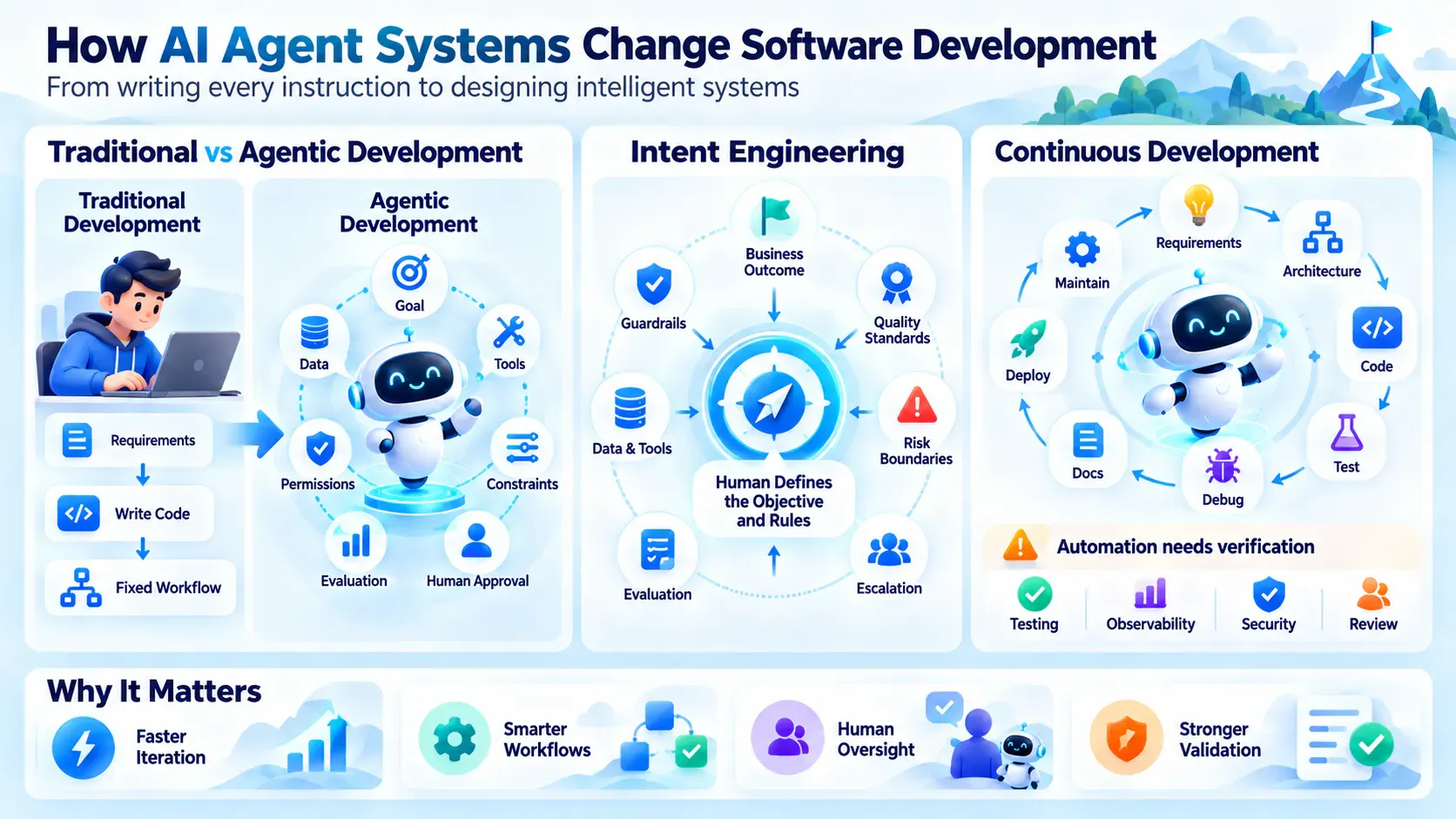
Traditional development requires engineers to translate requirements into explicit technical instructions.
With AI agent systems, engineers may increasingly define:
- What the system should accomplish.
- Which tools and systems it can access.
- What data it can use.
- Which actions are permitted.
- What constraints it must follow.
- How success should be evaluated.
- When human approval is required.
The engineer therefore becomes responsible not only for source code, but also for designing the environment in which an agent operates.
This requires a combination of software architecture, AI system design, testing, security, observability, and business understanding.
The rise of intent engineering
Another important concept is intent engineering.
When software is designed to pursue an objective rather than execute a completely predetermined sequence, the objective needs to be clearly defined.
Organizations need to establish:
- The desired business outcome.
- Acceptable and unacceptable actions.
- Quality standards.
- Available data and tools.
- Risk boundaries.
- Escalation conditions.
- Evaluation criteria.
Poorly defined intent can produce inconsistent outcomes even when the underlying AI model is capable.
As a result, human expertise remains critical. People define the goals, constraints, priorities, and standards that determine what successful agent behavior looks like.
Software development becomes more continuous
AI agents can potentially support multiple stages of the software lifecycle, including:
- Requirements analysis.
- Architecture planning.
- Code generation.
- Testing.
- Debugging.
- Documentation.
- Deployment support.
- Maintenance.
This creates the possibility of a more continuous development process in which software can respond more dynamically to new requirements and operational feedback.
However, greater automation also introduces new risks. Errors can propagate from one task to another, technical debt can accumulate, context can become outdated, and incorrect changes may appear reasonable without proper validation.
AI-assisted development therefore makes verification and testing more important, not less.
Business Applications of AI Agent Systems
The business value of AI agent systems is not simply measured by how much code an AI can generate.
The more important question is whether these systems can help organizations achieve meaningful outcomes with less unnecessary complexity.
Automating complex workflows
Many business processes are structured enough to have a clear objective but variable enough that rigid automation becomes difficult to maintain.
Consider a customer support workflow.
An AI agent system could potentially:
- Understand a customer's request.
- Retrieve account information.
- Review previous interactions.
- Identify the appropriate process.
- Prepare a response.
- Update an internal system.
- Escalate unusual or sensitive cases.
Rather than creating separate automation rules for every possible scenario, the system can coordinate different actions around the intended outcome.
Human approval can remain part of the process whenever the consequences of an incorrect action are significant.
Connecting information, tools, and actions
Modern organizations rarely operate through a single application.
Business information may be distributed across CRM systems, databases, communication platforms, analytics tools, internal applications, and document repositories.
AI agent systems can potentially act as an orchestration layer between these environments.
This can support use cases such as:
- Cross-system workflow automation.
- Internal knowledge retrieval.
- Automated research.
- Customer service support.
- Operational assistance.
- Software development workflows.
- Data analysis and reporting.
The potential benefit is not simply reducing the number of manual clicks. It is connecting information and actions around a specific business objective.
Human Oversight and Governance
Greater autonomy does not mean that every business process should become fully autonomous.
For sensitive, financial, customer-facing, or high-impact activities, organizations need clear governance.
A practical division of responsibility can look like this:
AI agents: research, execution, repetitive reasoning, information processing, and workflow coordination.
People: business intent, critical judgment, exceptions, accountability, governance, and ethical oversight.
Organizations should also define access controls, auditability, monitoring, testing requirements, and escalation procedures before deploying agents in production.
This becomes particularly important as AI agent systems gain access to more business tools and data. The greater the system's ability to act, the greater the need to control what it is allowed to do.
The Future of AI Agent Systems
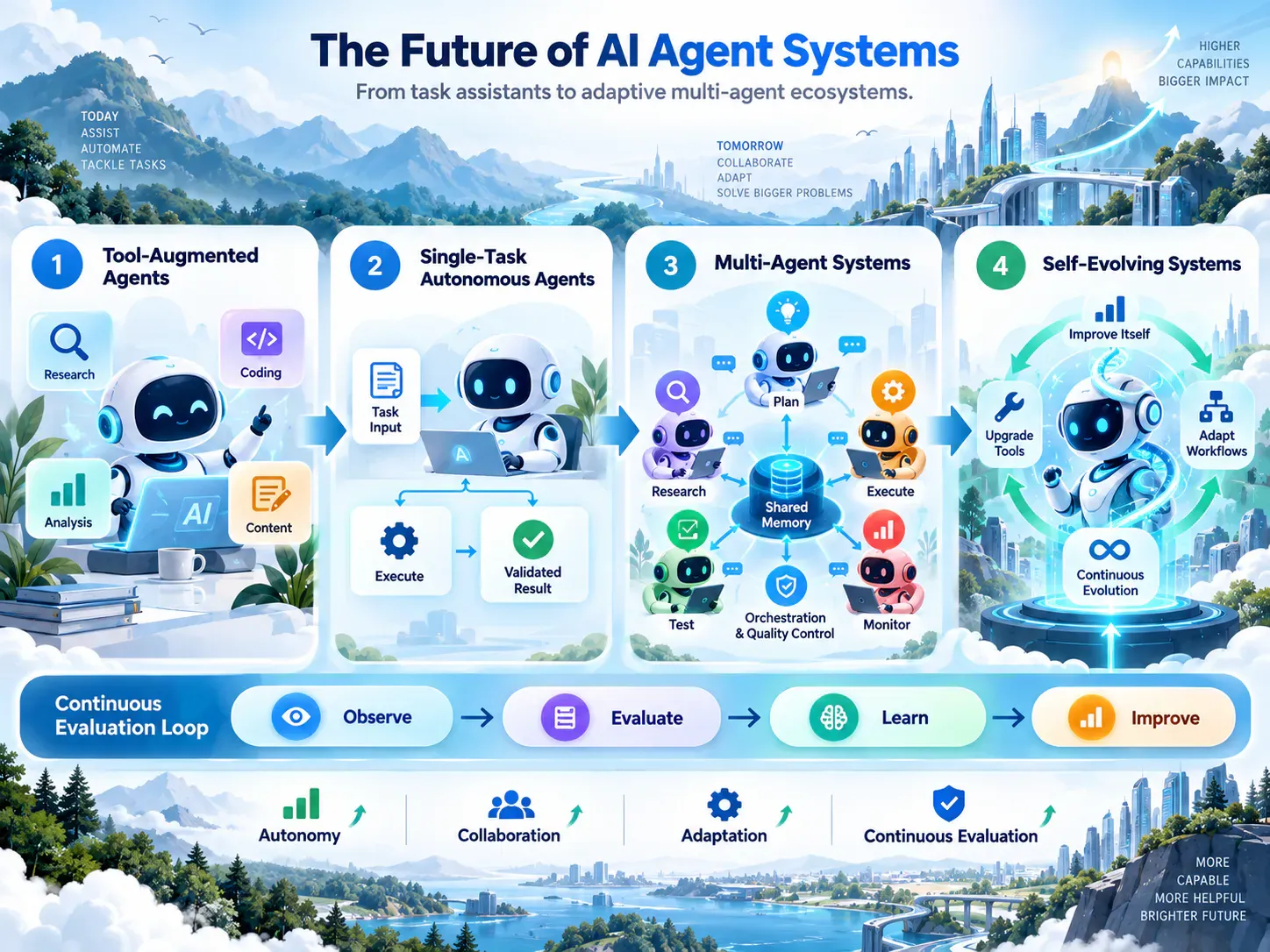
AI agent systems are developing toward increasingly autonomous and collaborative models. The progression can be viewed in several stages.
Tool-augmented agents
At the first stage, AI supports people with individual tasks such as research, coding, analysis, and content generation.
Single-task autonomous agents
The next stage involves agents handling more complete tasks, from receiving a specification to producing and validating an outcome.
Multi-agent systems
More complex workflows may involve several specialized agents.
For example:
- A planning agent defines the task.
- A research agent gathers information.
- An execution agent performs the work.
- A testing agent validates the result.
- A monitoring agent evaluates performance.
This approach can distribute responsibilities across specialized agents, but it also introduces additional complexity around communication, orchestration, shared memory, observability, and quality control.
More agents do not automatically produce better outcomes. Their roles, permissions, interactions, and evaluation mechanisms need to be deliberately designed.
Toward self-evolving systems
The longer-term vision is for AI systems to become capable of adapting their own workflows, improving their tools, and supporting continuous software evolution.
This remains an active area of development rather than a solved capability.
One of the key challenges is that success on an individual task does not necessarily translate into reliable long-term performance. Continuous operation can introduce context drift, accumulated errors, unexpected dependencies, and maintenance challenges.
For this reason, evaluation needs to become a continuous part of AI agent system development.
Why Testing Matters in AI Agent Systems
Traditional software testing often focuses on whether a system produces the expected result for a defined set of inputs.
AI agent systems can be more difficult to evaluate because they may use different paths to achieve the same objective.
Businesses therefore need to evaluate more than task completion.
Important dimensions can include:
- Accuracy.
- Reliability.
- Security.
- Business outcome quality.
- Maintainability.
- Compliance.
- Tool-use correctness.
- Human approval requirements.
- Long-term performance.
Testing also needs to consider the interactions between the agent and the systems it can access.
For example, an agent may produce a technically reasonable response but use outdated information, call the wrong API, modify the wrong record, or fail to escalate an exceptional situation.
As AI systems become more capable of taking action, software testing must increasingly validate behavior, integrations, and outcomes, not just individual functions.
How Fix Partner Supports AI-Driven Software
Adopting AI agent systems is not only an AI challenge. It is also a software engineering, integration, testing, and quality challenge.
As businesses introduce AI-driven workflows, the underlying software still needs to be reliable, maintainable, secure, and aligned with business requirements.
Fix Partner supports organizations with software engineering and quality-focused services, including mobile automation testing, software testing, and automation engineering.
This foundation becomes particularly valuable as development workflows become increasingly AI-driven.
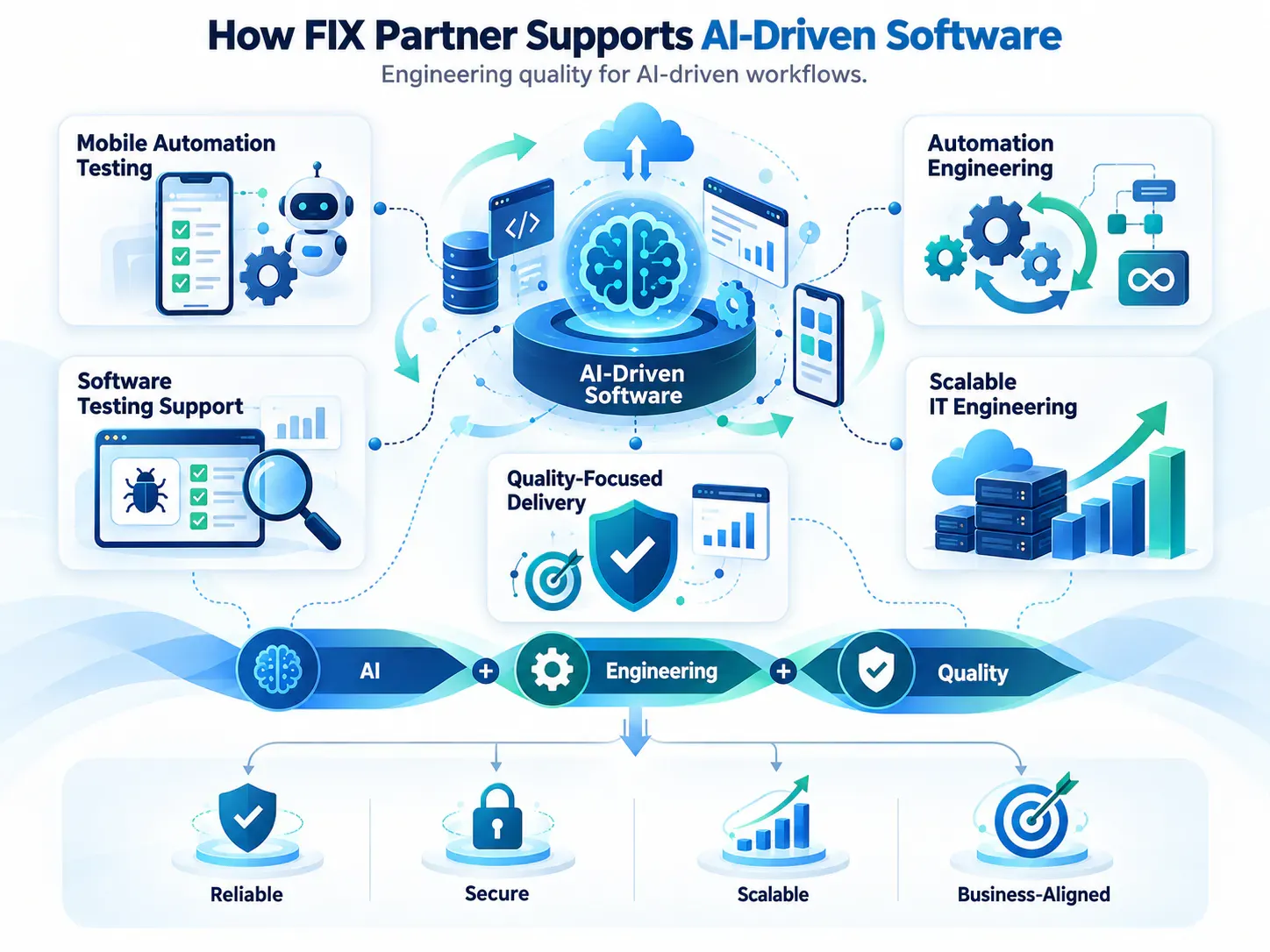
Fix Partner can support businesses through:
- Mobile automation testing to make quality assurance more efficient and repeatable.
- Software testing support for evolving development and integration workflows.
- Automation-focused engineering to reduce repetitive testing activities.
- Scalable IT engineering support for organizations expanding their software capabilities.
- Quality-focused delivery that keeps technical execution connected to business objectives.
The goal is not to introduce automation for its own sake. It is to help organizations build software processes that can evolve while maintaining quality, reliability, and business alignment.
Conclusion
AI agent systems represent a significant evolution in how businesses can approach software.
Traditional applications primarily execute predefined logic. AI agent systems can combine reasoning, planning, tools, memory, and evaluation to work toward goals in more dynamic environments.
This creates opportunities to automate complex workflows, connect fragmented systems, support software development, and help employees handle reasoning-intensive tasks.
But greater autonomy also creates greater responsibility.
Successful adoption requires more than capable AI models. Organizations need clear business objectives, appropriate system access, strong testing, continuous evaluation, security controls, and human oversight.
The most practical starting point is not to automate everything. It is to identify workflows with clear objectives, accessible data, measurable outcomes, and a meaningful opportunity for intelligent coordination.
As AI agent systems continue to evolve, businesses that build strong software engineering and quality foundations can be better prepared to adopt increasingly capable forms of AI-driven software.
Ready to explore how AI-powered software and automation can support your business?
Talk to Fix Partner about your next software engineering and testing initiative.
Written by
Hannah Huynh
Published by
FIX Partner
FIX Partner helps organizations design, build, test, and modernize software products with engineering, AI, data, and QA expertise.
About FIX Partner →Ask FIX Partner
Have a question about this topic?
Leave your details and a short note. Our team can help you identify a practical next step.
Related articles
Shift Left, Shift Right, AI Shift: FIX Partner’s Agile QA
Hannah HuynhSep 10, 2026
Explore FIX Partner’s Agile QA with Shift Left, Shift Right, and AI Shift to improve software quality, test automation, and continuous testing.
Read more →
How AI Is Transforming Software Testing in Modern QA Teams
Hannah HuynhJun 26, 2026
Discover how AI in software testing helps QA teams automate processes, improve quality, detect bugs faster, and accelerate software delivery.
Read more →
AI Can Write Code Fast: Can AI Replace Developers?
Hannah HuynhJun 21, 2026
Discover how AI can write code fast and transform software development while helping businesses improve efficiency with AI-generated code.
Read more →