Why Human Resource Software Matters for Business Growth
Discover how human resource software helps businesses streamline HR processes, improve workforce decisions, and support sustainable business growth.
Managing people effectively gets harder as a business grows. Employee records, attendance, payroll, recruitment, performance reviews, benefits, and compliance can quickly become difficult to manage when HR teams rely on spreadsheets, emails, and disconnected systems.
On this page
That is why human resource software has become an increasingly important part of modern business operations. According to a Zipdo study in 2023, more than 85% of large enterprises worldwide had implemented at least one HRIS system to manage their workforce. This reflects a broader shift toward technology-supported HR management.
For growing businesses, human resource software offers value beyond reducing administrative work. A well-designed HR system can organize workforce information, automate routine processes, improve visibility, and provide managers with more reliable information for business decisions.
What Can Human Resource Software Do for a Business?
Human resource software brings multiple HR processes together in a structured digital environment. Instead of managing employee information, attendance, payroll, recruitment, and performance data across separate files and systems, businesses can manage these activities through a connected platform.
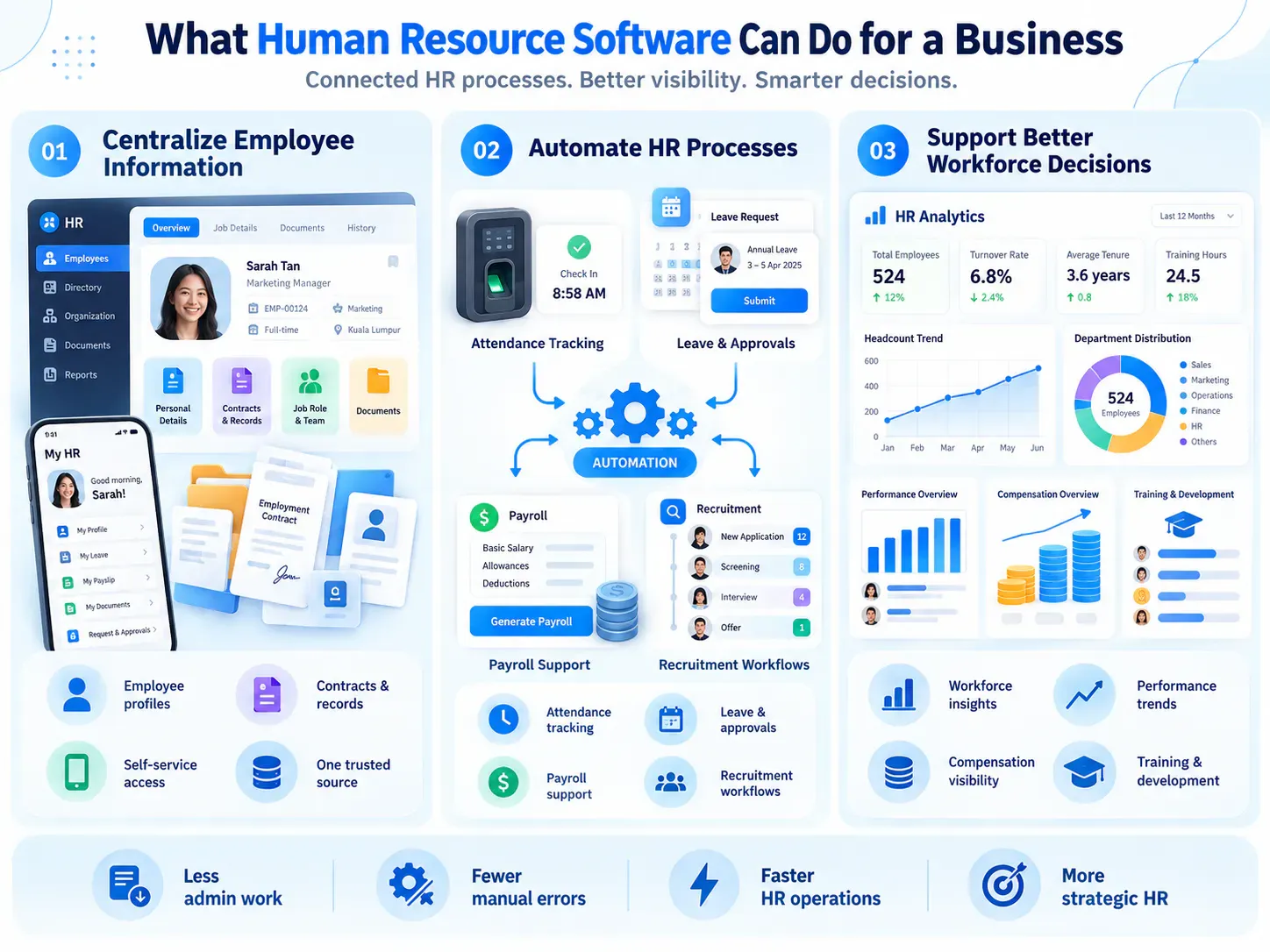
Centralize Employee Information
Employee records provide the foundation for effective HR management. Human resource software can create digital employee profiles containing personal information, qualifications, employment history, contracts, job positions, organizational changes, and other relevant documents.
Having this information in one system makes it easier for authorized HR staff and managers to access accurate data when needed. It can also reduce duplicated or outdated records caused by maintaining information across multiple spreadsheets and files.
Many systems also provide employee self-service capabilities, allowing employees to access selected information, submit requests, and update appropriate records. This can reduce routine administrative work for HR teams while giving employees greater visibility into their own information.
Automate Repetitive HR Processes
A large portion of HR administration involves recurring tasks that follow predefined rules. Human resource software can automate workflows such as attendance tracking, leave requests, payroll calculations, recruitment updates, and approval processes.
For example, attendance information can be collected from fingerprint scanners, facial recognition systems, GPS-based solutions, or other supported devices. The resulting data can then be used in payroll calculations and attendance reporting.
Automation can reduce manual data entry and the risk of errors. More importantly, it allows HR professionals to spend less time on repetitive administration and more time on activities that require human judgment, such as workforce planning, employee development, and engagement.
Support Better Workforce Decisions
As a business grows, managers need more than basic employee records. They need a clearer view of workforce trends and operational performance.
A centralized HR system can help businesses analyze information related to:
- Workforce size and structure
- Attendance and leave
- Recruitment activity
- Employee performance
- Compensation and benefits
- Training and development
This can make HR information more useful for workforce planning and business decision-making, helping HR become a more strategic business function.
What Features Should Businesses Look For?
The right human resource software should reflect the organization's actual HR requirements rather than simply offering the largest possible feature set. Businesses should evaluate which capabilities are most relevant today while considering how their needs may evolve in the future.
Employee Records and Core HR
Core HR functionality should provide a reliable employee database for managing essential workforce information. This may include employee profiles, contracts, organizational structures, job positions, employee history, and self-service functions.
A strong core HR foundation can also support other processes, including payroll, performance management, recruitment, and reporting. By maintaining consistent employee data across these functions, businesses can reduce duplication and improve information accuracy.
Attendance, Leave, and Payroll
Attendance and payroll are among the most sensitive HR processes because errors can directly affect employees. A capable system should be able to connect attendance data with working schedules, leave, overtime, allowances, deductions, and other payroll-related information.
Businesses should also consider whether the software can support their specific payroll and compliance requirements, including applicable tax and social insurance regulations. For businesses operating in Vietnam, a Vietnam-compliant vHRMS can help address local HR and payroll requirements through a more integrated approach.
Connecting attendance, leave, and payroll can create a more consistent workflow while reducing the need to transfer information manually between different systems.
Recruitment and Onboarding
Recruitment becomes more complex as businesses expand and hiring volumes increase. Human resource software with recruitment functionality can help HR teams manage candidates through different stages of the hiring process.
Typical capabilities may include applicant tracking, candidate profiles, interview management, recruitment-stage tracking, talent pools, and onboarding workflows.
A structured recruitment process can help organizations maintain consistency while giving HR teams better visibility into hiring progress and recruitment effectiveness.
Performance and Employee Development
Performance management is another important area where HR technology can support business growth. Rather than treating performance reviews as a once-a-year administrative task, businesses can use software to establish goals, monitor progress, provide feedback, and track employee development.
Depending on the solution, businesses may be able to manage KPIs or OKRs, conduct periodic evaluations, collect feedback, and connect performance results with training and development activities.
According to a Gartner report in 2022, organizations that optimize their Performance Management systems can increase employee performance by up to 24% through continuous feedback and transparent goal setting.
A structured digital process can make goals more visible, encourage more consistent communication between managers and employees, and help businesses identify development opportunities earlier.
Benefits and Leave Management
Human resource software can also support the administration of employee benefits, bonuses, insurance information, and leave policies. Managing these processes within a connected HR environment can give HR teams greater visibility and help organizations apply policies more consistently.
The specific requirements will depend on factors such as company size, workforce structure, industry, and local regulations.
Which Type of Human Resource Software Fits Your Business?
Human resource software can be deployed in different ways, with each model offering different advantages and considerations. Businesses should select an approach based on their technical capabilities, data requirements, budget, and long-term objectives.
Type of HR Software
| Key Advantages
| Main Considerations
| Suitable For
|
|---|---|---|---|
On-Premise
|
Greater control over infrastructure and data
|
Higher upfront investment and internal IT requirements
|
Organizations with specific data-control or infrastructure requirements
|
Cloud-Based
|
Easier deployment, maintenance, and access
|
Ongoing subscription costs and reliance on the provider
|
Growing businesses seeking flexibility and simpler IT management
|
Open-Source
|
High customization and flexibility
|
Requires technical expertise for customization and maintenance
|
Businesses with strong internal IT or development capabilities
|
On-Premise HR Software
On-premise software is installed on the company's own servers and internal network. This gives organizations greater control over their technology environment, but it also means they are responsible for infrastructure, maintenance, security, backups, updates, and technical support.
This approach may be suitable for organizations with established IT teams and specific requirements around infrastructure or data management.
Cloud-Based HR Software
Cloud-based or SaaS HR software is hosted by the provider and accessed through the internet. The provider typically manages system infrastructure, maintenance, and updates, reducing the technical burden on the customer.
Cloud-based solutions can be particularly practical for businesses that want to modernize HR operations without making significant investments in internal infrastructure.
Open-Source HR Software
Open-source HR software provides access to the underlying source code, allowing organizations to customize the platform extensively. However, businesses also need to consider the technical resources required for implementation, customization, security, maintenance, and troubleshooting.
Therefore, lower licensing costs do not necessarily translate into a lower total cost of ownership.
How Should Businesses Evaluate Human Resource Software?
Choosing human resource software should involve more than comparing feature lists. A platform may offer a wide range of functions but still fail to match the way a particular organization operates.
Look Beyond the Feature List
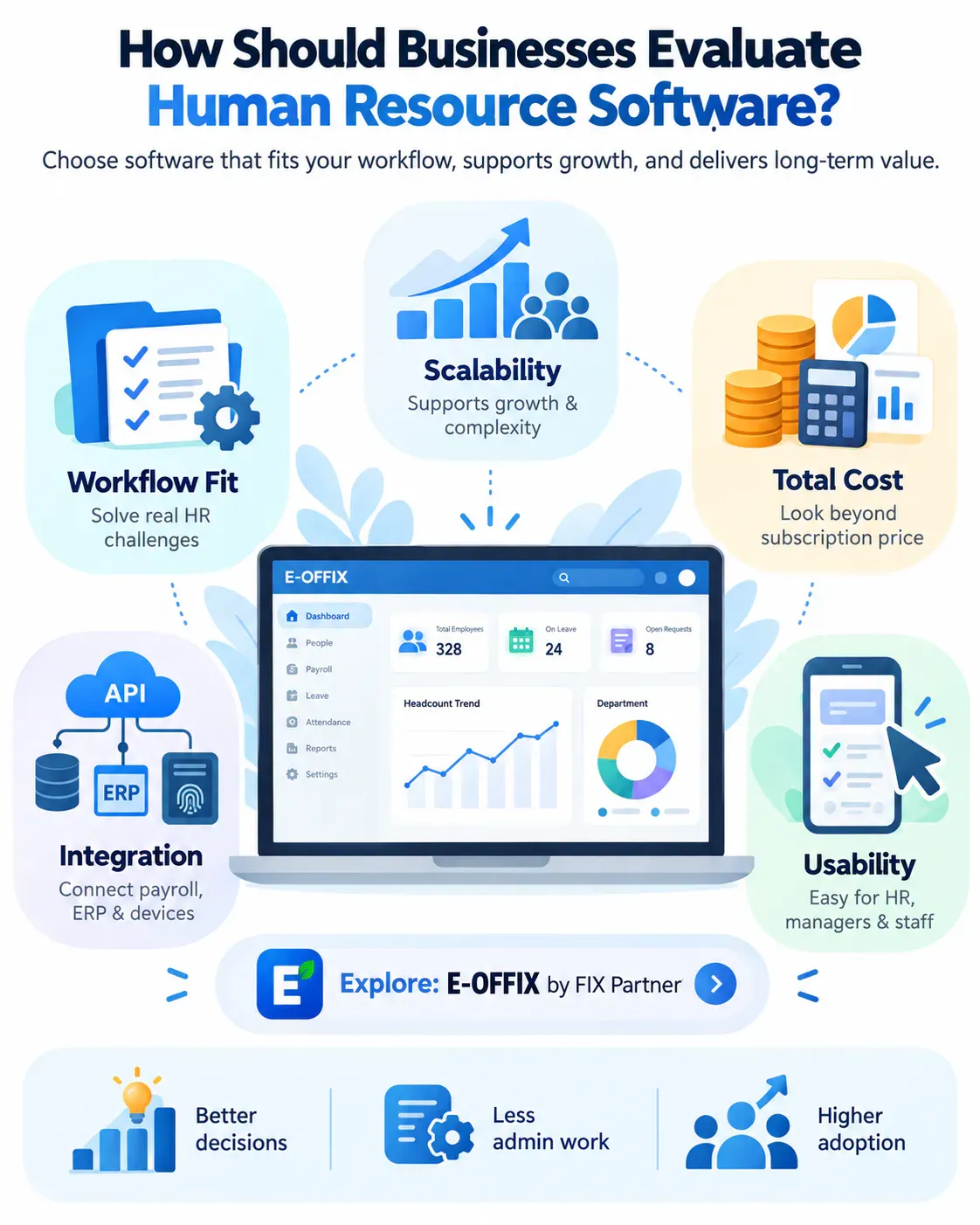
Businesses should first identify their most important HR challenges. For example, a company experiencing payroll issues may prioritize attendance and payroll integration, while a rapidly growing organization may focus more on employee records, recruitment, and workforce management.
The goal is to find software that supports existing workflows without introducing unnecessary complexity.
Businesses looking for a more structured approach to digital HR management can also explore E-OFFIX by FIX Partner as part of their technology evaluation.
Evaluate Scalability
Scalability is important because HR requirements can change significantly as a business grows. A solution that works well for a small workforce may not provide the same level of value when the organization expands.
Businesses should consider whether the system can accommodate:
- More employees and users
- Larger amounts of workforce data
- More complex organizational structures
- Additional HR workflows
- Multiple departments or locations
- New HR capabilities in the future
The goal is to select a platform that can support the organization's development rather than requiring another major system change shortly after implementation.
Consider Total Cost of Ownership
The initial purchase price or subscription fee represents only part of the overall investment. Businesses should also consider implementation, configuration, data migration, employee training, maintenance, technical support, and infrastructure costs where applicable.
Evaluating total cost of ownership provides a more realistic view of whether a solution can deliver long-term business value.
Check Integration Capabilities
HR software rarely operates in complete isolation. It may need to connect with attendance devices, accounting platforms, ERP systems, payroll applications, or other business tools.
Integration capabilities and APIs should therefore be part of the evaluation process. Effective enterprise software integration can reduce duplicate data entry and allow information to move more smoothly between HR and other business functions.
Prioritize Usability
A feature-rich system may still deliver limited value if employees and managers find it difficult to use. Usability can directly affect adoption and the overall return on investment.
Businesses should consider the user experience, employee self-service, approval workflows, reporting, accessibility, training requirements, and vendor support before making a final decision.
Conclusion
Human resource software can help businesses build more efficient and connected HR operations. By organizing workforce information and streamlining key processes such as attendance, payroll, recruitment, and performance management, businesses can reduce administrative complexity while gaining better visibility into their workforce.
However, selecting the right solution requires more than comparing features. Scalability, integration, usability, total cost of ownership, and alignment with business objectives should all be considered before making a decision.
Ready to modernize your HR operations?
Contact FIX Partner today to discover how our technology solutions can support your digital transformation journey.
Written by
Hannah Huynh
Published by
FIX Partner
FIX Partner helps organizations design, build, test, and modernize software products with engineering, AI, data, and QA expertise.
About FIX Partner →Ask FIX Partner
Have a question about this topic?
Leave your details and a short note. Our team can help you identify a practical next step.
Related articles
AI Speeds Up Development for Digital Product Delivery
Hannah HuynhAug 30, 2026
AI speeds up development by accelerating software delivery, boosting productivity, reducing repetitive tasks, and enabling smarter digital product development.
Read more →
Multi-Cloud Management: A Guide for Modern Businesses
Hannah HuynhJun 12, 20269 min read
Learn how multi-cloud management improves flexibility, reduces vendor lock-in, optimizes cloud costs, and strengthens business resilience.
Read more →
Mobile Application Development Services for Business Growth
Hannah HuynhMay 29, 20268 min read
Mobile applications are powerful because they place your service directly into the hands of users. For non-IT teams, the challenge often lies in...
Read more →