Product teams launching an app
Validate a new customer experience across iOS, Android or both without committing to the wrong architecture.
FIX Partner designs, builds and supports native and cross-platform mobile apps for teams launching new products or improving existing ones. We help solve platform, integration, quality and release challenges for consumer-facing and enterprise workflows.
Using AI-assisted software development, our AI-augmented engineers cover mobile application design, development, integration, release, and ongoing management across the complete product lifecycle.
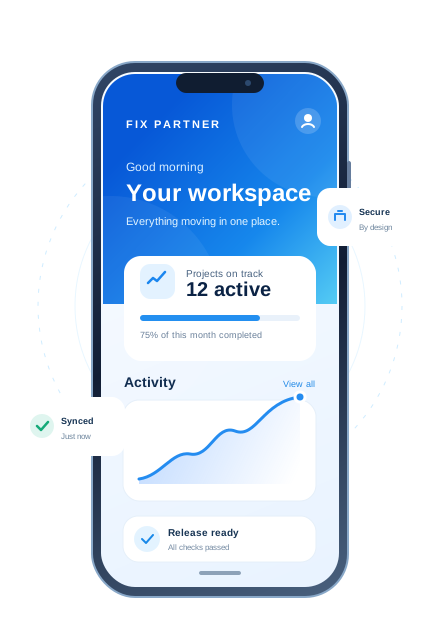
Mobile delivery is useful when customers or employees need dependable access to a service, workflow or device capability beyond the desktop.
Validate a new customer experience across iOS, Android or both without committing to the wrong architecture.
Bring CRM, ERP, commerce or field workflows to mobile while preserving secure data flows.
Address slow releases, aging dependencies, unstable performance or poor adoption with a focused modernization plan.
We deliver comprehensive mobile app development services that cover the full journey from inception to ongoing support. Our team specializes in creating high-performance applications that users love.
Whether you need a native iOS app, Android application, or cross-platform solution, we bring the expertise and creativity to transform your vision into a polished, production-ready mobile experience.
New experiences
Native performance, cross-platform efficiency, or hybrid flexibility — we deliver exceptional apps for all major platforms and devices.
Build powerful Android applications with native performance, reaching billions of devices worldwide across phones, tablets, TVs, and wearables.
Create premium iOS applications with seamless integration across the Apple ecosystem — iPhone, iPad, Apple Watch, and Apple TV.
Maximize reach and efficiency with a shared codebase that delivers responsive, native-like experiences across iOS and Android.
Native, cross-platform, and hybrid development solve different business problems. We assess product complexity, device integrations, release goals, internal skills, and long-term ownership before recommending a direction.
Platform-specific apps engineered for maximum performance and control.
Typical stack
Swift, SwiftUI, Kotlin, Jetpack Compose
Best for: Performance-critical products, complex UX, fintech, media, IoT, and device-heavy apps.
Consideration: Supporting both platforms usually requires separate development tracks.
One shared product foundation for iOS and Android with native integrations where needed.
Typical stack
React Native, Flutter, TypeScript, Dart
Best for: Customer and enterprise apps that need broad reach with balanced speed and performance.
Consideration: Some features may still require platform-specific code or dependency management.
Web technology delivered inside a mobile shell for rapid, web-first deployment.
Typical stack
Ionic, Capacitor, HTML, CSS, JavaScript
Best for: Internal tools, service portals, content apps, and straightforward business workflows.
Consideration: Less suitable for graphics-heavy experiences or intensive hardware workloads.
There is no universal winner. The best choice depends on what the app must do now, how it will evolve, and how your team plans to operate it.
| Decision factor | Native | Cross-platform | Hybrid |
|---|---|---|---|
| Codebase | Separate iOS and Android codebases | Mostly shared, with native modules when required | Shared web code inside a mobile shell |
| Performance | Highest and most predictable | Near-native for most product experiences | Web-view dependent |
| Device access | Direct access to platform APIs | Plugins plus custom native modules | Bridge and plugin based |
| User experience | Deeply tailored to each platform | Consistent UI with platform adaptation | Web-oriented UI across platforms |
| Multi-platform launch | More effort for two platform tracks | Balanced speed, quality, and reuse | Often the quickest for simpler products |
| Best fit | Complex, hardware-intensive, or performance-critical apps | Most iOS and Android product roadmaps | Content, portal, and workflow applications |
We leverage the latest frameworks, tools, and best practices to build scalable, secure, and high-performance mobile applications.
The final handover is defined in the statement of work. Depending on the engagement, it can include the following tangible outputs.
Prioritized journeys, requirements, architecture decisions and release milestones.
User flows, interface designs and platform-specific interaction guidance.
Agreed iOS, Android or shared codebase with documented build configuration.
API contracts, authentication flows and data-handling decisions.
Test coverage, device checks, defect tracking and store-release preparation.
Technical documentation, operational runbook and agreed post-launch responsibilities.
We design for real devices, unreliable networks, secure data, release constraints, and the operating realities of mobile products.
Choose the delivery approach from product and operating requirements.
Keep critical workflows usable across connectivity and device conditions.
Operate dependable releases and learn from real product usage.
Product discovery, device-focused design, engineering, testing, and release operations work as one loop.
Clarify business goals, users, constraints, and measurable success criteria.
Define workflows, functional requirements, user stories, and an achievable MVP.
Shape system boundaries, data models, integrations, security, and delivery plans.
Validate journeys through wireframes, prototypes, and accessible interface design.
Build in reviewable increments with shared standards and continuous integration.
Test functionality, performance, security, compatibility, and user acceptance.
Release through controlled pipelines with monitoring and rollback preparation.
Use product signals and operational data to guide support and future releases.
Business, product, and engineering decisions stay connected.
Frequent reviews replace long periods without visibility.
Risk, security, and quality are checked throughout delivery.
Adoption and operational data guide the next improvement.
There is no reliable fixed duration or price for every mobile app. Discovery establishes the feature scope, platform strategy, integration work and release requirements before FIX Partner proposes milestones and commercial terms.
Define users, features, constraints, integrations and success criteria.
Approve user flows, platform approach and technical plan.
Develop in increments with device testing and review checkpoints.
Prepare store submissions, observe production behavior and prioritize updates.
FIX Partner provides a project-specific estimate after requirements are reviewed; the figures here are not a fixed-price offer.
A snapshot of mobile app delivery across FIX Partner engagements. Ask our team for context on project scope and measurement periods.
20+
Apps Delivered
10M+
Downloads
99.8%
Uptime Rate
4.9/5
Client Rating
From dedicated teams to project-based collaboration, we adapt to your needs.
Scale your operations with a fully managed, dedicated team of software engineers. Led by an expert Project Manager, we handle all coordination and execution. Simply define your requirements, and let FIX Partner deliver your long-term technology goals.
Bridge skill gaps instantly. Whether you need specific expertise in a niche technology or additional QA testing support, skip the recruitment costs. Augment your internal team with pre-vetted, top-tier developers from FIX Partner today.
Turn your concept into a reality with end-to-end software outsourcing. From custom web development to mobile apps, our team manages the full lifecycle. We offer flexible engagement models—including Fixed Cost and Time & Material—to fit your budget.
Practical answers about architecture, platform coverage, delivery, and ongoing support.
Native apps are built specifically for iOS or Android. Cross-platform apps use a shared framework such as React Native or Flutter while still supporting native components. Hybrid apps use web technologies inside a mobile container, making them efficient for simpler, web-first experiences.
Cross-platform development is often a strong MVP option when the product must launch on both iOS and Android. A hybrid approach may suit a straightforward portal or workflow, while native development is preferable when performance, advanced animation, or deep device integration is central to the product.
Yes. React Native and Flutter can access common device capabilities through maintained packages or custom native modules. We review each integration during discovery to confirm platform support, security requirements, and maintenance considerations.
Native development is a good fit for demanding graphics, real-time media, advanced hardware use, platform-specific experiences, or products that need immediate access to new operating-system features.
Yes. We can assess the current codebase, architecture, dependencies, performance, and release process, then recommend incremental modernization, migration to a new framework, or a focused rebuild based on business risk and expected value.
The timeline depends on scope, platforms, integrations, compliance, design maturity, and release requirements. A discovery phase turns these inputs into an architecture recommendation, delivery roadmap, and project estimate before development begins.
App Store and Google Play preparation, release support, monitoring, bug fixes, and ongoing improvements can be included in the project scope or a post-launch support engagement.
Yes. A mobile app can connect to existing APIs, identity systems, CRM or ERP workflows, payments and analytics. During discovery, we review the available interfaces, data ownership and security constraints before committing to an integration plan.
The estimate depends on platform choice, feature scope, design maturity, integrations, security requirements, testing and support. FIX Partner scopes these inputs during discovery and proposes milestones and a commercial model before development starts.
Tell us about your users, platforms and core journeys. We will help define the right build and release path.
Discuss scope and next steps with FIX Partner
No obligation to start a project
We will use your details to respond to this mobile app development enquiry.
By submitting, you agree to our Privacy Policy .