
H-1B Visa Costs and Offshore Software Development
Explore offshore software development cost strategies to optimize IT budgets, access skilled talent in Vietnam, and improve delivery quality with FIX Partner.
US businesses face growing pressure to control technology spending while securing the skills needed to compete. Hiring software engineers locally can involve substantial salaries, recruitment expenses, benefits, and, in some cases, immigration-related costs. Meanwhile, changing workforce requirements and uncertainty surrounding H-1B visa policies, including the White House's September 2026 proclamation extending certain restrictions on H-1B workers, can make long-term IT staffing decisions more complicated.
On this page
For business leaders, the question is no longer simply where to find developers. It is how to build the right technology capabilities without creating unnecessary financial and operational commitments.
One option worth exploring is offshore software development. By working with an experienced team in Vietnam, US companies can access technical expertise, expand delivery capacity, and manage their budgets without relocating every specialist to the United States.
However, reducing costs requires more than choosing a lower hourly rate. Businesses must understand their actual staffing expenses, compare delivery models, and consider how each approach affects software quality and long-term business performance.
Understanding H-1B Visa Costs and IT Staffing Challenges
The H-1B visa program allows eligible US employers to hire foreign professionals for qualifying specialty occupations that generally require specialized knowledge and a relevant bachelor's degree or equivalent qualification.
Technology companies have traditionally used the program to recruit software engineers, data specialists, cybersecurity professionals, and other skilled workers when suitable talent is difficult to find locally.
However, sponsoring international employees involves more than offering a competitive salary.
Depending on the circumstances, employers may need to account for petition filing fees, legal assistance, administrative work, and other applicable immigration-related expenses. Selection uncertainty, processing timelines, and regulatory requirements can also complicate workforce planning.
These costs and requirements vary by employer, petition type, and individual circumstances. Businesses should therefore verify current requirements with qualified immigration counsel rather than relying on a single estimated sponsorship cost.
The broader challenge is that companies must balance access to specialized talent with predictable operating expenses.
For example, a growing software company might need additional engineers to complete a product launch within six months. Recruiting permanent employees could create ongoing payroll commitments, while international recruitment may introduce additional procedural uncertainty.
This raises an important question: Does every technical specialist need to work physically in the United States?
Many software development, quality assurance (QA), automated testing, and application maintenance activities can be performed remotely. When physical presence is unnecessary, offshore delivery offers another way to access technical capabilities.
The objective is not to eliminate domestic hiring or replace every onsite employee. It is to identify which roles genuinely require a local presence and which can be delivered effectively through a remote team.
Comparing Offshore Software Development Cost With Onsite Hiring
A meaningful offshore software development cost comparison starts with the total expense of delivering the required work, rather than comparing salaries or hourly rates alone.
An onsite software engineer may involve several cost categories:
- Salary, bonuses, and performance incentives
- Employer payroll taxes and employee benefits
- Recruitment, interviews, and onboarding
- Applicable immigration filing and legal expenses
- Relocation, temporary accommodation, and travel
- Computers, software licenses, and office facilities
- Training, retention, and management overhead
Not every business incurs all these expenses. For instance, immigration costs may not apply when hiring someone who already has the appropriate US work authorization.
Offshore development has a different cost structure. Companies typically pay an agreed service fee for a dedicated team, defined project, or specialized technical service. Additional expenses may include onboarding, project management, communication tools, security requirements, and quality assurance.
The following comparison illustrates the main differences.
Cost consideration
| Onsite US team
| Offshore team in Vietnam
|
|---|---|---|
Labor costs
|
Reflect US employment markets
|
Reflect Vietnam's delivery market
|
Recruitment
|
Local or international hiring
|
Provider-assisted team sourcing
|
Immigration
|
May apply to eligible international hires
|
Generally unnecessary for work performed in Vietnam
|
Infrastructure
|
May include office and workplace expenses
|
Often managed through the provider's delivery setup
|
Scaling capacity
|
Depends on hiring and employment arrangements
|
Depends on contract terms and available resources
|
Coordination
|
Easier for local, in-person collaboration
|
Requires planned communication and time-zone overlap
|
Consider a company that needs five developers for a six-month project. Hiring five permanent employees could leave the business with additional payroll commitments after the project ends. An offshore engagement may provide the required capacity for the agreed period without necessarily expanding permanent US headcount.
Nevertheless, offshore development is not automatically cheaper in every situation. Poor communication, inadequate technical skills, or frequent rework can increase total expenditure.
Businesses should compare equivalent team seniority, project scope, delivery expectations, and timelines to understand the real financial difference.
How Vietnam Offshore Development Supports Business Growth
Vietnam has an established and growing IT services sector serving international clients across software engineering, application maintenance, QA, and automated testing.
For US companies, Vietnam can offer access to technical talent under a different labor-market cost structure. This can help businesses expand engineering capacity while keeping more control over their operating budgets.
Three advantages deserve particular attention.
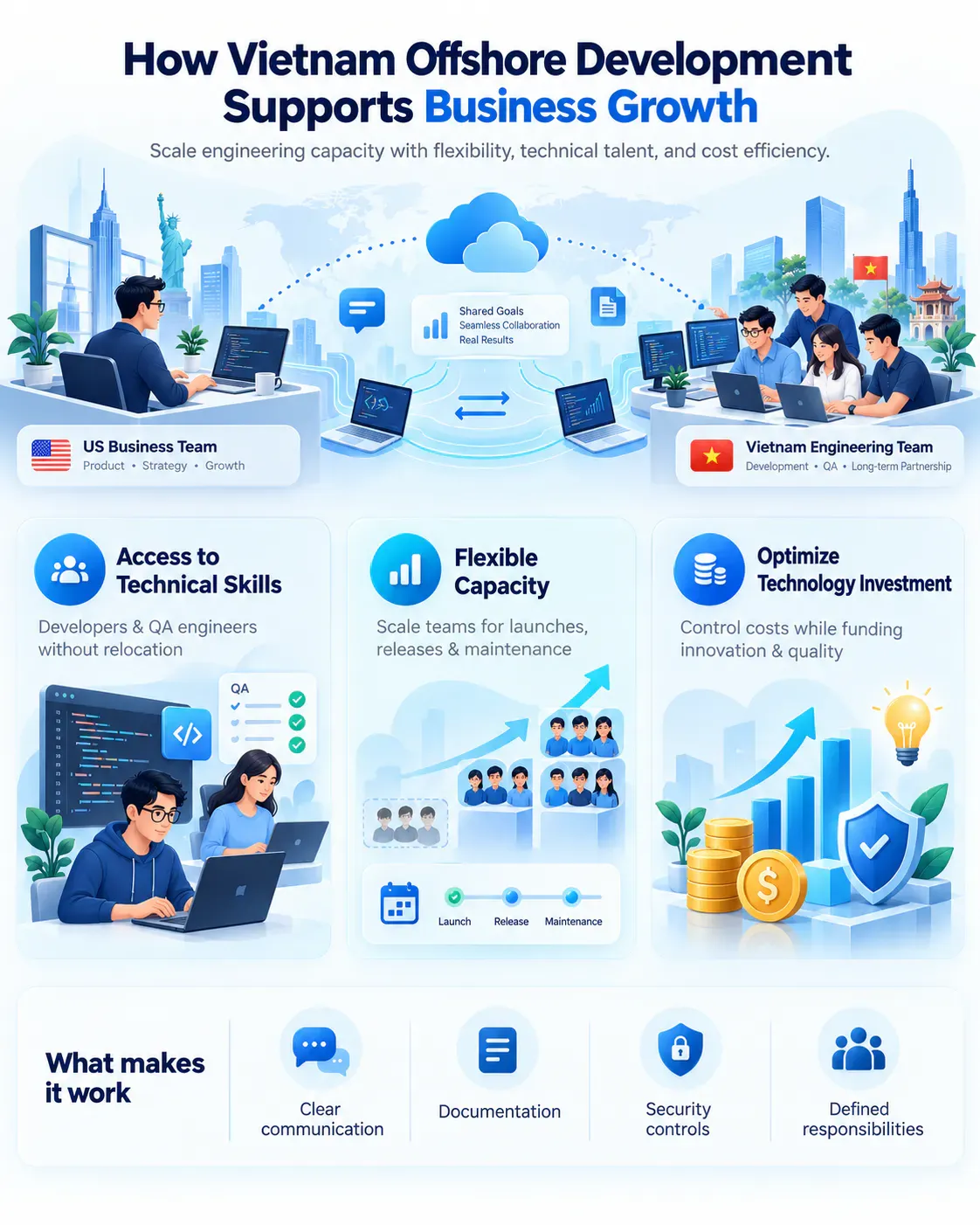
Access to technical skills without relocating every specialist
Offshore delivery allows developers and QA engineers to work from Vietnam while collaborating with US-based product owners, architects, and business stakeholders.
This arrangement can reduce the need to relocate employees when the work itself does not require physical presence in the United States.
It can also help companies address local recruitment constraints, especially when they need a particular combination of technical skills and project experience.
Flexible capacity for changing project demands
Business requirements rarely remain constant. A company may need additional developers during a product launch, more testers before a release, or ongoing maintenance support after implementation.
An offshore engagement can provide greater flexibility when its contractual terms support adjustments to team size and scope.
Instead of committing to permanent positions for every temporary requirement, businesses can align technical resources with project priorities.
More opportunities to optimize technology investment
Cost optimization becomes more valuable when savings can support other business priorities, such as product innovation, cybersecurity, customer experience, and digital transformation.
For example, a company could assign routine regression testing and application maintenance to an offshore team while keeping strategic product decisions and customer-facing responsibilities within its US organization.
This division of responsibilities helps businesses manage costs without treating quality as an optional expense.
However, successful offshore delivery requires clear documentation, suitable security controls, defined responsibilities, and regular communication. Companies should assess these capabilities before selecting a provider.
Building a Cost-Effective IT Strategy With the Right Delivery Model
The best workforce strategy does not necessarily choose between onsite and offshore development. In many cases, combining both models delivers better results.
US-based employees can lead product strategy, manage local stakeholders, and make decisions that benefit from direct customer interaction. Offshore specialists can support development, testing, maintenance, and other remote-compatible activities.
To determine the right balance, business leaders should evaluate four factors.
Total cost of ownership: Include service fees, recruitment, onboarding, management, tools, quality assurance, and potential rework. Compare the cost of achieving the same outcome under each model.
Project requirements: Identify whether the work requires physical access, specialized local knowledge, close customer interaction, or can be completed remotely.
Delivery quality: Evaluate technical expertise, testing practices, documentation, code quality, and the provider's ability to meet agreed milestones.
Scalability and risk: Consider how easily the team can adapt to changing requirements, how knowledge will be retained, and how the engagement protects intellectual property and confidential information.
A practical starting point is to select a project with clearly defined deliverables, measurable quality standards, and manageable dependencies. A pilot engagement can help the business evaluate communication, delivery performance, and actual costs before expanding the relationship.
Companies should also distinguish between engaging an offshore service provider and employing an individual who works remotely from another country. The latter can involve separate employment, tax, data protection, and compliance considerations.
For immigration decisions, businesses should consult qualified legal professionals. Offshore development is a workforce planning option, not a substitute for understanding applicable employment and immigration rules.
FIX Partner Helps Businesses Optimize IT Spending
For US companies looking to balance technical capability, delivery quality, and budget control, FIX Partner provides an offshore IT services option to consider.
Rather than focusing exclusively on reducing developer rates, businesses should look for a partner that understands their objectives and helps translate technology investment into measurable results.
FIX Partner supports businesses through services such as software development and automated testing, helping them address technical delivery needs without relying exclusively on expanding their domestic workforce.
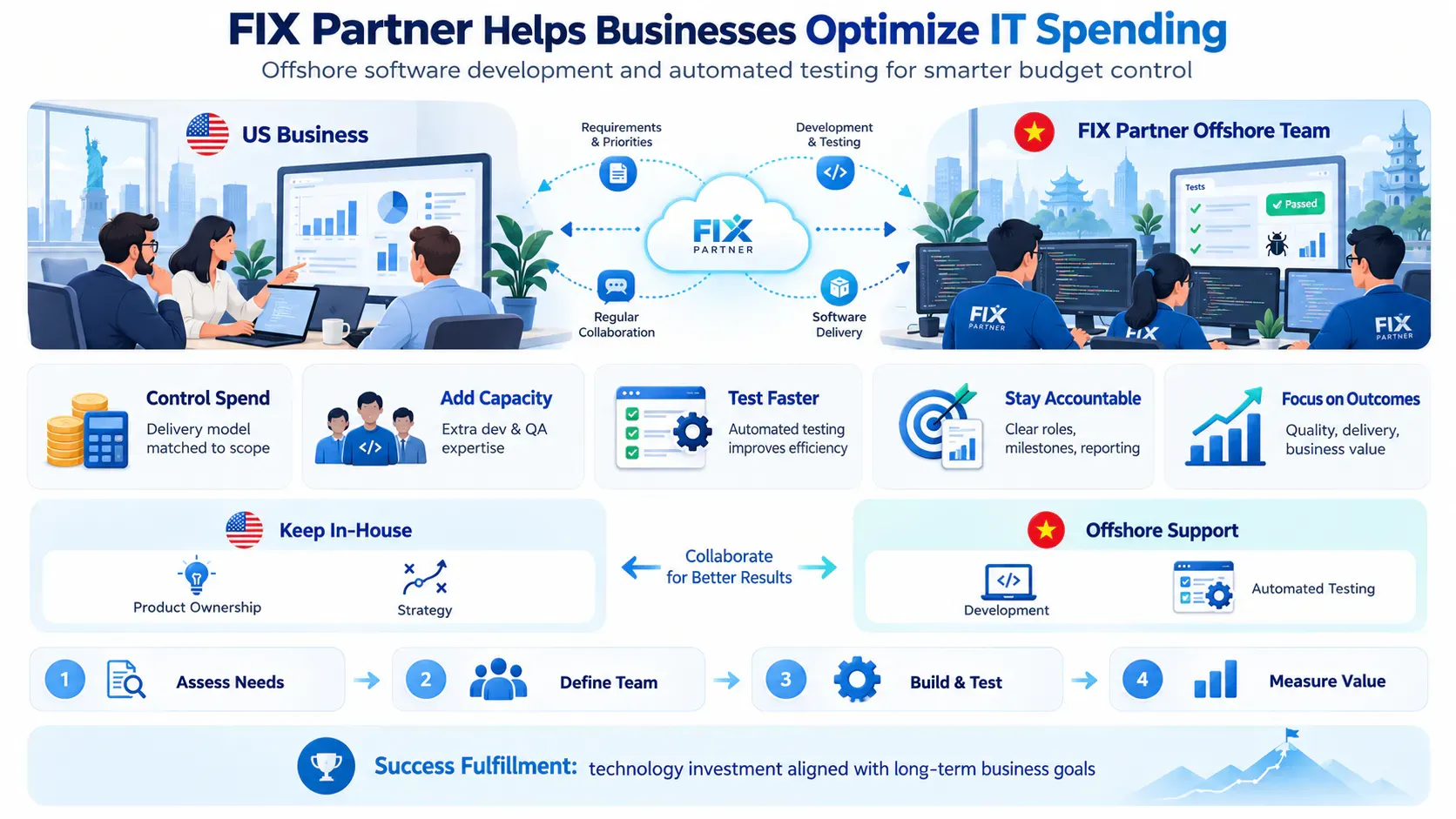
A well-structured engagement can help companies:
- Manage development expenditure: Establish a delivery model aligned with project scope, resource requirements, and budget expectations.
- Expand technical capacity: Access additional development and testing expertise when internal teams need support.
- Improve testing efficiency: Use automated testing to support repeatable validation, earlier defect detection, and more consistent software releases.
- Maintain delivery accountability: Define responsibilities, milestones, reporting practices, and quality expectations from the beginning.
- Align technology work with business goals: Evaluate success through delivery outcomes, software quality, and operational value rather than headcount alone.
For example, a US business preparing to release a new application could retain product ownership and strategic decision-making internally while engaging an offshore team to support development and automated testing.
This arrangement can reduce the need to recruit every required specialist locally while giving internal leaders greater flexibility in allocating resources.
The right engagement should begin with a clear assessment of business requirements, current technical capabilities, expected deliverables, and budget constraints. From there, both parties can define the appropriate team structure, communication process, and performance measures.
FIX Partner's approach is centered on Success Fulfillment: helping customers achieve their goals and realize their potential through lasting fulfillment and satisfaction. This means evaluating an engagement not simply by the initial cost, but by how effectively the partnership supports the customer's business objectives.
For companies evaluating offshore software development costs, this outcome-focused perspective helps keep financial efficiency connected to long-term value.
Conclusion
H-1B visa requirements and the broader costs of hiring technical professionals have encouraged US companies to reconsider how they build and scale their IT teams. However, the most effective response is not necessarily to reduce hiring or pursue the lowest available development rate.
Instead, businesses should evaluate the full cost of delivering technology projects and identify where on-site expertise is essential and where offshore capabilities can provide a practical alternative.
Vietnam offers one option for companies seeking software development, QA, and automated testing services through a remote delivery model.
With clear requirements, transparent cost comparisons, strong security practices, and a reliable delivery partner, offshore development can help businesses build more flexible technology teams while maintaining quality and accountability.
Contact FIX Partner to explore an offshore delivery model aligned with your technology goals, operational needs, and budget priorities.
Written by
Hannah Huynh
Published by
FIX Partner
FIX Partner helps organizations design, build, test, and modernize software products with engineering, AI, data, and QA expertise.
About FIX Partner →Ask FIX Partner
Have a question about this topic?
Leave your details and a short note. Our team can help you identify a practical next step.
Related articles
FIX Partner × NexaCore: ERP Solutions for Business Growth
FIX PartnerOct 14, 2026
FIX Partner and NexaCore collaborate on ERP solutions to streamline business operations, connect processes, and support sustainable growth.
Read more →
Why Human Resource Software Matters for Business Growth
Hannah HuynhOct 9, 2026
Discover how human resource software helps businesses streamline HR processes, improve workforce decisions, and support sustainable business growth.
Read more →
How System Integrators Are Evolving into Super Intelligence
Hannah HuynhOct 2, 2026
Discover how the shift from System Integrator to Super Intelligence can improve business efficiency, decisions, customer experience, and growth.
Read more →