CTOaaS for High-Growth SaaS Startups and Scale-Ups
Explore CTOaaS for SaaS Startups to access flexible technology leadership, scale your engineering team, strengthen strategy, and drive sustainable growth.
Building a SaaS company is exciting, but growth changes the technology challenges you face. What works with a small product team can quickly become difficult to manage as you gain customers, hire more engineers, add integrations, and face higher expectations around security, performance, and reliability.
At the early stage, a founder or technical co-founder can often handle most technology decisions. They may write code, review architecture, manage developers, and choose the tools the team uses. As the business grows, however, technology becomes too important and complex to manage on an ad hoc basis.
This is where CTOaaS for SaaS Startups can make a meaningful difference.
CTO as a Service, also known as a Fractional CTO or Virtual CTO, gives your business access to experienced technology leadership without requiring a full-time CTO from day one. Instead of committing to a permanent executive role, you gain senior technical expertise when your business needs it.
The value goes beyond filling a leadership gap. A CTOaaS partner can help connect technology decisions with business objectives, strengthen your engineering organization, and prepare your technology foundation for the next stage of growth.
What Is CTO as a Service for SaaS Companies?
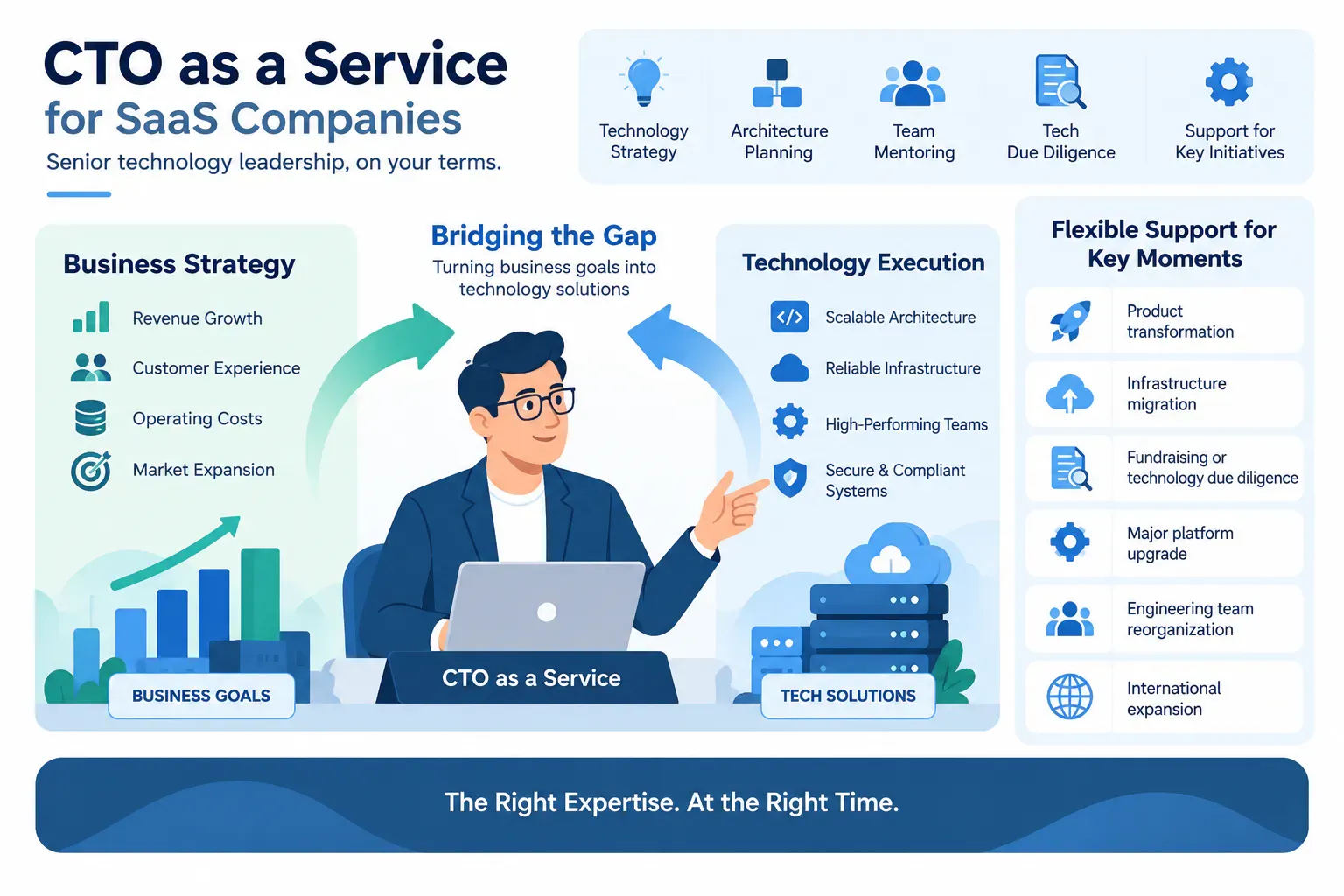
CTO as a Service provides access to CTO-level expertise on a flexible basis. Depending on your company's needs, this can include technology strategy, architecture planning, engineering leadership, team mentoring, technology due diligence, and support for major technical initiatives.
For SaaS companies, the role connects business strategy with technology execution.
Connecting technology with business goals
Technology decisions can directly affect revenue, customer experience, operating costs, and growth. A decision that looks purely technical can have significant business consequences.
For example, when deciding whether to rebuild part of your platform, the key questions are not only about architecture. You also need to consider:
- How will the decision affect the product roadmap?
- What is the cost of maintaining the current system?
- Will the investment improve reliability or scalability?
- What risks could arise if the decision is delayed?
- How could the change affect customers and revenue?
A CTOaaS professional brings these business considerations into technology planning, helping leadership understand what needs to change, why it matters, and when to act.
Flexible access to senior expertise
Not every SaaS company needs a full-time CTO at every stage.
You may need intensive technology leadership during a:
- Product transformation
- Infrastructure migration
- Fundraising or technology due diligence
- Major platform upgrade
- Engineering team reorganization
- International expansion
Once the initiative is complete, your needs may change. CTOaaS allows the level of support to evolve with the business, giving you access to senior expertise without building a permanent technology leadership structure too early.
Why CTOaaS Is More Than Cost Savings
CTOaaS is often positioned as a cost-effective alternative to hiring a full-time CTO. While financial efficiency can matter, the bigger opportunity is improving the quality of technology decisions as your company becomes more complex.
Challenging assumptions before they become expensive
Founders naturally become deeply involved in their products and technology. That ownership is valuable, but it can make it difficult to objectively evaluate decisions that have accumulated over time.
An external CTO can provide an independent perspective.
For example, your team may believe that a platform needs a complete rebuild when targeted improvements could solve the actual problem. Or an existing architecture may be becoming a genuine constraint while the business continues postponing the investment needed to address it.
An experienced CTO can help distinguish between these situations.
The objective is not to change technology for the sake of change. It is to identify which decisions have real business impact and prioritize them accordingly.
Prioritizing technical investment
Growing SaaS companies rarely have unlimited engineering capacity. There may be competing demands across product development, infrastructure, security, technical debt, and internal systems.
Trying to address everything at once can keep your team busy without moving the business forward.
CTO-level leadership can help prioritize initiatives based on:
- Business impact
- Customer needs
- Technical risk
- Scalability requirements
- Available resources
- Expected return on investment
This creates a clearer relationship between your technology roadmap and business roadmap.
Helping engineering teams mature
A growing engineering team needs more than additional developers.
Processes that work with five engineers may become inefficient with twenty. Communication becomes harder, technical decisions can become inconsistent, and areas such as testing, documentation, release management, and ownership become increasingly important.
A CTOaaS partner can help establish the structure needed for growth while avoiding unnecessary bureaucracy.
The goal is to create an engineering organization that can move quickly, maintain quality, and support business priorities.
Building a Technology Foundation for SaaS Growth
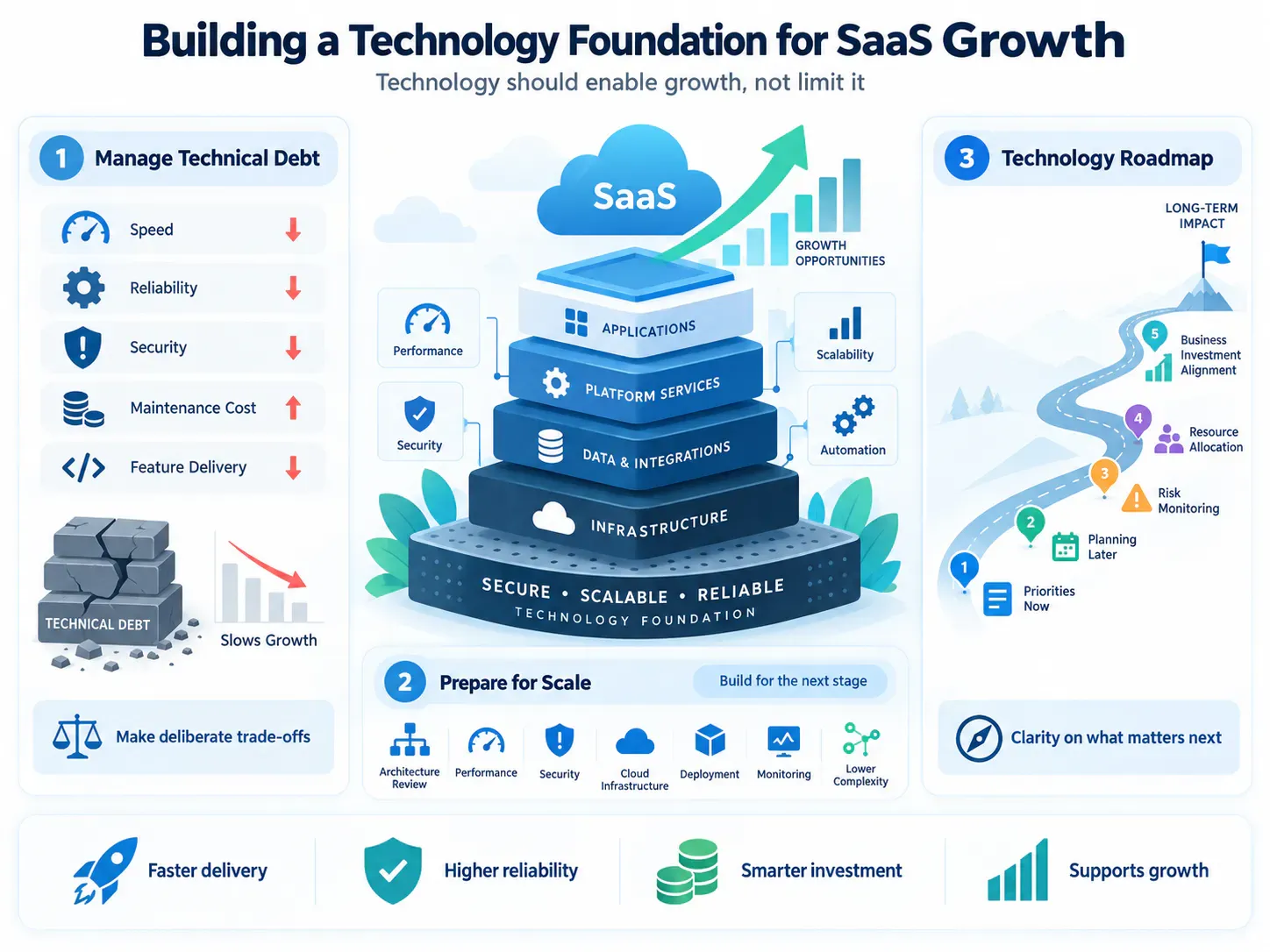
Technology should support growth rather than become a constraint on it. For SaaS businesses, that means looking beyond individual features and considering whether the underlying architecture, infrastructure, and processes can support increasing demand.
Managing technical debt strategically
Technical debt is not automatically a problem. Startups constantly make trade-offs to validate ideas, respond to customers, and move quickly.
The problem occurs when temporary solutions become permanent and begin affecting:
- Development speed
- Product reliability
- Security
- Maintenance costs
- Ability to launch new features
A CTOaaS engagement can help identify which technical debt is creating the greatest business impact and develop a realistic plan to address it.
The goal is not to eliminate every technical issue. It is to make deliberate trade-offs based on business priorities.
Preparing architecture for the next stage
A platform designed for an early-stage product may not be suitable once customer numbers, data volumes, integrations, and product complexity increase.
Preparing for scale can involve:
- Reviewing application architecture
- Improving system performance and reliability
- Strengthening security practices
- Assessing cloud infrastructure
- Improving deployment and monitoring
- Reducing unnecessary operational complexity
- Planning for future product requirements
The right approach depends on your business. A CTO should evaluate technology based on your product, customers, team, budget, and growth plans rather than recommending technology simply because it is popular.
Creating a practical technology roadmap
A technology roadmap gives leadership visibility into what needs to happen next.
It helps your company determine:
- What needs attention now
- What can be planned for later
- What risks need monitoring
- Where engineering resources should be allocated
- Which investments support upcoming business goals
For non-technical founders, this can make complex technology decisions much easier to understand. You do not need to know every implementation detail. You need clarity around what is required, why it matters, what it will take, and how it supports the business.
AI Strategy Is Now Part of Technology Leadership
AI has added another important responsibility to the CTO role. SaaS companies are evaluating AI for product development, customer experiences, internal operations, and software engineering.
At the same time, AI adoption creates new questions around quality, security, privacy, governance, cost, and return on investment.
Simply allowing employees to use AI tools is not the same as having an AI strategy.
Finding practical AI opportunities
A useful AI strategy starts with business needs rather than technology trends.
Potential opportunities may include:
- AI-powered customer support
- Intelligent search and recommendations
- Workflow automation
- Software development assistance
- Data analysis
- AI-powered product features
However, not every use case deserves investment.
A technology leader can assess opportunities based on business value, implementation complexity, operational risk, customer impact, and available resources.
The objective is to identify where AI can create measurable value, rather than adopting AI simply because it is trending.
Establishing AI guardrails
AI-assisted development can accelerate coding, but faster code generation can also increase the amount of code that needs to be reviewed and tested.
Your engineering process may therefore need stronger practices around:
- Code review and testing
- Security and privacy
- Sensitive data
- Intellectual property
- Approved AI tools
- Human oversight
Clear guardrails allow teams to experiment with AI while maintaining appropriate standards.
Giving leadership a clear view of AI maturity
Founders, boards, and investors may increasingly ask where the company stands with AI.
A practical AI strategy should help answer:
- Where are we already using AI?
- What results are we seeing?
- Which experiments should continue?
- Where are the key risks?
- What should we prioritize next?
- What capabilities do we need internally?
CTOaaS can help turn these questions into a practical roadmap rather than leaving AI adoption to disconnected experiments across the organization.
How FIX Partner Supports SaaS Companies
For a growing SaaS business, technology leadership is most valuable when strategy can be connected to execution.
FIX Partner approaches CTOaaS as more than periodic technical advice. The focus is on helping businesses make informed technology decisions, strengthen engineering capabilities, and turn those decisions into practical results.
Combining strategy with engineering expertise
A strategy only creates value when your team can execute it.
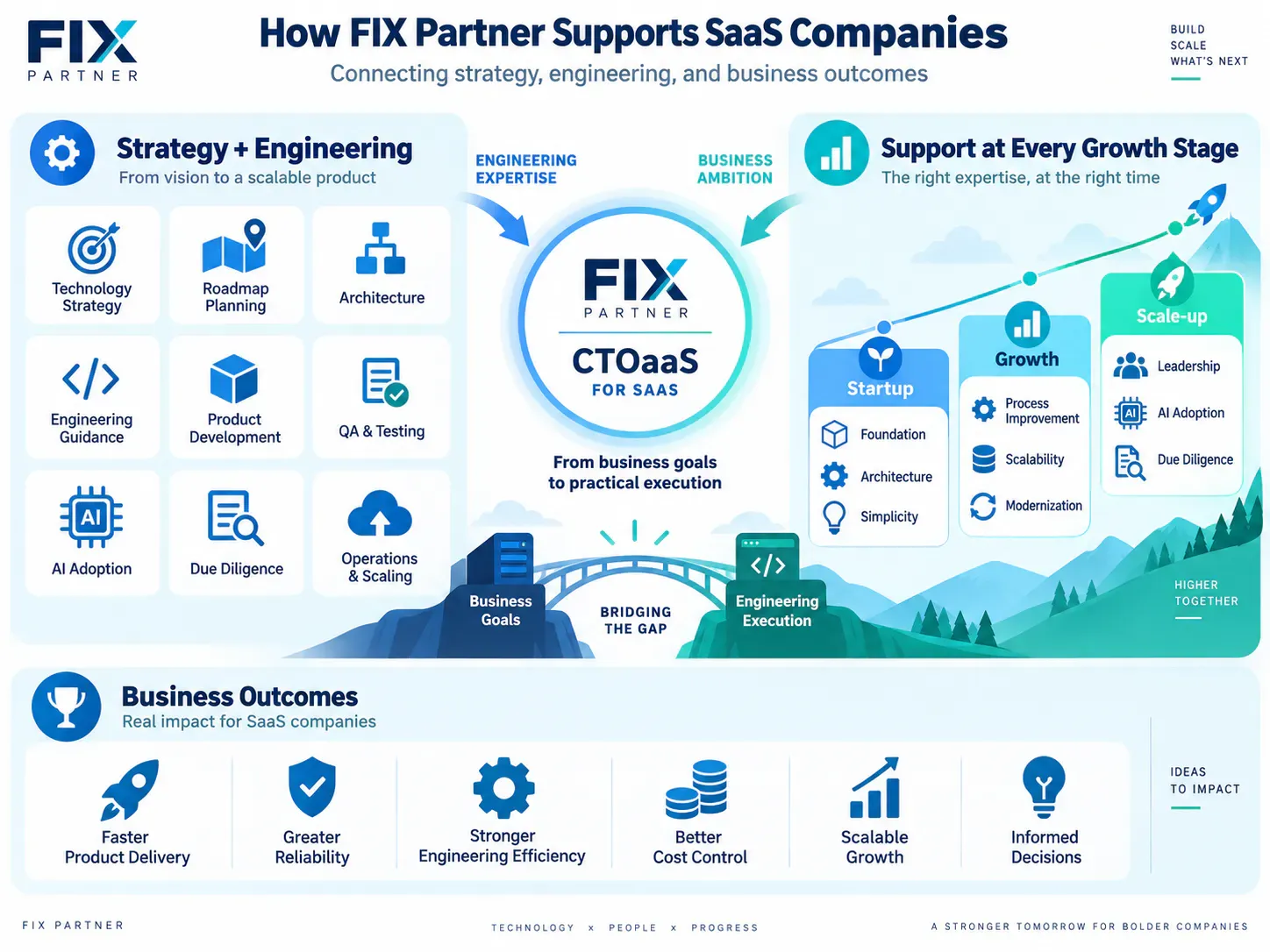
FIX Partner brings together CTO-level guidance and engineering capabilities to support SaaS companies across areas such as:
- Technology strategy and roadmap planning
- Architecture assessment and modernization
- Engineering team guidance
- Product and software development
- Quality assurance and testing
- AI engineering and adoption
- Technology due diligence
- Technology operations and scaling
This helps reduce the gap between what business leadership wants to achieve and what the engineering organization needs to deliver.
Supporting different stages of SaaS growth
Technology requirements evolve as your company grows.
An early-stage SaaS startup may need help validating its technical foundation, choosing the right architecture, and avoiding unnecessary complexity.
A scale-up may need a different type of support, such as:
- Engineering process improvement
- Platform scalability
- Technology modernization
- Team structure and leadership
- AI adoption
- Technical due diligence
FIX Partner's CTOaaS approach can adapt to these changing requirements instead of applying the same technology strategy to every company.
Keeping the focus on business outcomes
Technology should ultimately serve the business. Effective CTOaaS should help turn technical decisions into tangible value:
- Faster product delivery: remove technical bottlenecks that slow down the roadmap.
- Greater reliability: create a more stable experience as usage grows.
- Stronger engineering efficiency: improve processes and team effectiveness without unnecessary complexity.
- Better cost control: align technology investments with business priorities.
- Scalable growth: prepare systems for increasing customers, data, integrations, and product demands.
- More informed decisions: provide experienced guidance when evaluating major technology investments and risks.
As your SaaS company moves from startup to scale-up, you may not need a large technology leadership structure immediately. What matters is having the right expertise available when important decisions arise.
Conclusion
As a SaaS company grows, technology becomes increasingly connected to how you operate, serve customers, and plan for the future. Experienced technology leadership can help founders approach these decisions with greater clarity while keeping the organization flexible.
CTOaaS for SaaS Startups provides a practical way to access CTO-level expertise when it matters most, whether you are strengthening your technology foundation, evolving your engineering organization, or exploring new opportunities.
Ready to strengthen your SaaS technology strategy?
Talk to FIX Partner about CTOaaS.