Shift Left, Shift Right, AI Shift: FIX Partner’s Agile QA
Explore FIX Partner’s Agile QA with Shift Left, Shift Right, and AI Shift to improve software quality, test automation, and continuous testing.
Software development is moving faster than ever. Businesses are releasing new features more frequently, adopting cloud technologies, connecting multiple systems, and responding to customer expectations with shorter development cycles.
But faster delivery also creates a major challenge: how can businesses maintain software quality without slowing innovation?
Traditional testing models often treat QA as the final step before release. Developers build the product, QA tests it, defects are fixed, and the software is eventually deployed. While this approach may work for slower development cycles, it becomes difficult to sustain when businesses release updates weekly, daily, or even continuously.
Quality can no longer be something checked only at the end.
It needs to be built into development from the beginning, continuously validated after release, and increasingly supported by intelligent technologies.
This is where Shift Left, Shift Right, and AI Shift come together.
Shift Left brings testing and quality activities earlier into the development lifecycle. Shift Right continues quality validation after deployment by observing how software performs in real-world conditions. AI Shift adds intelligence to the process, helping teams analyze data, identify risks, optimize testing, and make faster quality decisions.
For FIX Partner, these three approaches form a modern Agile QA mindset designed to help businesses improve software quality while maintaining the speed and flexibility needed to compete.
Shift Left: Build Quality Earlier
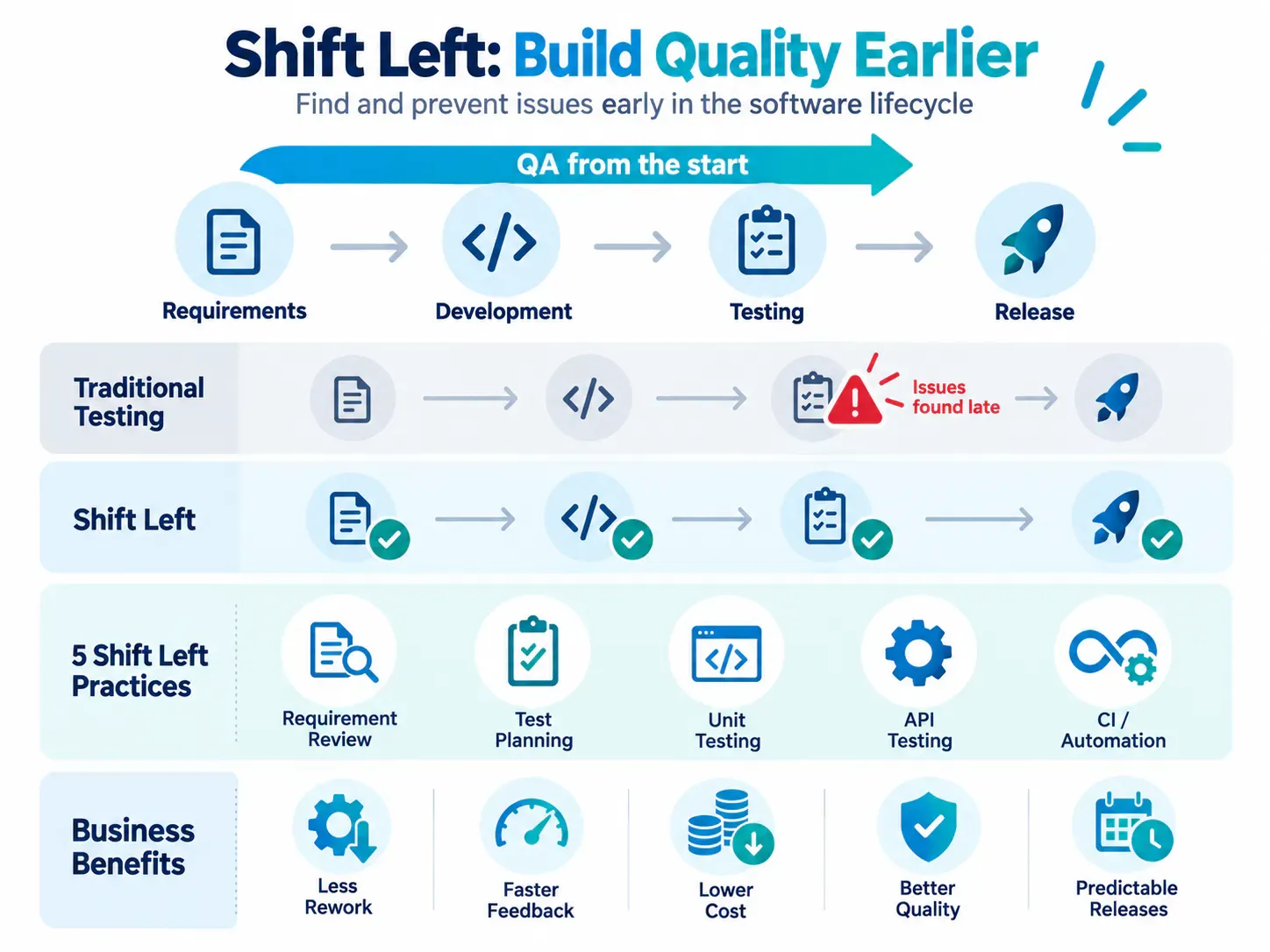
Shift Left is based on a simple idea: find and prevent problems as early as possible.
Instead of waiting until development is almost complete, QA becomes involved from the beginning of the software lifecycle. Testers work with product owners, business stakeholders, and developers to understand requirements, identify risks, and define how quality will be measured.
This changes the role of QA from simply finding bugs to actively helping prevent them.
Why Shift Left Matters to Businesses
Consider a company developing a new online payment feature.
If an important business rule is unclear during the requirements stage, developers may interpret it differently from the product team. The issue may not become visible until the feature is already developed and integrated.
At that point, fixing the problem can involve rewriting code, changing test cases, updating documentation, and potentially delaying the release.
With Shift Left, QA can review the requirement before development begins and identify the ambiguity early.
The business avoids unnecessary rework because the problem is addressed when it is still relatively easy to change.
What Shift Left Looks Like in Practice
Shift Left can include activities such as:
- Requirement and acceptance-criteria reviews
- Test planning during sprint planning
- Unit testing
- API testing
- Integration testing
- Static code analysis
- Test-driven development
- Automated regression testing
- Continuous integration testing
Automation is especially important because modern Agile teams need rapid feedback.
When automated tests run as developers make changes, potential problems can be identified much earlier instead of accumulating until the end of a sprint or release cycle.
From Defect Detection to Defect Prevention
The real value of Shift Left is not simply testing more. It is testing at the right time.
By moving quality activities earlier, businesses can reduce rework, shorten feedback cycles, and make development more predictable.
That is why Shift Left fits naturally into Agile and DevOps environments: quality becomes part of development rather than a separate activity waiting at the finish line.
Shift Right: Keep Quality Moving After Release
Testing should not stop when software goes live.
Even when an application passes functional, integration, security, and performance testing before deployment, real-world conditions can reveal unexpected issues.
Users may behave differently from test scenarios. Traffic may increase unexpectedly. A particular device or network environment may expose a problem. A new integration may behave differently under production conditions.
This is where Shift Right becomes important.
Why Production Is Part of the Quality Lifecycle
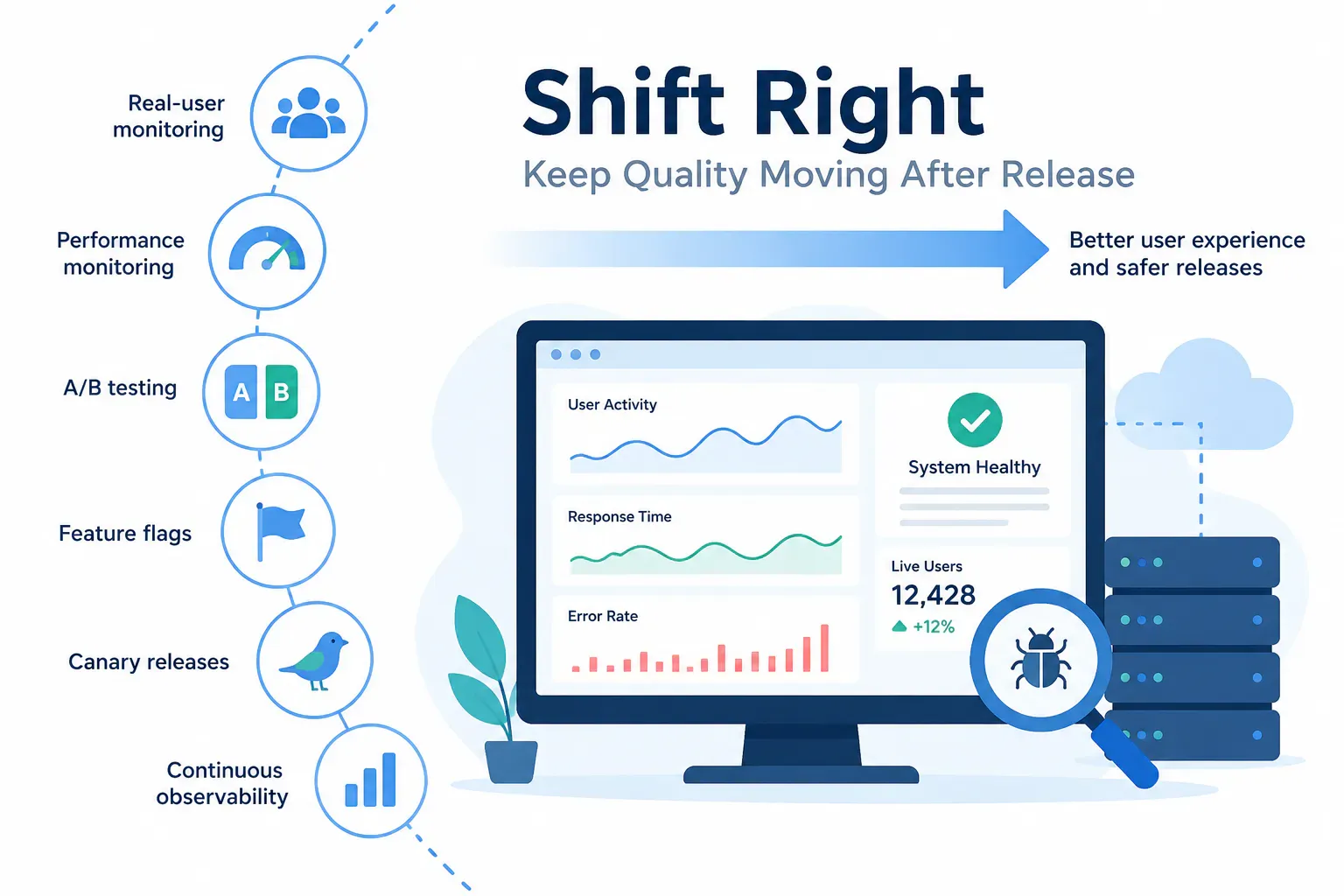
Shift Right focuses on observing, validating, and learning from software after deployment.
Instead of asking only:
“Did we test the software before release?”
teams also ask:
“Is the software performing as expected for real users?”
This creates a much broader definition of quality.
Common Shift Right practices include:
- Real-user monitoring
- Synthetic monitoring
- Performance monitoring
- A/B testing
- Feature flags
- Canary releases
- Chaos testing
- Continuous observability
These practices give businesses greater visibility into application behavior after release.
Turning Real-World Data Into Action
Imagine an application performs well during internal performance testing but experiences slower response times after being released to a larger customer base.
Without production monitoring, the business may only discover the problem after customers complain.
With Shift Right, monitoring can highlight unusual response times or error rates early, allowing teams to investigate before the problem becomes a larger customer experience issue.
This makes production data part of the testing feedback loop.
Safer Releases, Better Customer Experience
Shift Right also supports controlled releases.
With techniques such as canary deployment and feature flags, businesses can introduce changes gradually rather than exposing every customer to a new feature immediately.
This provides an additional layer of protection while allowing teams to learn from actual user behavior.
For businesses, the result is greater release confidence and a stronger ability to respond when production behavior differs from expectations.
AI Shift: Making Agile QA More Intelligent
Shift Left helps businesses prevent defects earlier.
Shift Right helps them understand software behavior after deployment.
But modern software environments generate an enormous amount of data across the entire lifecycle, from requirements and code changes to test results, production logs, performance metrics, and user behavior.
This creates the opportunity for the third pillar: AI Shift.
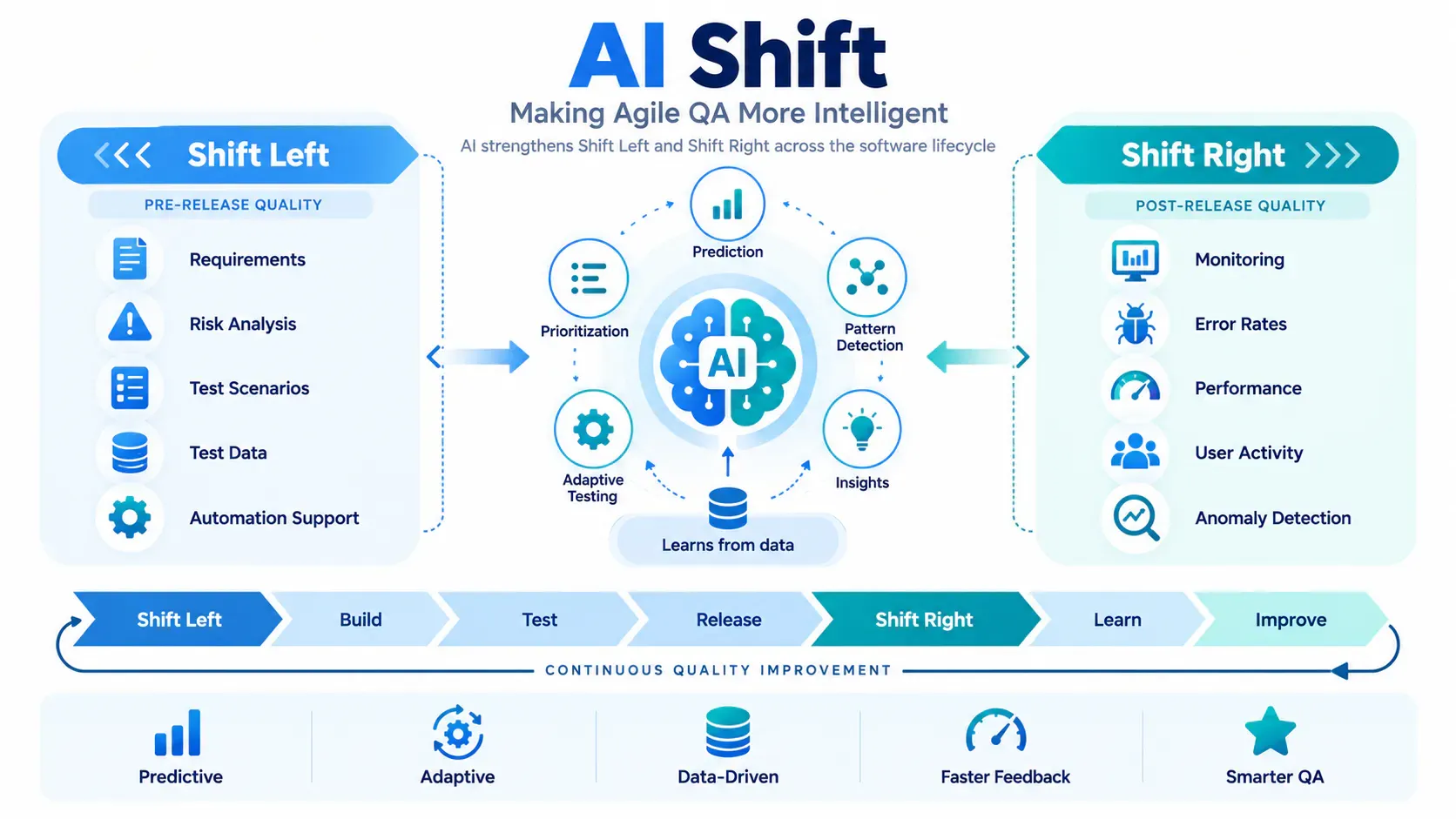
AI Shift means applying artificial intelligence to make software testing and quality management more intelligent, predictive, adaptive, and data-driven.
It does not replace Shift Left or Shift Right. Instead, it strengthens both.
AI Shift in Early-Stage Testing
On the Shift Left side, AI can help teams analyze requirements and identify potential risks before development progresses.
AI-assisted approaches can support:
- Requirement analysis
- Test scenario generation
- Test-case prioritization
- Risk identification
- Test-data generation
- Automation support
For a business with a large application, not every feature has the same level of risk.
AI can help analyze historical defects, recent changes, test results, and other available information to identify areas that may deserve greater testing attention.
This helps teams focus their time where it can create the most value.
AI Shift in Test Automation
Maintaining automation can become challenging as applications change.
A user interface may be redesigned. An API may be updated. A workflow may change. New functionality may affect existing test scenarios.
AI-assisted testing can help teams identify affected tests, generate or update test scenarios, and analyze automation results.
The objective is not to remove human QA expertise.
Instead, AI can reduce repetitive work and allow QA professionals to focus more on activities requiring human judgment, such as exploratory testing, business-risk analysis, usability, and quality strategy.
AI Shift in Production Monitoring
AI also strengthens Shift Right.
Production environments generate large volumes of data. Manually reviewing every signal is difficult, especially for complex applications.
AI can help identify unusual patterns across:
- Error rates
- Response times
- API behavior
- System performance
- User activity
- Application events
By identifying anomalies and patterns more quickly, AI-assisted monitoring can help teams investigate potential problems earlier.
This moves QA toward a more proactive model: not only detecting what went wrong, but identifying what may require attention next.
AI Shift Connects the Entire Lifecycle
The greatest value of AI Shift comes when it connects information across the entire quality lifecycle.
Shift Left generates early quality signals, while Shift Right provides real-world feedback. AI can help turn these signals into insights that influence future testing and development decisions.
This creates a continuous learning loop rather than a traditional testing cycle that ends with a pass-or-fail result.
From Testing to Intelligent Quality
The evolution of modern QA can be viewed through three connected approaches:
Approach
| Primary Focus
| Business Value
|
|---|---|---|
Shift Left
|
Prevent and detect defects early
|
Less rework and faster development
|
Shift Right
|
Validate real-world software behavior
|
Better reliability and customer experience
|
AI Shift
|
Predict, prioritize, and optimize
|
Smarter decisions and greater QA efficiency
|
Together, these approaches move testing beyond the traditional idea of simply finding bugs.
Shift Left makes quality earlier.
Shift Right makes quality continuous.
AI Shift makes quality more intelligent.
For Agile businesses, this combination creates a stronger foundation for faster releases, lower risk, better software reliability, and continuous improvement.
FIX Partner’s Agile QA: Bringing the Three Shifts Together
For FIX Partner, Shift Left, Shift Right, and AI Shift are not three disconnected testing trends.
They represent a more complete way of thinking about software quality.
The goal is to help businesses create quality throughout the software lifecycle, from requirements and development to deployment, production monitoring, and continuous improvement.
Quality Starts With Early Collaboration
FIX Partner works with product owners, developers, and stakeholders from the early stages of development.
Our QA teams can help review requirements, acceptance criteria, business workflows, and potential risk areas before implementation begins.
This allows teams to identify quality concerns early and establish a stronger foundation for development.
Automation Across the Testing Lifecycle
Test automation plays an important role in FIX Partner's Agile QA approach.
Depending on project requirements, our engineers can support:
- API automation
- UI automation
- Integration testing
- Regression testing
- Contract testing
- Performance testing
- CI/CD testing
The goal is not simply to automate as many tests as possible.
It is to build reliable and maintainable automation that provides useful feedback at the right stage.
Continuous Testing With CI/CD
FIX Partner integrates testing into continuous integration and delivery workflows where appropriate.
Automated tests can run alongside code changes, helping development teams identify regressions earlier.
This supports a faster feedback loop and enables businesses to move toward more frequent releases without sacrificing quality discipline.
Production Validation and Monitoring
FIX Partner also extends QA beyond deployment.
Monitoring and production validation can help businesses understand how applications behave under real-world conditions.
Teams can use production insights to identify performance issues, unexpected behavior, and areas where additional testing may be needed.
This creates a direct connection between customer experience and software quality.
AI-Assisted Quality Engineering
As AI continues to reshape software engineering, FIX Partner is also embracing the AI Shift as part of the evolution of modern QA.
AI-assisted approaches can support test generation, test prioritization, automation optimization, defect analysis, and anomaly detection.
However, technology alone does not create quality.
The strongest results come from combining AI capabilities with experienced QA professionals who understand business requirements, customer expectations, application risks, and project objectives.
This human-plus-AI approach helps businesses gain efficiency without losing the judgment that high-quality software still requires.
Why the Three Shifts Matter to Your Business
The value of this approach goes beyond technical testing metrics.
For business leaders, the impact can be seen in several areas:
- Faster Time to Market: Earlier feedback and automation can reduce unnecessary rework and help teams move changes through development more efficiently.
- Lower Development Risk: Shift Left helps prevent defects early, while Shift Right provides additional protection after deployment.
- Better Customer Experience: Production monitoring and real-world feedback help businesses understand what customers are actually experiencing.
- Smarter Use of QA Resources: Automation and AI-assisted analysis can reduce repetitive work and help teams focus on higher-value quality activities.
- Continuous Improvement: Instead of treating each release as an isolated event, businesses can use testing and production data to improve the next release. This creates a quality strategy that evolves alongside the product.
A Continuous Approach to Software Quality
Modern Agile software development requires more than a final round of testing.
It requires a continuous approach to quality.
Shift Left moves quality earlier, helping businesses prevent defects before they become expensive problems.
Shift Right moves quality beyond deployment, helping teams understand how software performs in real-world conditions.
AI Shift adds intelligence across the lifecycle, helping teams analyze data, prioritize risks, automate repetitive work, and continuously improve testing decisions.
Together, these approaches create a modern Agile QA model built around continuous learning and improvement.
This is the mindset FIX Partner brings to modern software quality.
By combining QA expertise, automation, continuous testing, production validation, and AI-assisted approaches, FIX Partner helps businesses pursue the right balance between speed, quality, reliability, and customer satisfaction.
Ready to strengthen your Agile QA strategy?
Partner with FIX Partner and build quality into every stage of your software lifecycle.