Enterprise Asset Management Solutions by FIX Partner
Discover how FIX Partner delivers enterprise asset management solutions to streamline procurement, asset lifecycle management, testing, and compliance.
Managing business assets is more than keeping a record of what a company owns. As organizations grow, they need to know where assets are, how they are being used, what they cost, when they need maintenance, and whether their investment continues to support business objectives.
On this page
This becomes increasingly important for organizations with large numbers of assets, such as hospitals, banks, financial institutions, transportation companies, industrial parks, and export-processing businesses. The asset lifecycle can involve procurement planning, supplier selection, purchasing, receiving, allocation, depreciation, maintenance, insurance, transfer, and eventual disposal. Without a connected approach, these activities can easily become fragmented across departments and systems.
FIX Partner can help businesses address this challenge by developing and implementing solutions that connect asset-related processes into a more structured management environment. Based on the capabilities outlined in the reference solution, the approach can cover procurement, fixed assets, equipment, inventory, fleet, property, maintenance, and asset disposal.
The goal is not simply to digitize asset records. It is to give businesses better visibility and control across the asset lifecycle.
Why Businesses Need Better Asset Management
For many organizations, asset management starts with a simple question: “What do we own?”
As the business grows, that question becomes much more complex. Management may also need to know where each asset is located, which department is using it, how much it is worth, whether it is being maintained properly, and how effectively the investment is being utilized.
The reference solution identifies several management concerns around asset investment, including asset value, lifecycle management, investment effectiveness, asset contribution to profitability, and the risks associated with asset investment.
Moving Beyond a Basic Asset Register
A basic asset register can tell a company that an asset exists. A broader enterprise asset management approach can connect that information with the processes surrounding the asset.
For example, a business may need to connect:
- Procurement planning with actual purchasing
- Suppliers with contracts and purchase orders
- Assets with locations and responsible employees
- Equipment with maintenance and repair activities
- Vehicles with fuel, mileage, inspection, and insurance records
- Properties with utilization and leasing information
- Assets with depreciation, transfer, and disposal activities
This connected approach helps reduce information gaps between procurement, finance, operations, maintenance, and management teams.
From Asset Data to Business Visibility
Asset information becomes more valuable when management can use it to understand business operations.
Instead of looking at individual transactions, decision-makers can gain a broader view of asset status, investment, utilization, maintenance, and lifecycle activities.
This is where FIX Partner can move beyond software development and focus on building solutions around the actual operational needs of the business.
What FIX Partner Can Help Businesses Manage
An effective enterprise asset management solution needs to support more than fixed assets alone. The reference solution covers a broader ecosystem of procurement, suppliers, inventory, equipment, fleet, property, construction projects, and supporting administrative processes.
FIX Partner can organize these capabilities into several practical business areas.
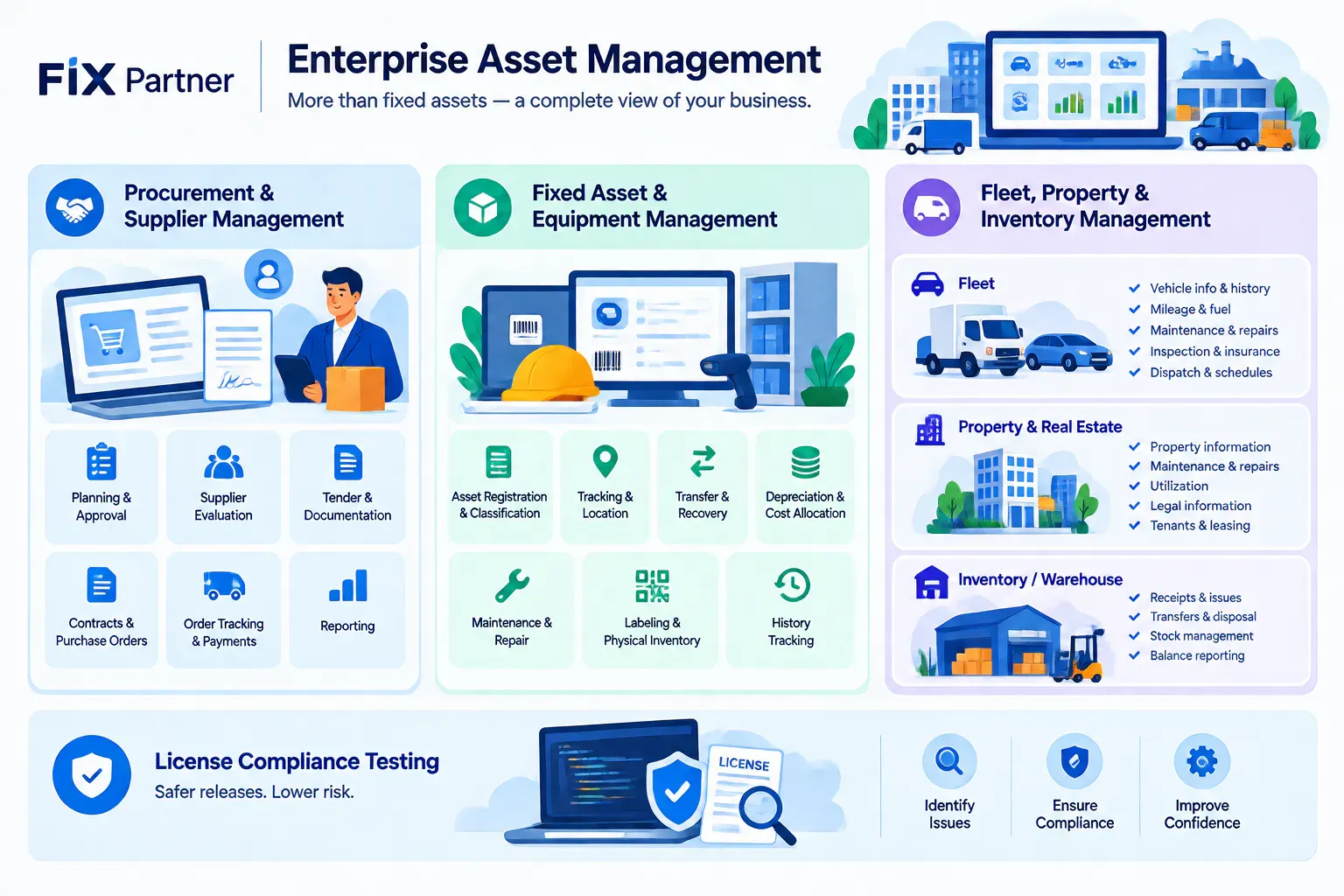
Procurement & Supplier Management
Before an asset enters the organization, there is already a process behind it.
FIX Partner can support businesses in structuring procurement-related workflows, including:
- Procurement planning and approval
- Supplier information and evaluation
- Tender and purchasing documentation
- Purchase contracts and purchase orders
- Order tracking and payment-related processes
- Procurement reporting
This creates a stronger connection between what a business plans to purchase and what it actually receives and manages.
Fixed Asset & Equipment Management
Once assets enter the organization, businesses need visibility throughout their useful life.
FIX Partner can support:
- Asset registration and classification
- Asset and equipment tracking
- Asset transfers and recovery
- Depreciation and cost allocation
- Maintenance and repair management
- Asset labeling and physical inventory
- Asset information updates and history tracking
The reference solution specifically includes asset registration, transfer, recovery, depreciation, repair workflows, physical inventory, and related reporting functions.
The business benefit is straightforward: teams have a clearer picture of what assets they have, where those assets are, and what is happening to them over time.
Fleet, Property & Inventory Management
Some organizations manage assets that require specialized processes.
For fleet operations, FIX Partner can support management of:
- Vehicle information and operational history
- Mileage and fuel consumption
- Maintenance and repairs
- Inspection and insurance
- Dispatch orders and operating schedules
For real estate and property, capabilities can include:
- Property information management
- Maintenance and repair records
- Property utilization
- Legal information
- Tenant and leasing information
- Building utilization reporting
The reference solution also includes materials warehouse management, covering material receipts, issues, transfers, disposal, inventory, and balance reporting.
These capabilities allow organizations to manage different asset categories without treating every type of asset as if it followed the same operational process.
License Compliance Testing
Beyond business application development and asset management solutions, FIX Partner can also support software quality assurance through License Compliance Testing.
FIX Partner ensures that license compliance considerations are incorporated into the testing process, helping businesses identify potential licensing-related issues and improve confidence in software releases.
Connecting the Full Asset Lifecycle
One of the biggest opportunities in asset management is connecting activities that are often handled separately.
An asset does not begin when it is recorded in a system. Its lifecycle can start with a business requirement and continue through procurement, deployment, maintenance, utilization, transfer, and disposal.
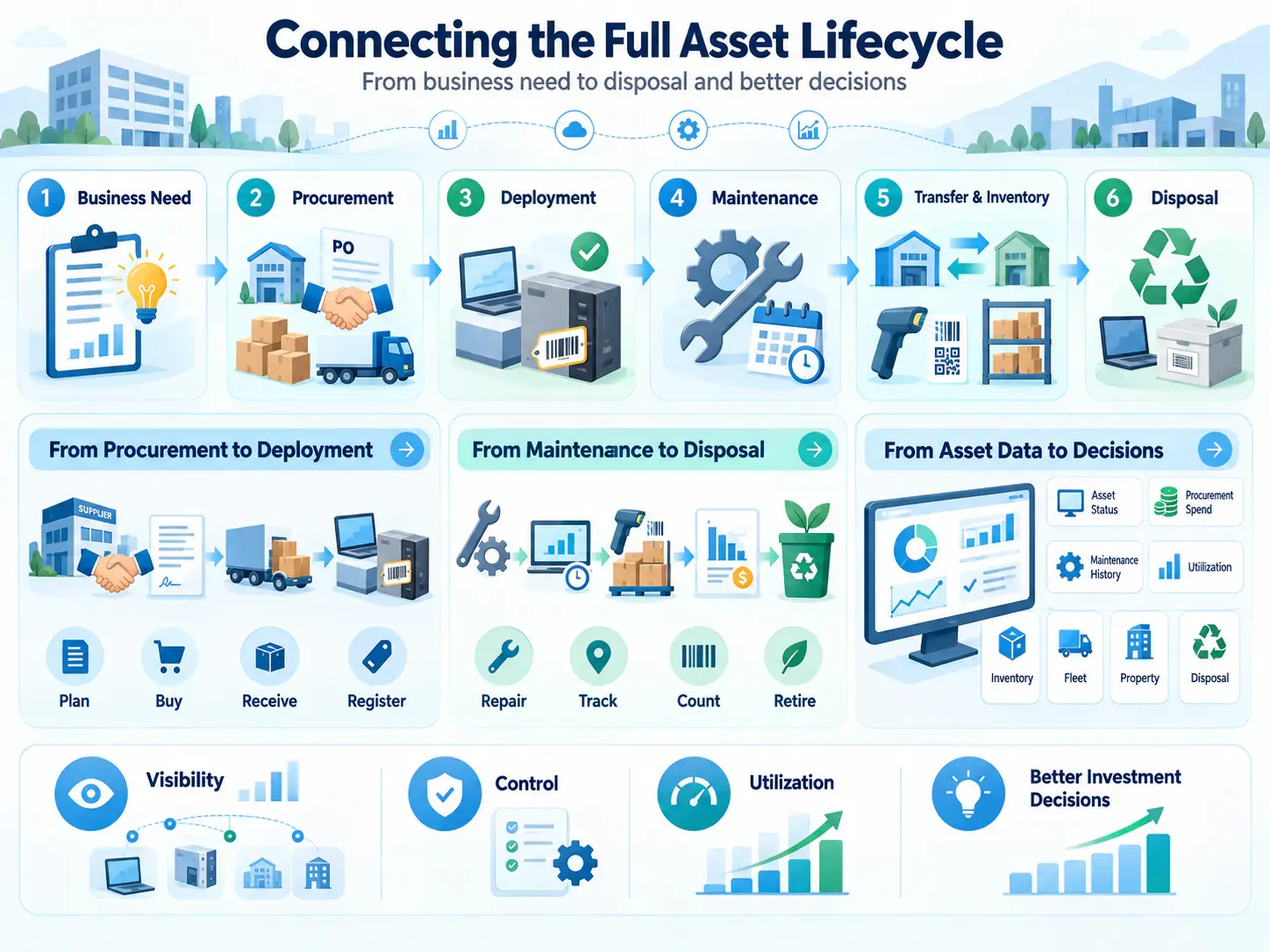
From Procurement to Deployment
The first stage is understanding what the business needs and how that requirement becomes an actual investment.
FIX Partner can help connect procurement planning with supplier management, purchasing, contracts, purchase orders, receiving, and asset registration.
This provides a more continuous flow of information from the initial purchasing requirement to the point where the asset becomes part of business operations.
From Maintenance to Disposal
Asset management should also continue after deployment.
Businesses may need to monitor repairs, maintenance, transfers, depreciation, physical inventory, and eventual disposal.
FIX Partner can support these processes so that asset information does not stop being useful once an asset is placed into operation.
The reference solution includes dedicated processes for maintenance, repair, transfer, recovery, depreciation, physical inventory, and disposal planning and execution.
From Asset Data to Business Decisions
The final stage is turning operational information into management visibility.
Instead of asking individual departments to collect information manually, businesses can establish structured data and reporting processes around assets.
This can help management review areas such as:
- Asset status and ownership
- Procurement and investment activities
- Maintenance and repair history
- Asset utilization
- Inventory levels
- Fleet operations
- Property utilization
- Disposal activities
The reference solution was developed with a focus not only on managing assets but also on analyzing asset utilization and investment effectiveness.
Turning Asset Management Into Business Value
Technology is only valuable when it helps people work better and make better decisions.
For a business, an enterprise asset management solution can create value in several practical ways.
Better Visibility Across the Organization
Centralized and structured asset information can make it easier for different teams to understand the current status of assets.
Procurement teams can track purchasing activities. Operations teams can understand asset availability. Maintenance teams can follow repair requirements. Management can access broader information for planning and decision-making.
Stronger Operational Control
Asset-related processes often involve multiple people and departments.
By defining workflows for procurement, approval, maintenance, transfer, inventory, and disposal, businesses can create more consistent processes and reduce reliance on disconnected spreadsheets or manual coordination.
FIX Partner can help translate these business processes into digital workflows based on the organization's requirements.
More Informed Investment Decisions
Asset investment is ultimately a business decision.
Management needs to understand not only how much has been invested, but also how assets are being used and maintained over time.
A structured asset management environment can provide the information needed to review asset performance, utilization, lifecycle costs, and investment effectiveness.
For organizations managing a large and diverse asset base, this visibility can become an important part of long-term operational planning.
A More Connected Digital Environment
The reference solution also includes master data management and system administration capabilities, covering areas such as asset classifications, suppliers, employees, locations, insurance companies, vehicle models, users, permissions, and organizational structures.
This supporting layer matters because reliable asset management depends on reliable underlying data.
FIX Partner can therefore approach enterprise asset management as a connected business solution rather than simply a collection of individual features.
Conclusion
Enterprise asset management is ultimately about helping businesses understand, control, and make better use of what they invest in.
FIX Partner can support organizations in building solutions that connect procurement, suppliers, fixed assets, equipment, maintenance, fleet, property, inventory, and disposal processes across the asset lifecycle.
With the right digital foundation, businesses can move from simply recording assets to gaining clearer visibility into how those assets support daily operations and long-term business objectives.
Ready to improve the way your business manages its assets?
Contact FIX Partner to discuss an Enterprise Asset Management solution tailored to your business processes.
Written by
Hannah Huynh
Published by
FIX Partner
FIX Partner helps organizations design, build, test, and modernize software products with engineering, AI, data, and QA expertise.
About FIX Partner →Ask FIX Partner
Have a question about this topic?
Leave your details and a short note. Our team can help you identify a practical next step.
Related articles

Mobile Application Development Services for Business Growth
Hannah HuynhMay 29, 20268 min read
Mobile applications are powerful because they place your service directly into the hands of users. For non-IT teams, the challenge often lies in...
Read more →
Why Human Resource Software Matters for Business Growth
Hannah HuynhOct 9, 2026
Discover how human resource software helps businesses streamline HR processes, improve workforce decisions, and support sustainable business growth.
Read more →
AI Agent Systems: How Business Software Is Evolving
Hannah HuynhSep 26, 2026
Explore AI agent systems and how they transform business software through intelligent automation, dynamic decision-making, software development, and workflow orchestration.
Read more →