AI Speeds Up Development for Digital Product Delivery
AI speeds up development by accelerating software delivery, boosting productivity, reducing repetitive tasks, and enabling smarter digital product development.
Building a digital product involves much more than writing code. Businesses need to define requirements, understand customer needs, design user experiences, develop features, test functionality, fix issues, and continuously improve the product after launch.
Each stage can create delays. Manual tasks consume valuable time, unclear requirements lead to rework, and late-stage testing can push back release schedules. For businesses competing in fast-moving markets, these delays can affect both customer satisfaction and growth opportunities.
Artificial intelligence is changing how businesses approach software development. AI speeds up development by helping teams automate repetitive activities, generate and review code, create test scenarios, analyze results, and support decision-making throughout the product lifecycle.
The goal is not to replace developers or business teams. Instead, AI allows people to spend less time on repetitive work and more time on activities that require creativity, judgment, and business expertise.
How AI Speeds Up Development Across the Product Lifecycle
AI can support different stages of digital product development, from the initial idea to testing and maintenance. Its value becomes greater when businesses integrate it into the overall workflow rather than using it only as a coding assistant.
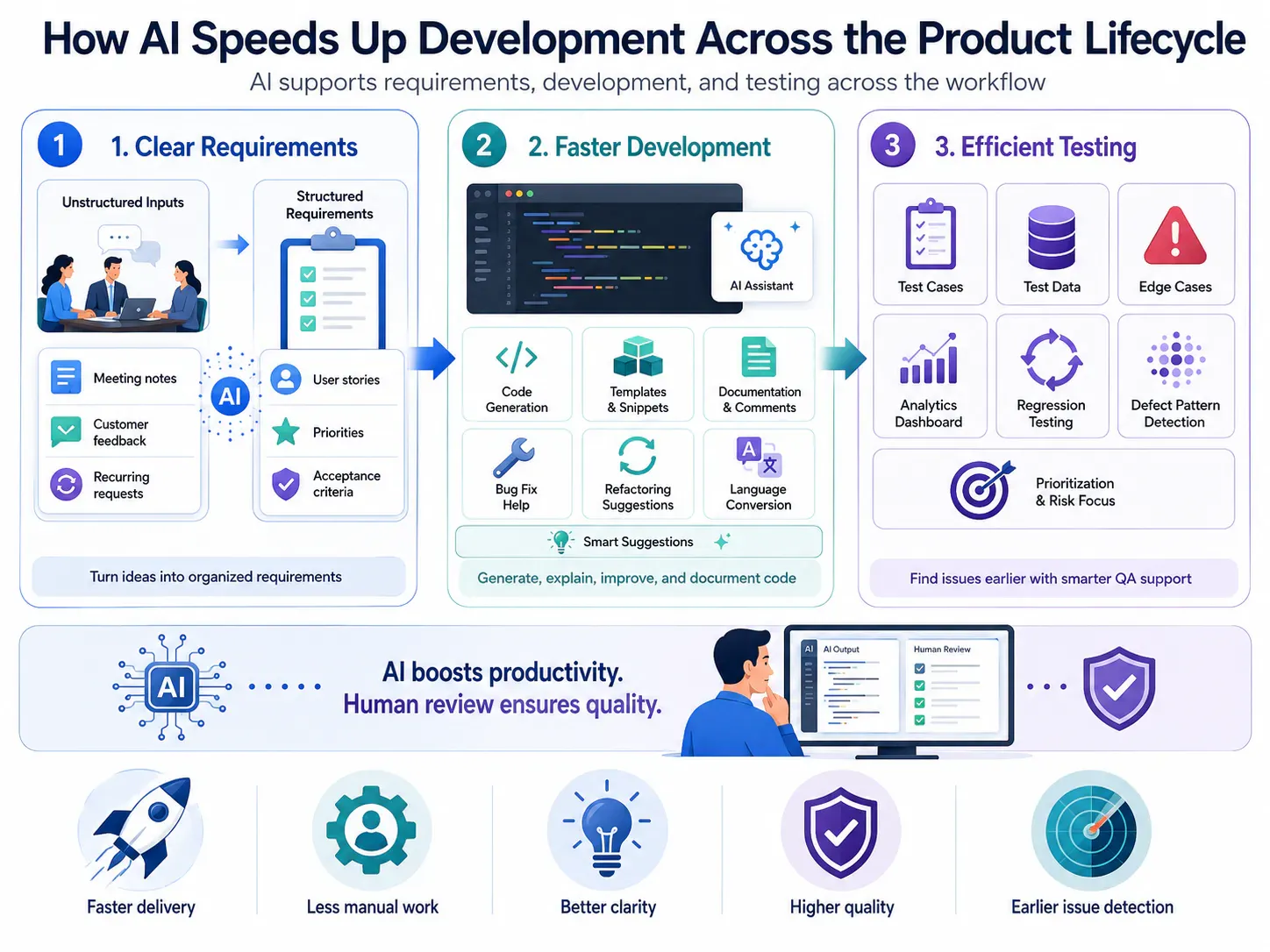
Turning Ideas Into Clear Requirements
One common cause of development delays is the gap between business expectations and technical requirements.
Business stakeholders may understand what customers need, but translating those needs into detailed requirements can take considerable time. AI can help teams organize and structure this information.
AI-assisted tools can support tasks such as:
- Summarizing product meetings and discussions
- Turning business ideas into initial user stories
- Organizing requirements by feature or priority
- Identifying missing or unclear information
- Generating initial acceptance criteria
- Summarizing customer feedback
- Identifying recurring customer requests
For example, a business team may provide several pages of meeting notes about a new customer portal. AI can help turn those notes into an initial list of features and user stories.
The development team can then review and refine the results before implementation. This makes AI a productivity tool while keeping human judgment at the center.
Accelerating Software Development
Software development includes many repetitive activities. Developers may need to create similar functions, write documentation, search through existing code, or troubleshoot common problems.
AI coding assistants can help by:
- Generating routine code
- Creating code templates
- Explaining unfamiliar code
- Suggesting possible solutions
- Identifying potential coding issues
- Refactoring existing code
- Generating technical documentation
- Creating basic test cases
- Supporting code conversion between languages
This is one of the most direct ways AI speeds up development.
Instead of starting every routine task from scratch, developers can use AI to create an initial version and then spend their time reviewing, improving, and adapting the output to the specific product.
Human review remains essential because AI-generated code can still contain errors or fail to meet specific business, security, or performance requirements.
Making Testing More Efficient
Testing can become a bottleneck as digital products become more complex. Every new feature can affect existing functionality, increasing the number of scenarios that need to be checked.
AI can support QA teams by:
- Generating test scenarios
- Creating test data
- Identifying potential edge cases
- Analyzing test results
- Detecting recurring defect patterns
- Supporting automated regression testing
- Prioritizing areas that require additional testing
When AI-assisted testing is combined with automation, teams can identify potential problems earlier and reduce the amount of manual effort required for repetitive testing activities.
Why Faster Development Creates Business Value
Development speed matters, but speed by itself is not the goal. The real value comes from delivering quality digital products faster while maintaining control over cost, security, and customer experience.
Shorter Time to Market
A shorter development cycle allows businesses to respond more quickly to market opportunities and customer expectations.
Faster delivery can be particularly valuable when:
- Customer requirements are changing quickly
- Competitors are launching new digital services
- A business wants to validate a new product idea
- Customers are requesting new features
- Market opportunities have a limited window
- Management needs faster feedback before making a larger investment
Instead of spending months developing every possible feature, businesses can launch a focused product, collect real customer feedback, and improve it through subsequent releases.
Higher Developer Productivity
AI can reduce the amount of time developers spend on routine activities. This gives teams more capacity to focus on higher-value work, including:
- Business logic
- Product architecture
- User experience
- Security
- Performance optimization
- Complex integrations
- Problem-solving
- Product innovation
The objective is not necessarily to make developers work longer or simply produce more code.
It is to help them spend a greater percentage of their time on work that requires expertise and human judgment.
Lower Development Waste
Development costs are influenced by more than the number of developers involved. Rework, manual processes, defects, delays, and inefficient communication can all increase the total cost of delivering a product.
AI can help reduce unnecessary effort by supporting repetitive tasks and improving workflow efficiency.
Potential benefits include:
- Less manual work
- Faster completion of routine tasks
- Earlier identification of issues
- Reduced rework
- More efficient use of development resources
- Faster feedback between teams
However, businesses should not assume that AI automatically reduces costs. AI adoption itself requires investment, training, governance, and appropriate human review.
The focus should be on measurable productivity and business outcomes.
More Opportunities for Product Improvement
Faster development also gives businesses more opportunities to learn from customers.
Teams can potentially:
- Test new features sooner
- Collect customer feedback earlier
- Analyze product usage
- Improve existing functionality
- Respond to changing market needs
- Remove features that provide limited value
This creates a more flexible product development cycle where businesses can continuously learn and adapt.
How Businesses Can Adopt AI Effectively
Businesses do not need to transform their entire development process overnight. A gradual approach can make AI adoption easier to manage and evaluate.
Start With Repetitive, High-Volume Tasks
The best starting point is often a task that is repetitive, time-consuming, and relatively easy for people to validate.
Examples include:
- Documentation generation
- Requirements summarization
- Code generation
- Code explanation
- Test-case generation
- Bug analysis
- Data preparation
- Technical research
- Routine development activities
Starting with these use cases allows teams to experience the productivity benefits of AI while keeping potential risks manageable.
Keep Human Review at the Center
AI can produce outputs quickly, but speed does not guarantee accuracy.
AI-generated results may contain:
- Incorrect assumptions
- Coding errors
- Security weaknesses
- Incomplete requirements
- Outdated information
- Poorly optimized solutions
A practical AI-assisted workflow can follow these steps:
- Business defines the objective
- AI assists with the initial solution
- Experts review the output
- The team tests the result
- Business stakeholders validate it
- The product is released and monitored
This approach combines the efficiency of AI with the experience of people who understand the product and its customers.
Measure Business Outcomes
AI adoption should be measured by results rather than the number of AI tools a company uses.
Businesses can track metrics such as:
- Development cycle time
- Feature delivery time
- Release frequency
- Defect rates
- Rework rates
- Testing time
- Developer productivity
- Cost per release
- Time required to resolve issues
- Customer satisfaction
These measurements help determine whether AI speeds up development in a way that actually creates business value.
How Fix Partner Helps Businesses Speed Up Development
Fix Partner helps businesses integrate AI-assisted capabilities into software development workflows to make digital product delivery faster, more efficient, and more scalable.
Rather than adopting AI simply because it is a growing technology trend, Fix Partner focuses on identifying where AI can create practical value across development and testing processes.
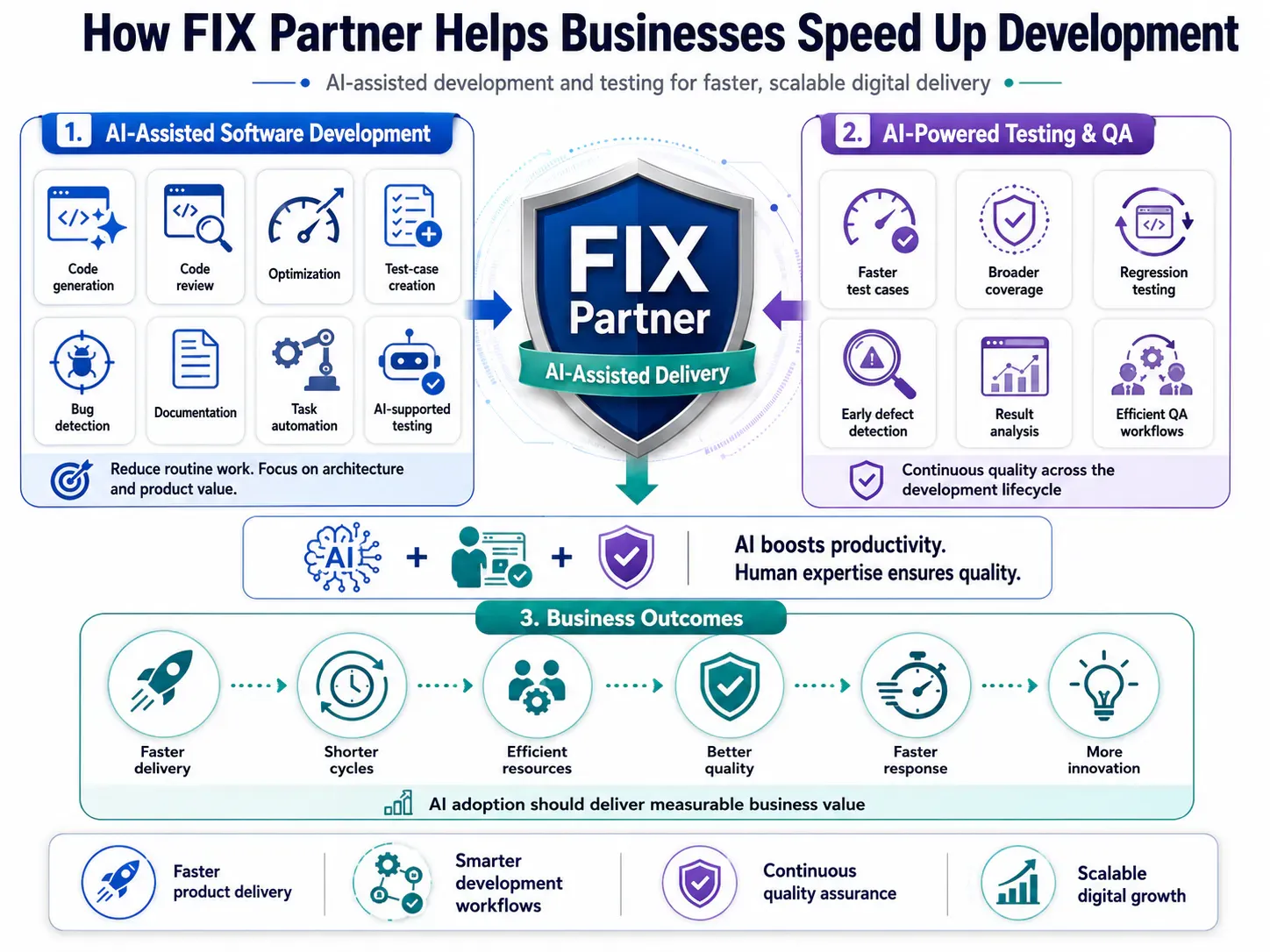
AI-Assisted Software Development
Fix Partner can support businesses in applying AI to routine development activities, including:
- AI-assisted coding and code generation
- Code review and optimization
- Automated test-case creation
- Bug detection and analysis
- Technical documentation generation
- Repetitive development task automation
- AI-supported software testing
These capabilities can help development teams reduce time spent on routine activities while focusing more on architecture, business logic, complex problem-solving, and product improvement.
AI-Powered Testing and Quality Assurance
AI can also strengthen the software testing process. Fix Partner can help businesses introduce AI-assisted testing practices that support:
- Faster test-case generation
- Broader test coverage
- Automated regression testing
- Earlier defect identification
- Test-result analysis
- More efficient QA workflows
Instead of treating testing as a final step before launch, businesses can integrate AI-assisted quality assurance throughout the development lifecycle.
This helps create a more continuous relationship between development and testing, supporting faster releases without ignoring software quality.
From AI Adoption to Business Outcomes
The value of AI should ultimately be measured by what it helps a business achieve.
With the right AI-assisted development strategy, businesses can work toward:
- Faster digital product delivery
- Shorter development cycles
- More efficient use of development resources
- Better software quality
- Faster response to customer needs
- More frequent product improvements
- Greater opportunities for innovation
For Fix Partner, this connects directly with its Success Fulfillment approach: helping customers achieve their goals and realize their potential for lasting fulfillment and satisfaction.
By combining AI-assisted workflows with experienced software development and testing expertise, Fix Partner helps businesses turn AI from a technology trend into a practical tool for delivering digital products more efficiently.
Conclusion
AI is changing software development by helping teams work more efficiently across planning, coding, testing, and continuous improvement.
For businesses, the benefits can include:
- Faster software delivery
- Higher developer productivity
- Less repetitive manual work
- Earlier defect identification
- Shorter time to market
- More efficient testing
- Greater opportunities for product iteration
However, AI should not be viewed as a replacement for human expertise. The strongest results come when AI handles repetitive activities while experienced professionals remain responsible for strategy, quality, security, and business decisions.
Ultimately, AI speeds up development when it becomes part of a well-designed product delivery process. By combining AI-assisted workflows with strong development and testing practices, businesses can move from ideas to digital products faster while creating more opportunities to learn, adapt, and deliver lasting value to customers.
Ready to accelerate your digital product delivery?
Talk to Fix Partner about how AI-assisted development can support your business goals.