Native vs Hybrid vs Cross-Platform: Cost & Performance
Compare native, hybrid, and cross-platform app development by cost, performance, speed, and scalability to choose the right approach for your business.
Choosing the right approach to mobile app development is not simply a technology decision. For a business, it can affect development costs, time to market, user experience, scalability, and the long-term effort required to maintain the product.
When comparing native vs hybrid vs cross-platform app development, businesses often focus on one question: Which technology is the best?
A better question is: Which approach best fits the business goals, product requirements, budget, and growth plans?
Native development can deliver excellent performance and highly customized experiences, while hybrid development can reduce initial development effort. Cross-platform development offers a practical balance between cost, performance, and the ability to reach both iOS and Android users.
This guide compares these three approaches across the factors that matter most to businesses, including cost, performance, development speed, maintenance, and scalability.
Native vs Hybrid vs Cross-Platform: Key Differences
The biggest difference between native, hybrid, and cross-platform development is how an application is built and how much code can be shared across platforms.
Criteria
| Native App Development
| Hybrid App Development
| Cross-Platform App Development
|
|---|---|---|---|
Development approach
|
Built separately for each platform
|
Web technologies wrapped in a native container
|
Shared codebase for multiple platforms
|
iOS & Android
|
Separate development
|
One codebase can support both
|
One shared codebase can support both
|
Initial cost
|
High
|
Low–Medium
|
Medium
|
Development time
|
Longer
|
Shorter
|
Shorter than native
|
Performance
|
Excellent
|
Good for simpler apps
|
Very good for most business apps
|
User experience
|
Highly optimized for each platform
|
More standardized
|
Strong with platform-specific customization
|
Device feature access
|
Excellent
|
Moderate to good
|
Very good
|
Code reuse
|
Low
|
High
|
High
|
Maintenance
|
Higher for multiple platforms
|
Relatively simple
|
Efficient across platforms
|
Scalability
|
Excellent
|
Moderate
|
Very good
|
Best for
|
Complex, performance-intensive apps
|
Simple apps and MVPs
|
Business apps targeting multiple platforms
|
Main drawback
|
Higher cost and development effort
|
Potential performance limitations
|
Some advanced features may require native code
|
Native App Development
Native apps are developed specifically for a particular operating system, such as iOS or Android. This means businesses typically maintain separate development efforts for each platform.
The major advantage is control. Native development allows the product team to take full advantage of platform-specific capabilities, device hardware, and operating system features.
This makes native development a strong option for applications where performance and a highly optimized user experience are essential.
However, the additional development effort can increase both initial and long-term costs, particularly when a business needs to support multiple platforms.
Hybrid App Development
Hybrid app development uses web technologies within a native application container. A single codebase can support multiple platforms, which can reduce development time and initial investment.
For businesses building relatively simple applications, internal tools, content-driven apps, or early-stage products, hybrid development can be a practical choice.
The trade-off is that hybrid applications may have limitations when an app requires intensive processing, complex animations, or extensive access to native device capabilities.
Cross-Platform App Development
Cross-platform development also allows businesses to build applications for multiple platforms using a shared codebase. However, modern cross-platform frameworks are designed to provide a more native-like experience than traditional hybrid approaches.
For many businesses, this creates an attractive middle ground.
Instead of maintaining completely separate applications, teams can reuse a significant portion of the code while still delivering strong performance and platform-specific experiences where necessary.
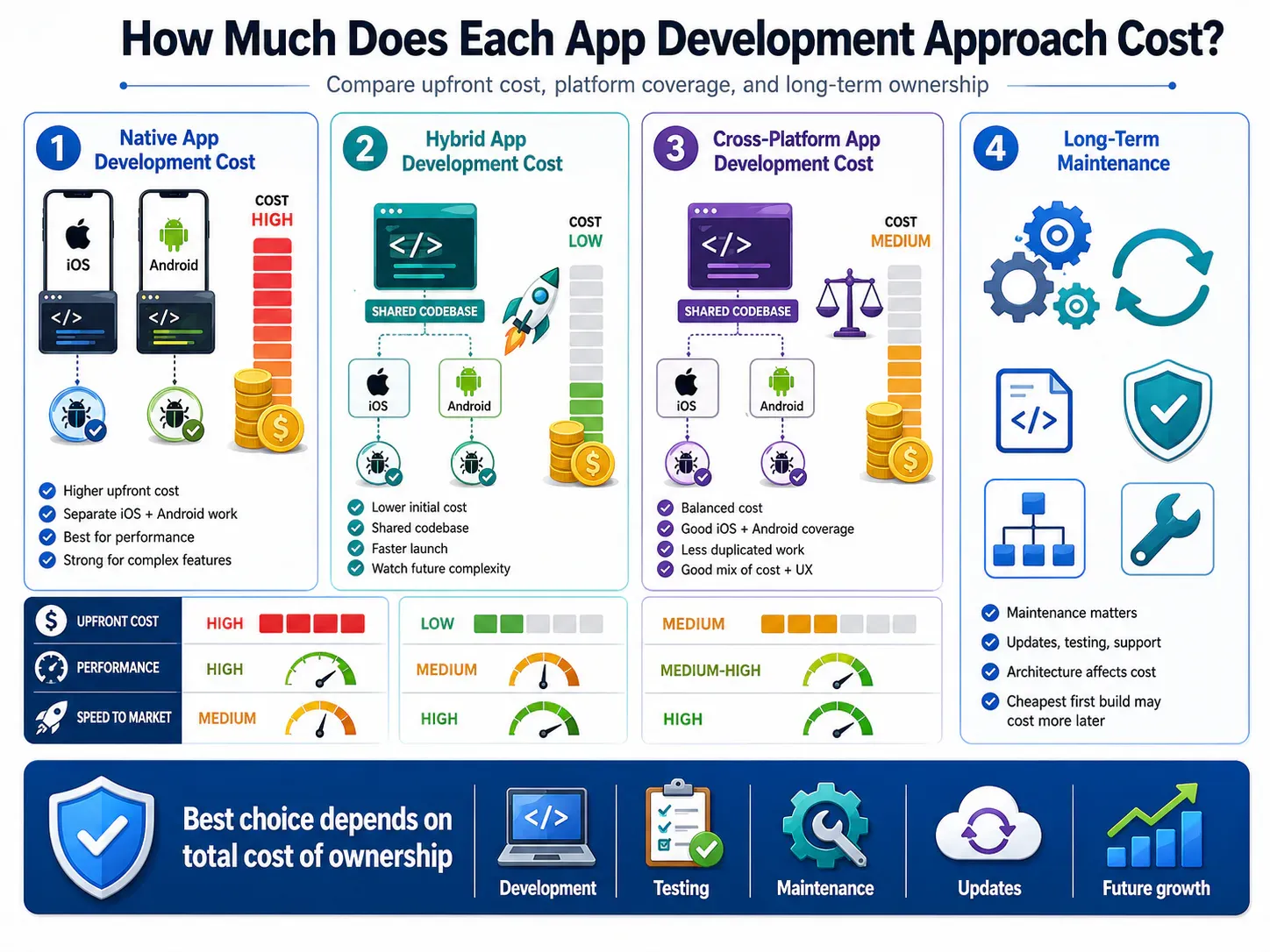
How Much Does Each App Development Approach Cost?
Cost is often one of the first considerations when choosing an app development approach. However, looking only at the initial development price can lead to the wrong decision.
A better evaluation considers the total cost of ownership, including development, testing, maintenance, updates, and future expansion.
Native App Development Cost
Native development generally requires a larger investment because iOS and Android applications may need separate development efforts.
For example, if a business wants to launch on both platforms, it may need different development work, testing processes, and ongoing updates for each platform.
The higher investment can be justified when the application requires advanced performance, complex interactions, or extensive platform-specific functionality.
For businesses with a high-performance product at the center of their revenue model, the additional investment may create long-term value.
Hybrid App Development Cost
Hybrid development can reduce the initial cost because much of the application can be developed from a shared codebase.
This makes it appealing for businesses with limited budgets or products that need to reach the market quickly.
However, a lower initial cost does not always mean lower long-term costs. If the application becomes more complex as the business grows, limitations in the original architecture may create additional development work later.
Businesses should therefore evaluate whether hybrid development can support not only the first version of the product but also its expected future requirements.
Cross-Platform App Development Cost
Cross-platform development can offer a strong balance between development investment and platform coverage.
A shared codebase can reduce duplicated development work while allowing a business to launch on both iOS and Android.
For companies that need to control development costs without sacrificing too much performance or user experience, this approach can be particularly attractive.
The actual cost will still depend on factors such as app complexity, integrations, design requirements, backend systems, security requirements, testing, and third-party services.
The Long-Term Cost of Maintenance
Maintenance is an important part of mobile app development that businesses sometimes underestimate.
Native applications may require separate updates for different platforms. Hybrid and cross-platform approaches can reduce duplicated work because more code can be shared.
However, maintenance costs depend on more than the development approach.
The quality of the architecture, testing process, documentation, codebase, and development team can have a significant impact on how easy the application is to maintain.
A slightly higher initial investment in a well-designed solution can therefore be more cost-effective than choosing the cheapest development option and facing expensive changes later.
How Do Native, Hybrid, and Cross-Platform Apps Perform?
Performance directly affects how users experience an application. Slow loading, delayed interactions, or inconsistent behavior can reduce user satisfaction and potentially affect business results.
That does not mean every business needs a native application.
The right question is how much performance the product actually requires.
Native App Performance
Native applications generally provide the highest level of platform-specific performance.
Because they are built specifically for an operating system, developers can optimize the application closely around that platform's capabilities.
Native development is particularly suitable for products involving demanding graphics, complex animations, intensive processing, advanced device functionality, or highly customized interactions.
For these use cases, the additional development cost may be justified by the performance and control that native development provides.
Hybrid App Performance
Hybrid applications can perform well for many straightforward business use cases.
For applications focused primarily on forms, content, basic transactions, or relatively simple interactions, the performance may be more than sufficient.
The limitations become more noticeable when an application requires demanding processing or extensive interaction with native device capabilities.
This is why hybrid development should be evaluated based on the actual product requirements rather than simply its lower development cost.
Cross-Platform App Performance
Cross-platform applications can provide very good performance for a wide range of modern business applications.
They are particularly useful when a company wants to serve iOS and Android users while keeping development and maintenance more efficient.
Some advanced features may still require platform-specific native code. However, this does not necessarily mean the entire application needs to be developed separately.
A well-structured cross-platform solution can combine shared development with native customization where it creates the most value.
Performance vs. User Experience
Performance should not be considered separately from user experience.
An application can be technically fast but still feel difficult to use. Likewise, a highly customized native application may not deliver business value if its features do not address customer needs.
Businesses should therefore evaluate:
- How quickly users need the application to respond
- Which device features the product requires
- How complex the user interface is
- Whether the application needs advanced animations or graphics
- How many platforms need to be supported
- How the product is expected to scale
The goal is not to choose the technology with the highest theoretical performance. The goal is to deliver the right experience at a sustainable cost.
Which App Development Approach Is Right for Your Business?
There is no universal winner in the native vs hybrid vs cross-platform comparison.
The right choice depends on the product, customers, budget, timeline, and long-term business strategy.
When to Choose Native Development
Native development may be the right option when:
- Performance is a critical business requirement
- The application relies heavily on device-specific features
- The product requires highly customized platform experiences
- Advanced graphics or intensive processing are involved
- The business has sufficient budget for separate platform development
For example, an application where responsiveness and advanced device capabilities directly affect customer experience may benefit from the additional control of native development.
When to Choose Hybrid Development
Hybrid development may be suitable when:
- The application has relatively simple functionality
- Speed to market is a major priority
- Initial development investment needs to remain low
- The product is being validated as an MVP
- Advanced native functionality is not a major requirement
For these situations, the simplicity and development efficiency of hybrid technology can outweigh its limitations.
When to Choose Cross-Platform Development
Cross-platform development can be a strong choice when:
- Both iOS and Android are important markets
- The business wants to reduce duplicated development
- Development speed matters
- The application requires good performance but not maximum platform-specific optimization
- The product is expected to grow over time
- The company wants a balance between cost, performance, and scalability
For many modern business applications, this balance makes cross-platform development an attractive option.
Questions to Ask Before Choosing
Before deciding on a development approach, businesses should ask:
What does the application need to achieve?
Start with business objectives rather than technology.
Who will use the application?
Customer expectations and usage patterns can influence performance and platform priorities.
Which platforms matter most?
If both iOS and Android are essential, the efficiency of a shared codebase can become an important consideration.
How complex will the product become?
A simple MVP and a large-scale application may require very different technical strategies.
What is the long-term budget?
Consider maintenance, updates, testing, and future development, not only the initial development cost.
How quickly does the business need to launch?
A faster development approach may provide an advantage when validating a new product or responding to market opportunities.
Why Choose FIX Partner for Mobile App Development?
Selecting the right technology is only one part of successful mobile app development. The development partner also plays an important role in turning business objectives into a reliable and scalable product.
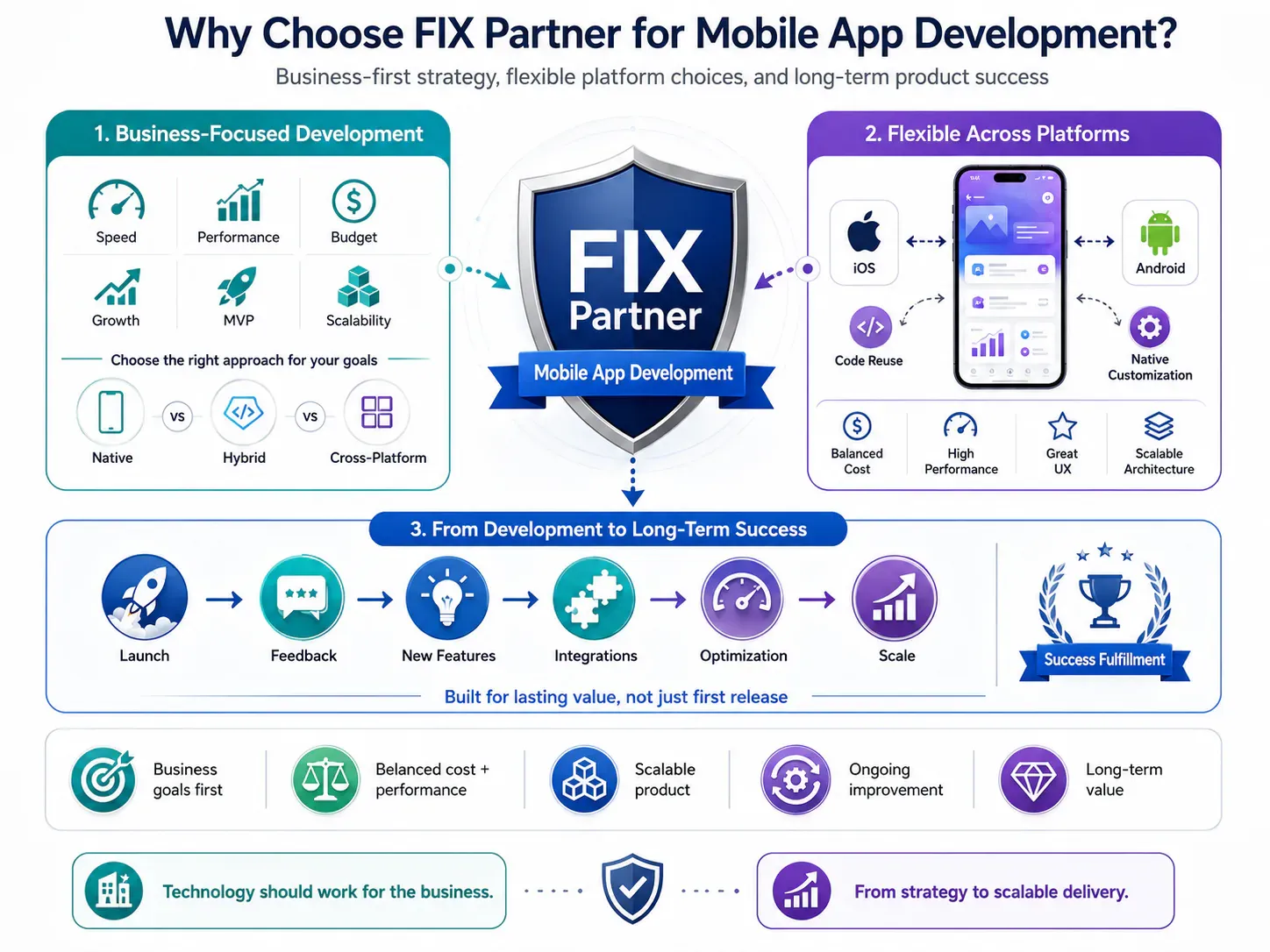
FIX Partner approaches mobile app development from a business perspective. Instead of recommending a technology simply because it is familiar or popular, the focus is on understanding what the application needs to achieve and selecting an approach that supports those goals.
Business-Focused App Development
Every business has different priorities.
One company may need maximum performance. Another may prioritize a fast MVP launch. A growing business may need to control development costs while preparing its application for future expansion.
FIX Partner can evaluate these priorities and help determine whether native, hybrid, or cross-platform development is the most appropriate direction.
The objective is not to make technology the center of the project. The objective is to make technology work for the business.
Flexible Development Across Platforms
Supporting multiple platforms does not always mean building two completely separate applications.
Depending on the product requirements, a shared development approach can help reduce duplicated effort while still providing room for platform-specific customization.
FIX Partner can help businesses assess where code reuse makes sense and where native capabilities may provide additional value.
This creates a more practical approach to balancing development cost, performance, user experience, and scalability.
From Development to Long-Term Success
A mobile application should not be viewed as a one-time development project.
As customers provide feedback, markets change, and business requirements evolve, the application may need new features, performance improvements, integrations, and ongoing optimization.
That is why the development approach should be capable of supporting the product beyond its initial launch.
FIX Partner focuses on Success Fulfillment, helping customers achieve their goals and realize their potential through solutions designed for lasting value and satisfaction.
Final Thoughts: Choose Based on Business Value
The comparison of native vs hybrid vs cross-platform app development does not have a single answer.
Native development offers maximum platform-specific performance and customization, making it suitable for demanding applications. Hybrid development can provide a cost-effective and fast route for simpler products. Cross-platform development offers a practical balance for businesses that want to support multiple platforms while controlling development effort.
The best approach is the one that aligns technology with the business.
Before making a decision, consider your product complexity, target users, budget, timeline, performance requirements, and long-term growth plans.
If you are still unsure which approach fits your application, FIX Partner can help you evaluate the options and build a mobile solution around your business goals, not simply around technology.
Talk to FIX Partner about the right app development approach for your business.