Vietnam vs India vs Philippines: Offshore Cost Comparison
Compare Vietnam, India, and the Philippines for offshore software development, including costs, technical skills, communication, and vendor selection.
Choosing an offshore development destination involves more than finding the lowest developer rates. Your business also needs to consider technical expertise, communication, project quality, and the long-term costs of maintaining a software product.
On this page
Vietnam, India, and the Philippines are established outsourcing destinations in Asia, but each has different strengths. India offers extensive engineering capacity, the Philippines has a strong English-speaking services workforce, and Vietnam provides established software development capabilities and dedicated team options.
When comparing Vietnam vs India vs Philippines offshore development, the best choice depends on your project requirements, budget, and internal management capabilities.
This guide compares offshore development costs, technical skills, communication, and delivery considerations to help your business make an informed decision.
1. Vietnam vs India vs Philippines: Key Differences
Each country has developed a distinct outsourcing ecosystem. Understanding these differences helps your business identify suitable providers rather than relying on general market reputation.
Vietnam: Software Engineering and Product Development
Vietnam has become an established destination for businesses seeking custom software development, mobile applications, web platforms, and ongoing product maintenance.
Its outsourcing market includes providers offering dedicated engineering teams, project-based development, and specialist support.
Vietnam may be suitable when your business needs to:
- Develop web applications, mobile products, or SaaS platforms.
- Extend an existing engineering team.
- Maintain and improve software over multiple releases.
- Combine development, testing, and technical support.
However, technical capabilities and delivery quality vary between providers. Your business should evaluate relevant experience, communication practices, and team continuity before making a decision.
For additional context, explore our guide to software outsourcing in Vietnam.
India: Large Talent Pool and Enterprise Capabilities
India has one of the world's largest technology services industries, with extensive experience in enterprise software, cloud computing, system integration, and large-scale IT operations.
Its broad talent pool can support businesses requiring multiple development teams or specialised technical expertise.
India may be particularly relevant for:
- Complex enterprise software projects.
- Large engineering programmes.
- Cloud and data infrastructure development.
- Projects requiring several technical specialisations.
The main consideration is finding a provider whose delivery processes, communication, and available specialists match your requirements. A large workforce does not automatically guarantee consistent project outcomes.
Philippines: Communication and IT-Enabled Services
The Philippines has an established IT and business process management industry, including customer support, technical services, and business operations.
Its English-speaking workforce can be valuable for projects requiring frequent communication with international stakeholders.
The Philippines may suit businesses seeking:
- Customer-facing technical support.
- Application maintenance and service operations.
- Software testing and quality assurance.
- Technology services involving frequent business communication.
For engineering-intensive projects, your business should verify the vendor's actual software development experience rather than assuming broader IT-enabled service capabilities cover every technical requirement.
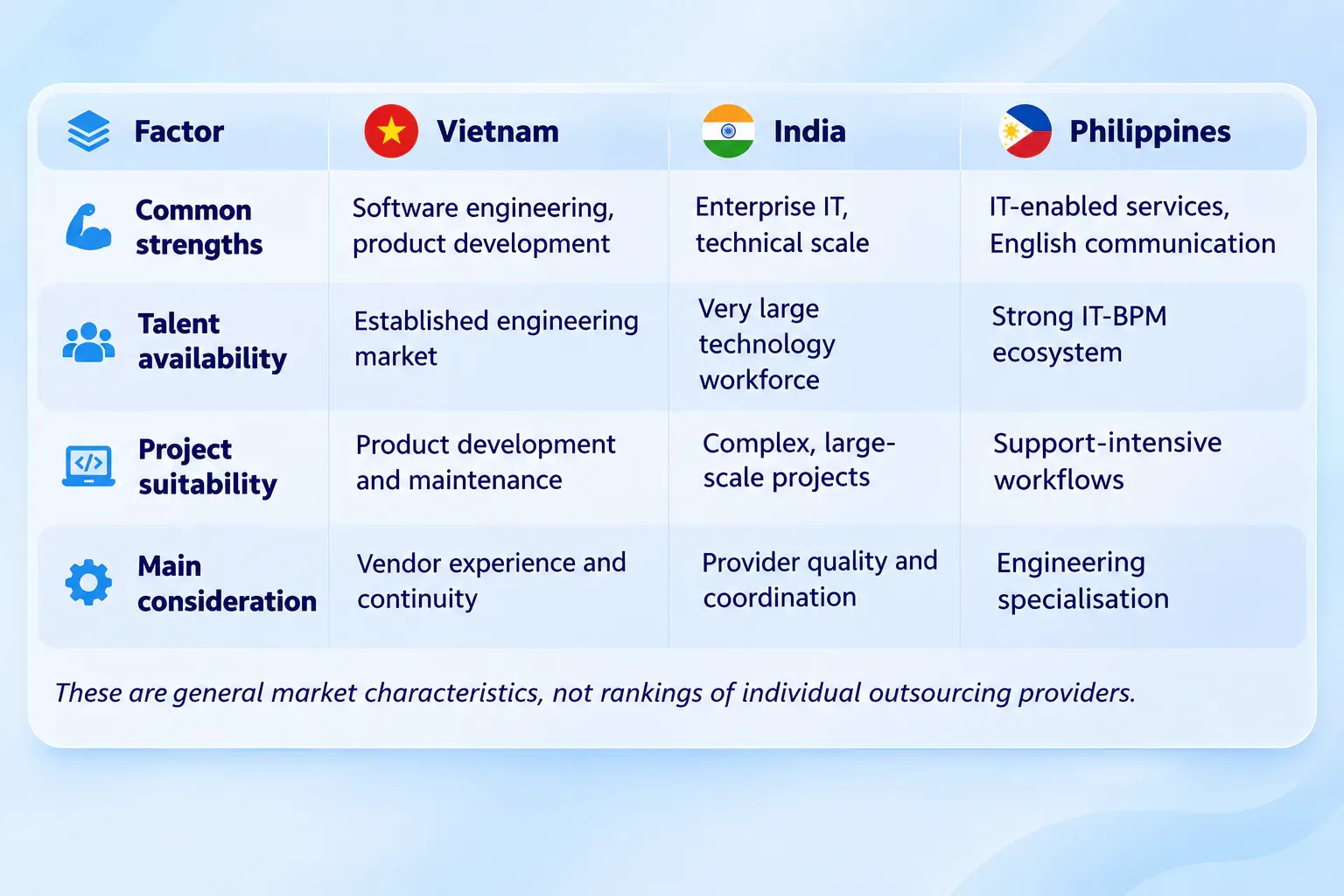
Key Differences at a Glance
While Vietnam, India, and the Philippines all offer offshore development opportunities, their strengths differ in technical capabilities, workforce availability, and service focus. The table below highlights the key considerations to help your business compare these destinations based on its project requirements.
2. Offshore Development Costs: Vietnam vs India vs Philippines
Cost is an important factor in offshore software development, but hourly rates alone do not represent the full investment required to deliver a project.
Your business should compare equivalent roles, working arrangements, and included services before deciding which destination offers better value.
How Much Does Offshore Development Cost in Each Country?
The Offshore Development White Paper 2025 provides a comparable reference for development costs across Vietnam, India, and the Philippines.
Its reported monthly rates include:
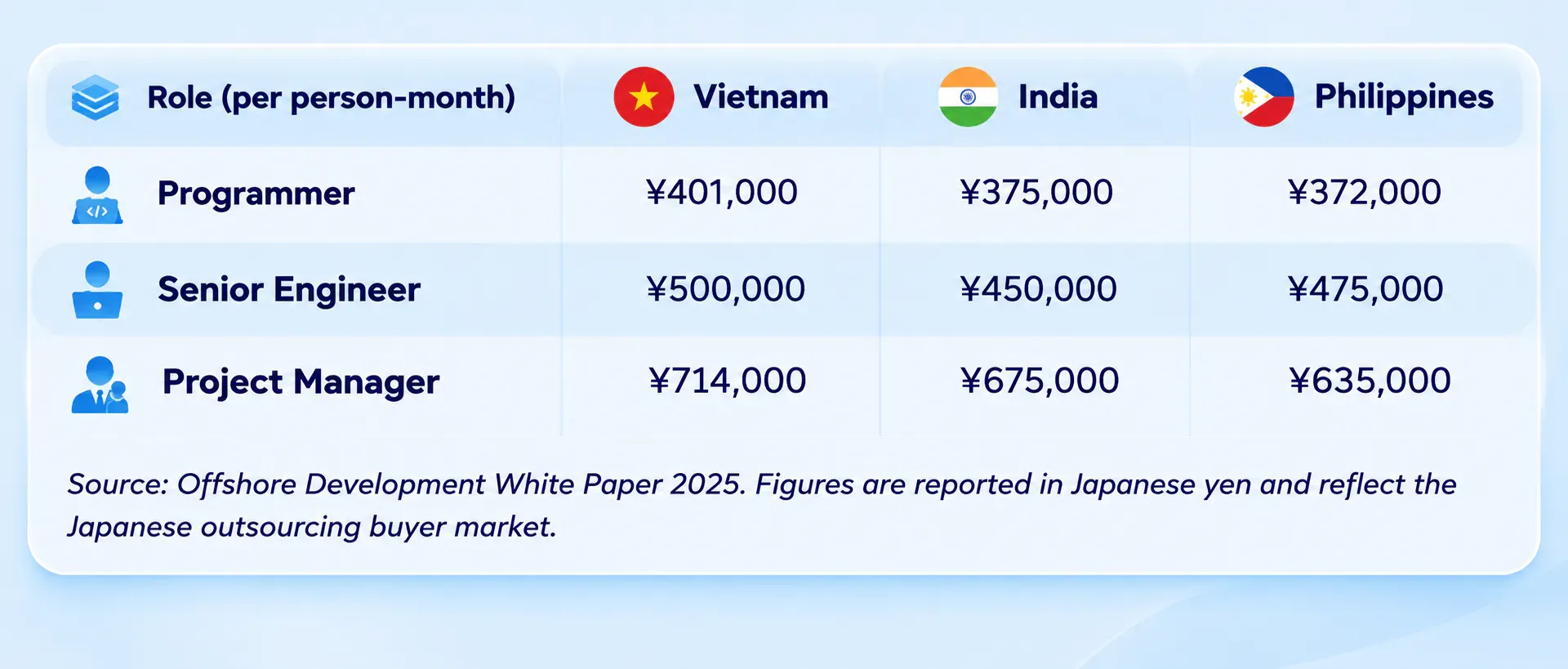
The data shows that India and the Philippines have lower average rates than Vietnam for these three roles within this particular survey.
However, these figures should not be treated as universal vendor quotations. Pricing depends on technical specialisation, experience, project complexity, and contractual arrangements.
For your business, the useful comparison is not which country has the lowest published average, but which provider can deliver the required outcome within an acceptable total budget.
FIX Partner's Offshore Development Rate Card
For a concrete Vietnam-based pricing example, FIX Partner's Rate Card provides indicative hourly and monthly rates for engineering and supporting roles.
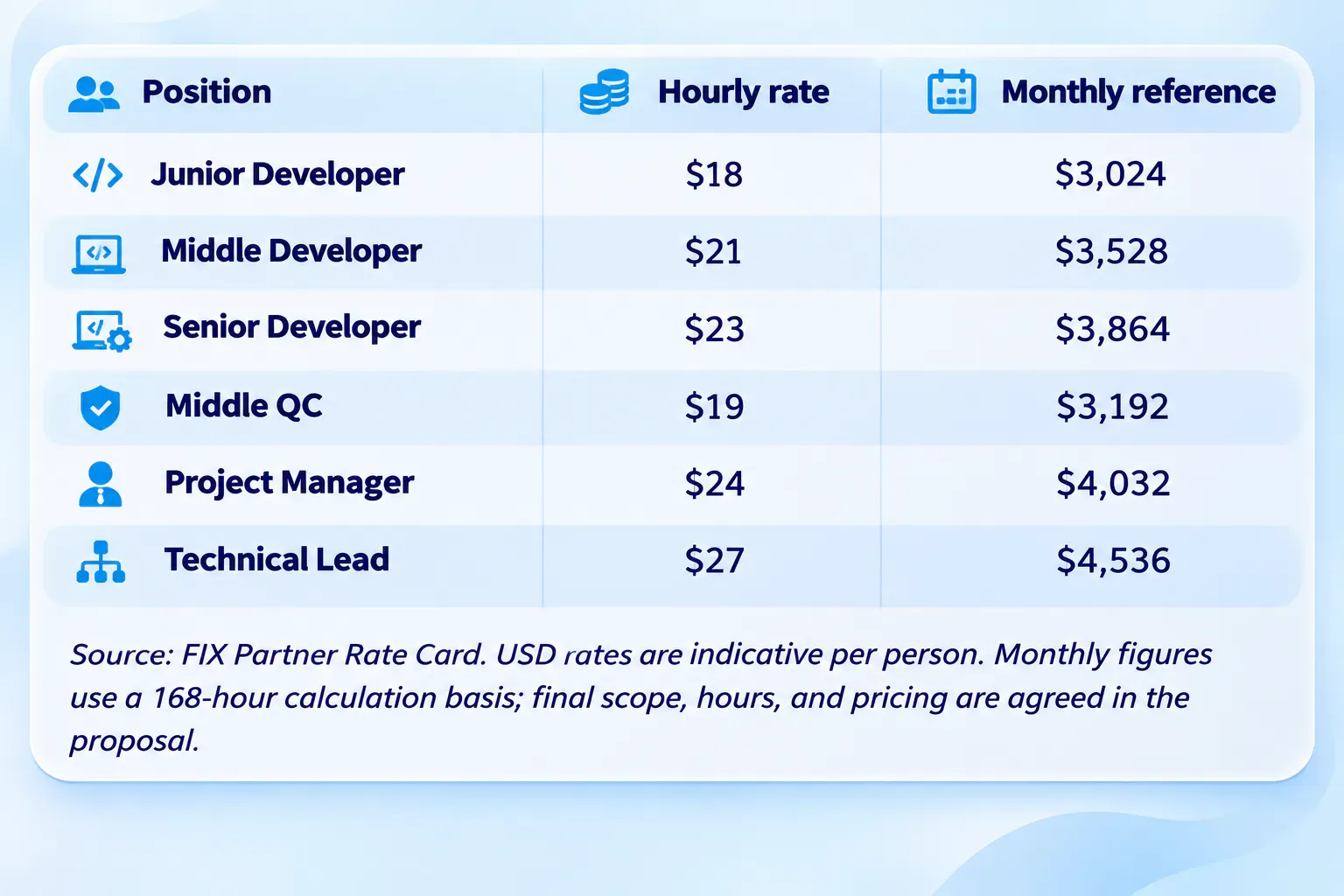
For example, a business developing a web application might consider:
- One Middle Developer: $3,528/month.
- One Senior Developer: $3,864/month.
- One Middle QC: $3,192/month.
Illustrative monthly personnel cost: $10,584.
This estimate covers the three specified roles only. Project management, infrastructure, software licences, and other requirements may involve additional costs.
FIX Partner also publishes indicative project starting prices:
- Technical Pilot: From $2,000.
- Proof of Concept (PoC): From $5,000.
- MVP Development: From $8,000.
These are separate project options, not cumulative development stages. Final pricing depends on the agreed deliverables and technical requirements.
Why Total Development Cost Matters More Than Hourly Rates
A lower hourly rate does not necessarily lead to a lower project cost.
For example, one vendor may charge less for development but require your internal team to manage testing, coordination, and technical documentation. Another may include broader delivery responsibilities at a higher rate.
When evaluating quotations, consider the complete cost of:
- Development and technical specialists.
- Quality assurance and project management.
- Internal coordination and approval activities.
- Changes, rework, and additional requirements.
- Maintenance, handover, and ongoing support.
Comparing equivalent responsibilities and deliverables gives your business a clearer view of overall value.
3. Compare Technical Skills, Communication, and Team Stability
Pricing provides an initial financial comparison, but the success of an outsourcing engagement also depends on how effectively the external team works with your business.
Match Technical Skills to Your Project Requirements
Different projects require different engineering capabilities.
India may offer advantages when your business needs specialists across multiple technology disciplines or sufficient capacity for a large enterprise programme.
Vietnam is worth considering for custom software, digital products, dedicated development teams, and ongoing application improvements.
The Philippines may be a suitable option when technical delivery is closely connected with application support, testing, or customer-facing operations.
Rather than assuming one country is technically superior, review each shortlisted vendor's relevant projects, technologies, and proposed team composition.
Evaluate English Communication and Time-Zone Compatibility
Clear communication helps your business explain requirements, review progress, and resolve issues before they affect delivery.
According to the EF English Proficiency Index 2026, the Philippines scored 565, Vietnam 489, and India 479.
These country-level scores provide general context, not a direct assessment of the engineers or project managers who would work with your business.
During vendor evaluation, assess whether the proposed team can explain technical decisions clearly, understand business requirements, and communicate potential problems.
Time zones also influence collaboration:
Country
| Time zone
|
|---|---|
Vietnam
|
UTC+7
|
India
|
UTC+5:30
|
Philippines
|
UTC+8
|
For businesses in Asia-Pacific, all three destinations provide opportunities for working-hour overlap. European and North American companies may need scheduled meetings and asynchronous updates.
The practical question is whether the proposed working arrangement supports timely decisions.
Assess Team Retention and Project Continuity
Developer turnover can disrupt delivery when project knowledge is concentrated in a few individuals.
Replacing an experienced engineer may require onboarding, knowledge transfer, and additional reviews of existing work.
Instead of relying only on national employee turnover statistics, your business should examine each vendor's actual continuity practices.
Questions to ask include:
- How is technical documentation maintained?
- What happens when a key developer leaves?
- Is backup capacity available for important roles?
- How are replacement engineers introduced to the project?
- Who remains accountable for delivery during personnel changes?
A structured handover process can help reduce disruption and protect long-term product knowledge.
4. How to Choose the Right Offshore Development Partner
There is no universally best offshore development country. Your business should evaluate destinations alongside the specific providers available within them.
A Practical Offshore Vendor Evaluation Checklist
Before selecting a partner, compare vendors using the same requirements and evaluation criteria.
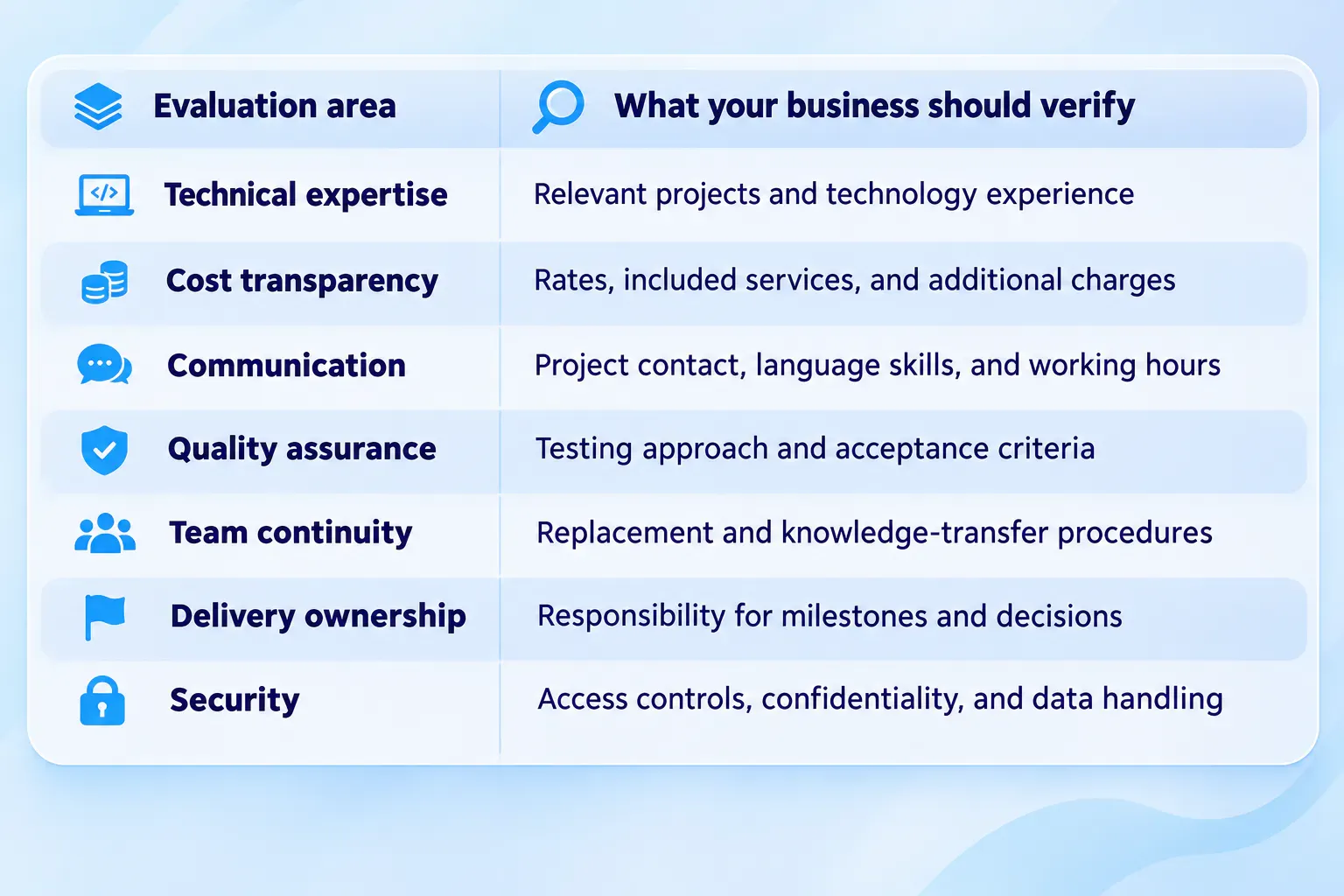
A consistent evaluation framework helps your business compare providers on delivery capability rather than pricing alone.
For higher-value or uncertain engagements, piloting vendors before long-term contracts can provide practical evidence of technical performance and collaboration.
How FIX Partner Supports Offshore Development in Vietnam
Choosing a destination is only one part of the outsourcing decision. Your business also needs a working arrangement that matches its technical requirements and internal management capacity.
At FIX Partner, we offer different engagement models depending on your project's scope and delivery needs:
- Dedicated Development Team: Supports ongoing development through an engineering team aligned with your product roadmap.
- IT Staff Augmentation: Adds technical specialists to your existing team while your business retains day-to-day management.
- Project-Based Outsourcing: Supports defined deliverables under agreed milestones and delivery responsibilities.
FIX Partner's published pricing provides a starting point for planning engineering capacity. The final proposal should clarify team composition, scope, project responsibilities, and commercial terms.
By reviewing these requirements before development begins, your business can select an engagement structure that reflects its budget and delivery expectations.
Conclusion
Comparing Vietnam vs India vs Philippines offshore development requires a balanced view of technical expertise, communication, team continuity, and total project costs.
India offers extensive technology capacity, the Philippines has a well-established English-speaking services ecosystem, and Vietnam provides software engineering and product development options.
Rather than choosing a destination solely by its average developer rate, your business should evaluate the actual provider, proposed team, and responsibilities included in the agreement.
Compare your offshore development options with FIX Partner to discuss an approach aligned with your project requirements, budget, and business priorities.
How FIX Partner can help
- Software Testing & QAManual, automated and AI-assisted testing for reliable releases.Explore Software Testing & QA
- Mobile App DevelopmentiOS, Android and cross-platform apps built to scale.Explore Mobile App Development
- Web App DevelopmentSecure, fast web applications and portals.Explore Web App Development
Written by
Hannah Huynh
Published by
FIX Partner
FIX Partner helps organizations design, build, test, and modernize software products with engineering, AI, data, and QA expertise.
About FIX Partner →Ask FIX Partner
Have a question about this topic?
Leave your details and a short note. Our team can help you identify a practical next step.
Related articles
Warehouse Management Software Benefits for Efficiency
Hannah HuynhNov 13, 20268 min read
Discover warehouse management software benefits beyond daily operations, including better business decisions, risk management, scalability, and growth.
Read more →
php2shell: Critical PHP Flaws Put Businesses at Risk
Hannah HuynhOct 23, 20266 min read
Learn how php2shell vulnerabilities could threaten PHP-powered businesses and discover practical steps to reduce security risks and improve software reliability.
Read more →
PHP Migration to Modern Programming Languages
Hannah HuynhOct 22, 20267 min read
Explore PHP migration to modern programming languages, compare alternatives, reduce risks, and build a secure, maintainable application for long-term business growth.
Read more →