Warehouse Management Software Benefits for Efficiency
Discover warehouse management software benefits beyond daily operations, including better business decisions, risk management, scalability, and growth.
As businesses expand into new markets, serve diverse customer groups, and manage complex supply chains, warehouse management becomes a strategic business priority. Beyond organizing daily operations, warehouse management software (WMS) helps companies make informed decisions, manage risk, adapt to new business models, and maintain stronger operational control. Understanding these broader warehouse management software benefits allows decision-makers to see WMS as a long-term investment that supports business resilience and competitiveness, not just a tool for managing warehouse activities.
On this page
1. Make Better Business Decisions Through Data-Driven Insights
Business decisions are only as reliable as the information behind them. When warehouse data is scattered across different departments or systems, managers may struggle to understand how operational activities affect overall business performance.
Warehouse management software can help address this challenge by turning warehouse-related information into useful business insights.
Understand Business Performance More Clearly
A WMS can collect and organize information about warehouse activities, product movement, demand patterns, and historical transactions. When combined with other business data, this information helps managers understand broader operational trends.
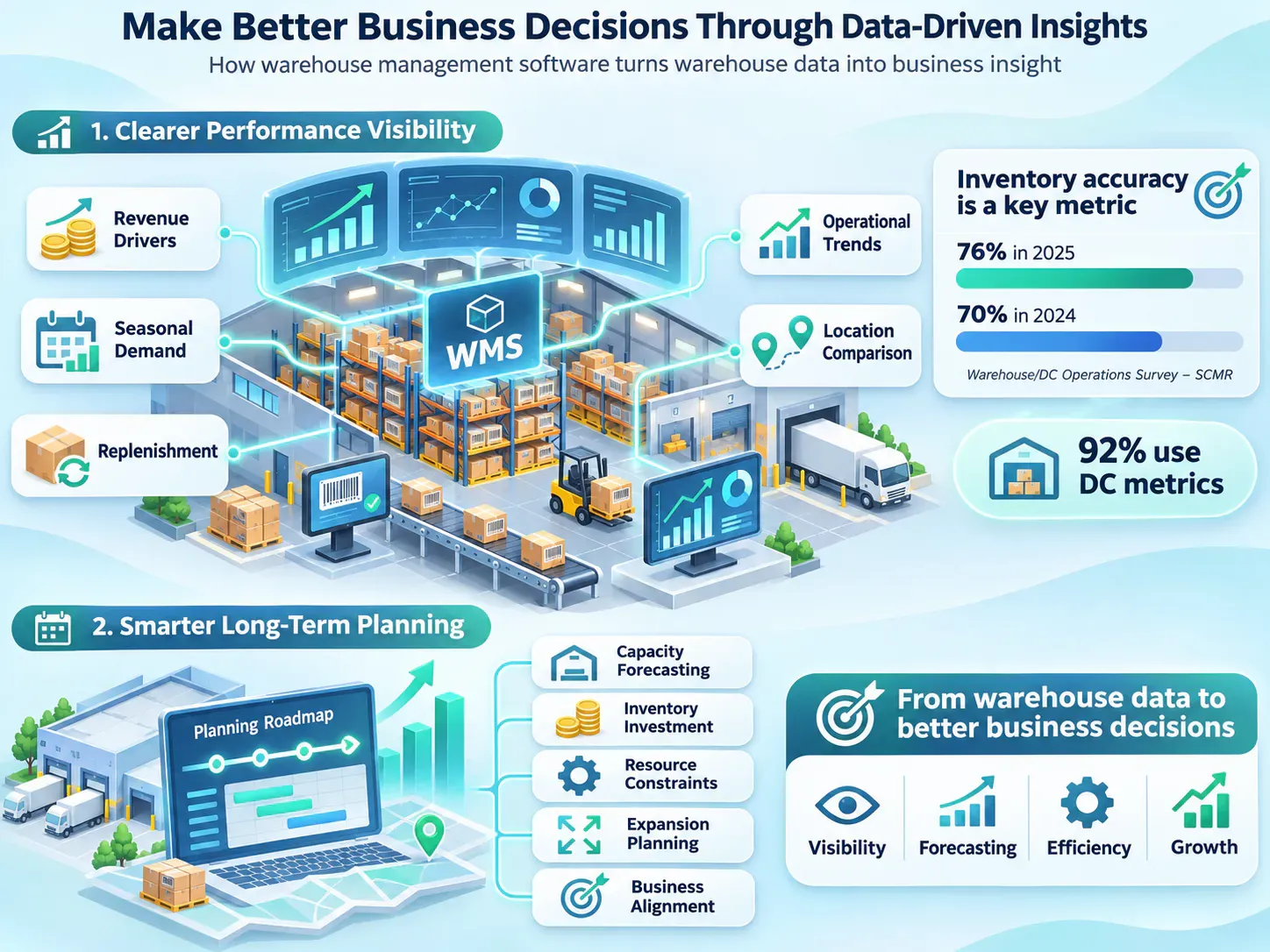
The growing importance of inventory visibility is also reflected in industry research. According to the Warehouse/DC Operations Survey published by Supply Chain Management Review, 76% of respondents reported using inventory accuracy as a key distribution center performance metric, compared with 70% in 2024. This highlights the importance of reliable inventory information in monitoring warehouse performance, identifying discrepancies, and supporting more informed operational decisions.
For example, a company may notice that certain products experience seasonal demand fluctuations or that particular product categories require more frequent replenishment.
These insights can support decisions such as:
- Identifying products that contribute most to business revenue.
- Understanding seasonal changes in customer demand.
- Evaluating purchasing and replenishment strategies.
- Identifying trends that may affect future business performance.
- Comparing operational results across different periods or locations.
Instead of relying entirely on assumptions or historical habits, managers can make decisions based on more structured information.
Improve Long-Term Business Planning
Planning for business growth requires an understanding of current capabilities and future requirements.
For example, a retailer preparing for a major expansion needs to consider whether its existing warehouse network can support additional product categories, new sales channels, and changing customer demand.
Warehouse management software can provide information that supports these discussions.
Managers can use historical data and operational trends to:
- Estimate future warehouse capacity requirements.
- Plan inventory investments more carefully.
- Identify potential resource constraints.
- Evaluate expansion opportunities.
- Align warehouse planning with broader business objectives.
This makes WMS valuable not only for warehouse managers but also for business owners, financial planners, and senior decision-makers.
2. Strengthen Business Resilience and Manage Operational Risks
Unexpected disruptions can affect almost every part of a supply chain. Supplier delays, transportation problems, sudden demand changes, and system failures may create challenges that extend beyond the warehouse itself.
Businesses need to prepare for these situations rather than simply react when problems occur.
One important warehouse management software benefit is its ability to support better risk awareness and business continuity planning.
Identify Potential Risks Earlier
When businesses depend heavily on manual records and disconnected information sources, identifying potential problems can take considerable time.
A WMS can help provide a more structured overview of warehouse activities and highlight situations that require management attention.
For example, managers may use system information to identify:
- Unusual changes in product movement.
- Repeated discrepancies in warehouse transactions.
- Products approaching expiration dates, where applicable.
- Operational patterns that indicate potential supply shortages.
- Unusual activity that requires further investigation.
These insights help businesses investigate potential issues earlier and make more informed decisions about corrective actions.
It is important to note that software does not eliminate supply chain risks. However, better information can help organizations recognize vulnerabilities and respond more systematically.
Support Business Continuity During Disruptions
Business continuity means maintaining essential activities even when unexpected events affect normal operations.
For companies operating multiple warehouses or distribution centers, having access to consistent operational information can support coordination when circumstances change.
For example, if one warehouse becomes temporarily unavailable, management may need to review available resources and consider alternative arrangements.
A well-designed WMS, supported by appropriate system backups and recovery procedures, can contribute to this process.
Businesses can benefit from:
- More structured operational records.
- Better coordination between warehouse locations.
- Clearer procedures for handling unexpected situations.
- Easier access to relevant information during operational reviews.
- More consistent communication between responsible teams.
By preparing for potential disruptions, businesses can improve their ability to maintain operations and protect long-term customer and supplier relationships.
3. Support Business Expansion and Omnichannel Growth
Business growth often introduces new operational requirements. A company that initially sells through physical stores may eventually expand into eCommerce, wholesale distribution, or international markets.
Although these opportunities create new revenue potential, they also increase the complexity of managing different sales channels and business relationships.
Warehouse management software can help businesses build a more adaptable operational foundation.
Adapt to Changing Business Models
Different business models create different warehouse requirements.
For example:
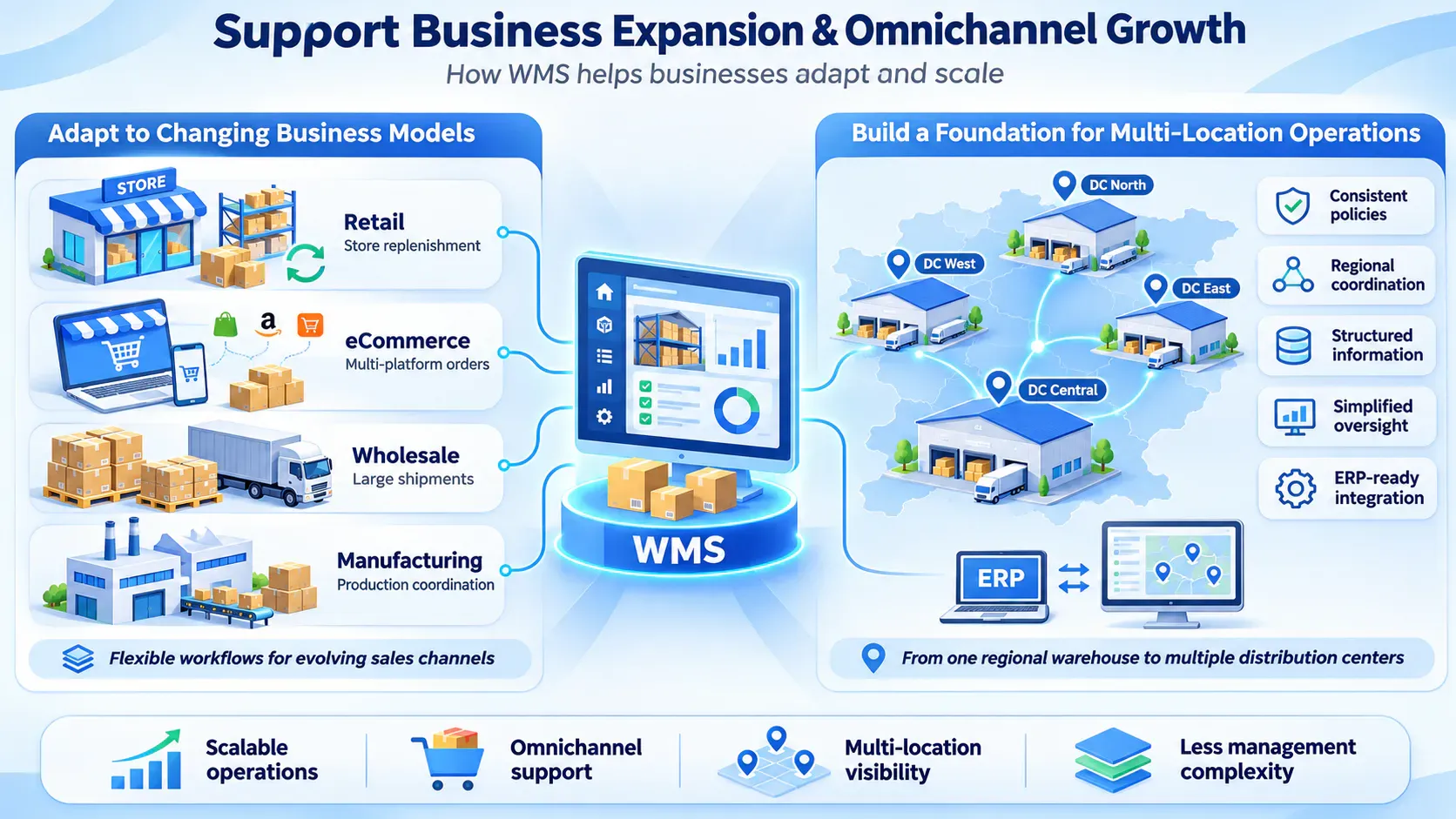
- Retail businesses may need to support regular store replenishment and seasonal product demand.
- eCommerce businesses may experience fluctuating order volumes across multiple online platforms.
- Wholesale companies may handle larger shipments and different delivery arrangements.
- Manufacturers may need to coordinate finished goods with production schedules and distribution requirements.
As business models evolve, warehouse processes may also need to change.
A flexible WMS can support these changing requirements by allowing businesses to configure workflows and operational rules according to their needs.
This reduces the need to redesign every warehouse process whenever the company introduces a new sales channel or expands its product portfolio.
Build a Foundation for Multi-Location Operations
Expanding into new regions may require businesses to operate several warehouses, distribution centers, or fulfillment facilities.
Without a coordinated technology environment, managing these locations independently can make it difficult for management to maintain a consistent view of the overall business.
A WMS with suitable multi-location capabilities can help organizations establish more standardized processes across different facilities.
Potential advantages include:
- Applying consistent operational policies across warehouse locations.
- Supporting coordination between regional facilities.
- Maintaining more structured information across business units.
- Simplifying management oversight as the organization expands.
- Supporting future integration with ERP and other enterprise platforms.
For example, a retailer expanding from one regional warehouse to several distribution centers can benefit from having a more consistent technology framework.
The result is a business operation that can adapt to growth without introducing unnecessary management complexity.
4. Improve Accountability, Traceability, and Business Control
As organizations become larger, maintaining accountability becomes increasingly important. Business owners need to understand how decisions are made, who is responsible for specific activities, and whether internal procedures are being followed.
These requirements are particularly relevant to companies operating in industries where product history, handling records, and regulatory documentation matter.
Establish Clearer Operational Accountability
In a warehouse environment involving multiple employees, departments, and management levels, unclear responsibilities can make it difficult to investigate problems.
Depending on the system's capabilities, WMS can maintain transaction histories and user activity records.
This information can help businesses understand what happened during a particular process and identify where further investigation may be necessary.
For example, managers may review system records to understand:
- Which user performed a specific transaction.
- When a particular activity was recorded.
- Whether an operational change followed established procedures.
- Where an unexpected discrepancy originated.
- Which processes may require additional internal controls.
Having clearer records supports accountability and helps management evaluate whether internal policies are being followed consistently.
Support Compliance and Business Transparency
Some industries require businesses to maintain detailed records about product origins, handling procedures, expiration dates, or distribution activities.
This is especially important in sectors such as food and beverage, pharmaceuticals, healthcare supplies, and manufacturing.
Depending on the business requirements and system configuration, warehouse management software can support documentation and traceability by maintaining relevant transaction histories.
Businesses may benefit from:
- More organized product-related records.
- Easier access to historical transaction information.
- Better preparation for internal reviews and audits.
- More consistent documentation across operational processes.
- Improved visibility into relevant product handling activities.
However, a WMS alone does not guarantee regulatory compliance. Companies still need appropriate policies, employee training, security controls, and procedures that meet applicable industry requirements.
When implemented as part of a broader business control framework, the software can make information management more structured and transparent.
FIX Partner: Supporting Your Business with Reliable Software Solutions
Adopting warehouse management software is a strategic investment that requires careful consideration of business requirements, system reliability, and long-term adaptability.
FIX Partner supports businesses in improving software quality through professional software testing and quality assurance solutions.
Our services help organizations build more reliable digital products while ensuring that software functions according to business and technical expectations.
By partnering with FIX Partner, your business can benefit from:
- Mobile Automation Testing: Automate repetitive testing activities to improve testing efficiency and reduce manual effort.
- Software Quality Assurance: Identify potential defects and verify that applications meet defined quality requirements.
- Improved Software Reliability: Detect issues earlier in the development process to reduce the risk of unexpected software problems.
- Optimized Testing Processes: Help development teams improve testing workflows and make better use of available resources.
- Flexible Testing Support: Adapt testing approaches to different project requirements, application complexity, and business growth.
Whether your business is developing a new warehouse management platform or upgrading an existing system, software quality plays an important role in supporting reliable digital operations.
With FIX Partner as your technology partner, you can strengthen software quality, improve development efficiency, and build digital solutions that support your long-term business objectives.
Conclusion: Look Beyond Warehouse Operations
The value of warehouse management software goes beyond managing daily warehouse activities. It can help businesses make informed decisions, prepare for disruptions, support expansion, and strengthen operational accountability.
By considering these strategic warehouse management software benefits, business owners can make better technology investments and build a stronger foundation for sustainable growth.
Looking to improve your software quality?
Contact FIX Partner to explore reliable software testing solutions for your business.
Written by
Hannah Huynh
Published by
FIX Partner
FIX Partner helps organizations design, build, test, and modernize software products with engineering, AI, data, and QA expertise.
About FIX Partner →Ask FIX Partner
Have a question about this topic?
Leave your details and a short note. Our team can help you identify a practical next step.
Related articles

AI Agent Systems: How Business Software Is Evolving
Hannah HuynhSep 26, 202610 min read
Explore AI agent systems and how they transform business software through intelligent automation, dynamic decision-making, software development, and workflow orchestration.
Read more →
php2shell: Critical PHP Flaws Put Businesses at Risk
Hannah HuynhOct 23, 20266 min read
Learn how php2shell vulnerabilities could threaten PHP-powered businesses and discover practical steps to reduce security risks and improve software reliability.
Read more →
Shift Left, Shift Right, AI Shift: FIX Partner’s Agile QA
Hannah HuynhSep 10, 2026
Explore FIX Partner’s Agile QA with Shift Left, Shift Right, and AI Shift to improve software quality, test automation, and continuous testing.
Read more →