PHP Migration to Modern Programming Languages
Explore PHP migration to modern programming languages, compare alternatives, reduce risks, and build a secure, maintainable application for long-term business growth.
On this page
PHP has powered websites and business applications for decades. However, as business requirements evolve, some organizations find their existing PHP applications increasingly difficult to maintain, extend, or integrate with newer technologies. For these businesses, PHP migration can be an opportunity to modernize their systems and build a stronger foundation for future growth.
Migrating to another programming language is a significant investment. Businesses must consider not only technical capabilities but also development costs, team expertise, application reliability, and long-term maintenance. Understanding the available alternatives and choosing the right migration strategy can help organizations make decisions that support their business goals.
Why Businesses Consider PHP Migration
PHP remains a practical choice for many websites and applications. However, older systems may rely on outdated versions, complex code, or dependencies that make development slower and maintenance more expensive.
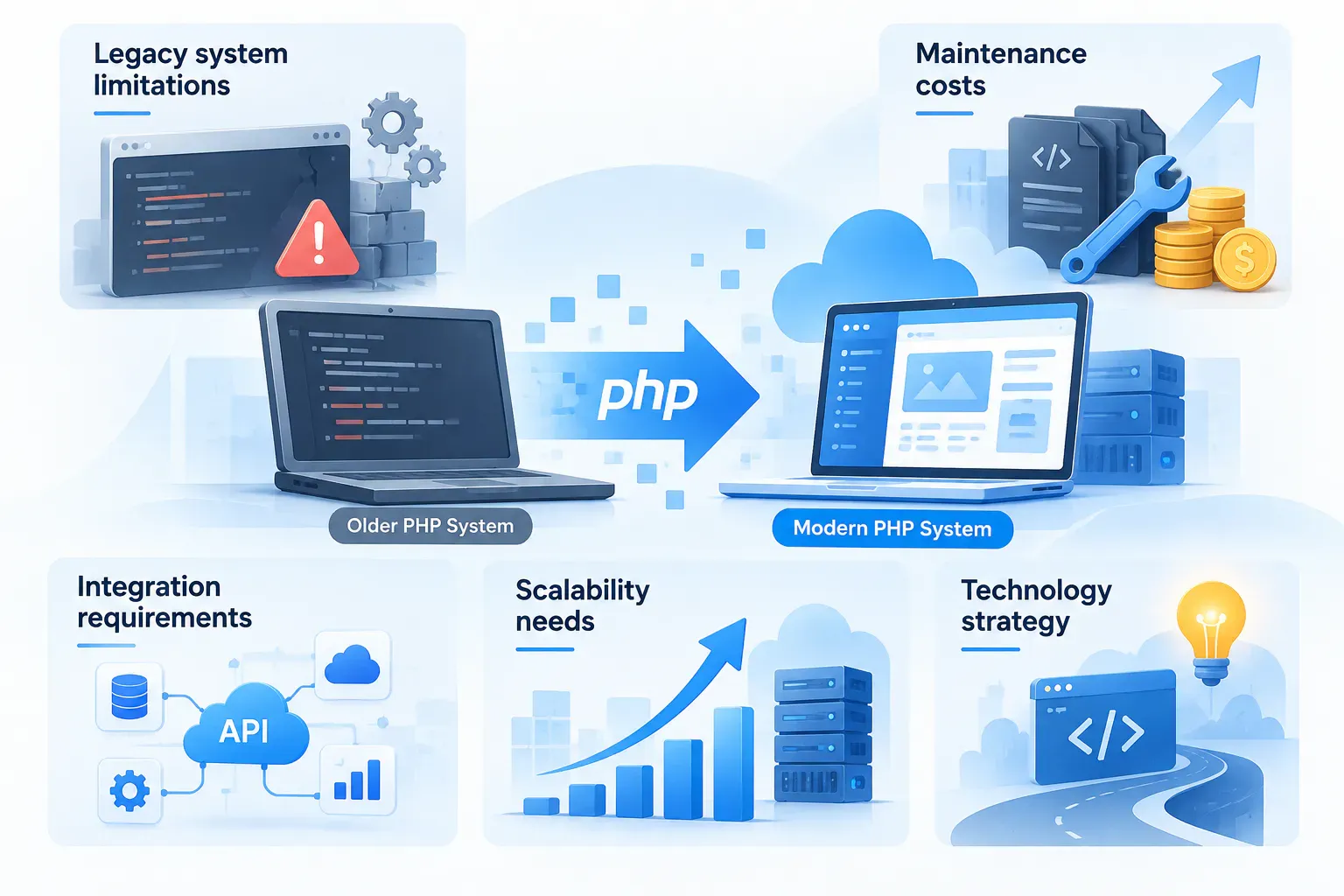
Businesses typically consider PHP migration for several reasons:
- Legacy system limitations: Older applications may be difficult to extend with new features or business processes.
- Maintenance costs: Complex code and limited documentation can increase the time required to fix issues and deliver improvements.
- Integration requirements: Businesses may need to connect their applications with modern APIs, cloud services, data platforms, or other enterprise systems.
- Scalability needs: Growing user demand and increasingly complex workflows may require changes to the application's architecture.
- Technology strategy: Organizations may prefer a language and ecosystem that better match their future product roadmap and development team's expertise.
Security is another important consideration. In October 2026, two critical PHP vulnerabilities known as PHP2Shell, identified as CVE-2026-109618 and CVE-2026-109619, highlighted the importance of maintaining supported software.
Both vulnerabilities received a severity score of 9.2 out of 10 and could allow attackers to execute code on affected servers without authentication. Automattic also confirmed that websites hosted on WordPress.com, WordPress VIP, WP Cloud, Pressable, and Tumblr were protected through its response to the vulnerabilities. Organizations managing their own PHP environments needed to ensure that the appropriate security updates were applied.
The official WordPress security announcement reinforces an important distinction: vulnerabilities in the PHP runtime cannot be resolved simply by updating WordPress, themes, or plugins. The underlying PHP environment must also be updated to a fixed version.
The PHP2Shell vulnerabilities also attracted attention from Japanese media. FNN covered the incident and its impact, providing additional context on why organizations need to take PHP security risks seriously.
These developments demonstrate why businesses should review their software lifecycle, security practices, and technology dependencies. However, PHP migration is not automatically the solution to every security issue. Updating PHP to a supported, patched version may be sufficient. Migration becomes more compelling when security concerns exist alongside broader limitations in maintainability, architecture, integration, or scalability.
Choosing the Right Programming Language for PHP Migration
The best replacement for PHP depends on what the business wants to achieve. Different programming languages offer different strengths, and the most popular option is not necessarily the most suitable one.
Python for Flexibility and Data-Driven Applications
Python is widely used for automation, data processing, artificial intelligence, and backend development. Its readable syntax and extensive library ecosystem can help teams develop and maintain applications efficiently.
Python may be a good fit for businesses expanding into data-driven services, automation, or AI-enabled features. However, teams should assess application performance, deployment requirements, and available expertise before choosing it for a large migration.
Java for Enterprise Applications
Java is commonly used for complex enterprise systems that require structured development practices and long-term maintainability. Its mature ecosystem makes it suitable for applications involving multiple business processes and integrations.
Businesses with large, mission-critical applications may consider Java when they need a consistent development structure. The trade-off is that migration can require significant planning, development resources, and testing, particularly when the existing PHP system contains extensive business logic.
JavaScript and Node.js for Web Applications
JavaScript with Node.js enables teams to use JavaScript across both frontend and backend development. This can simplify collaboration for teams already familiar with the language and may suit API-driven platforms or applications with real-time functionality.
However, businesses should evaluate architectural requirements, package dependencies, and maintenance practices to ensure the application remains reliable as it grows.
C# and .NET for Business Systems
C# and .NET provide a mature ecosystem for enterprise software, internal business applications, and systems that integrate with Microsoft technologies.
Organizations already using Microsoft infrastructure may find this option aligns well with their existing environment. As with other alternatives, the decision should account for migration costs, developer availability, and the complexity of the current application.
How to Compare Your Options
Before selecting a replacement, businesses should compare the available languages against practical business requirements.
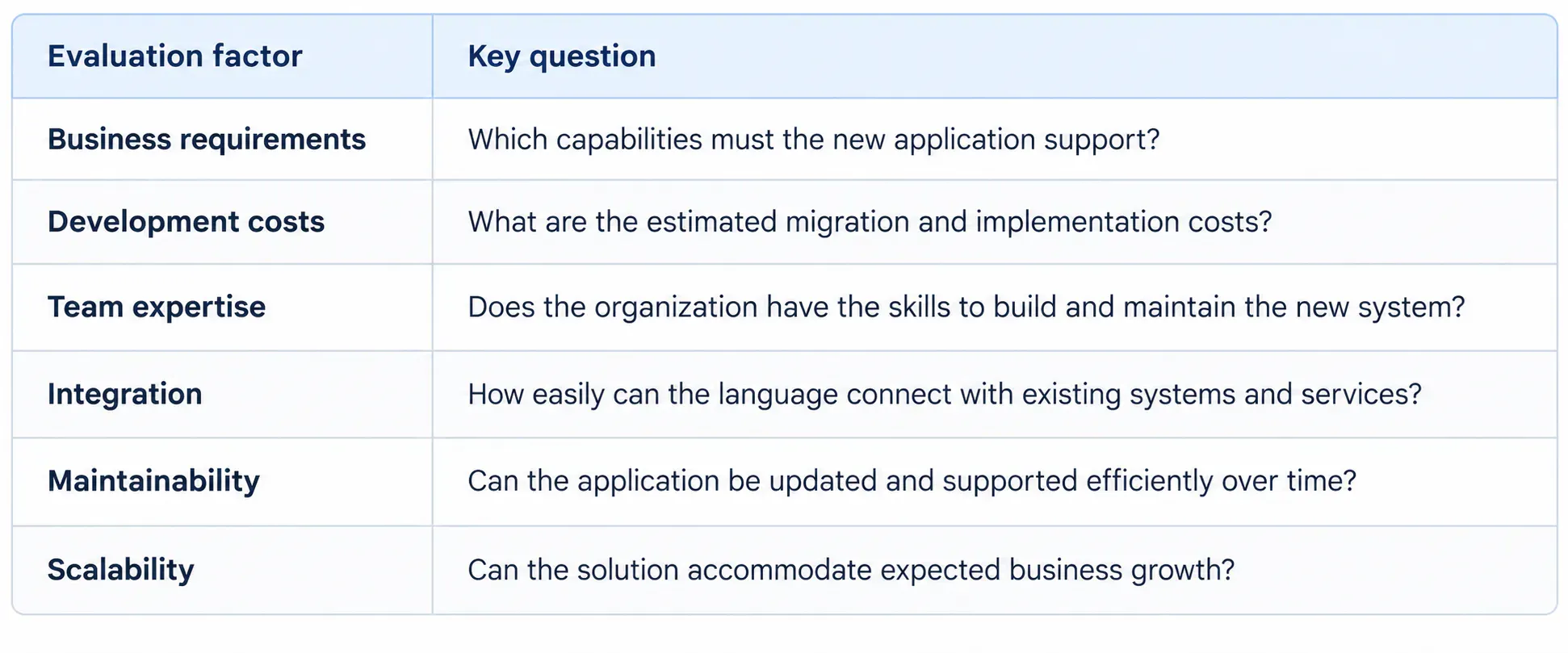
A complete rewrite is not always necessary. Some businesses may benefit more from upgrading PHP, improving the existing architecture, or gradually replacing selected components. The best decision is the one that addresses the underlying business problem while keeping costs and risks manageable.
How to Plan and Execute a Successful PHP Migration
Once a business has selected its target technology, the next challenge is moving the application without disrupting essential operations. A structured migration plan helps teams manage complexity and verify that the new system delivers the expected results.
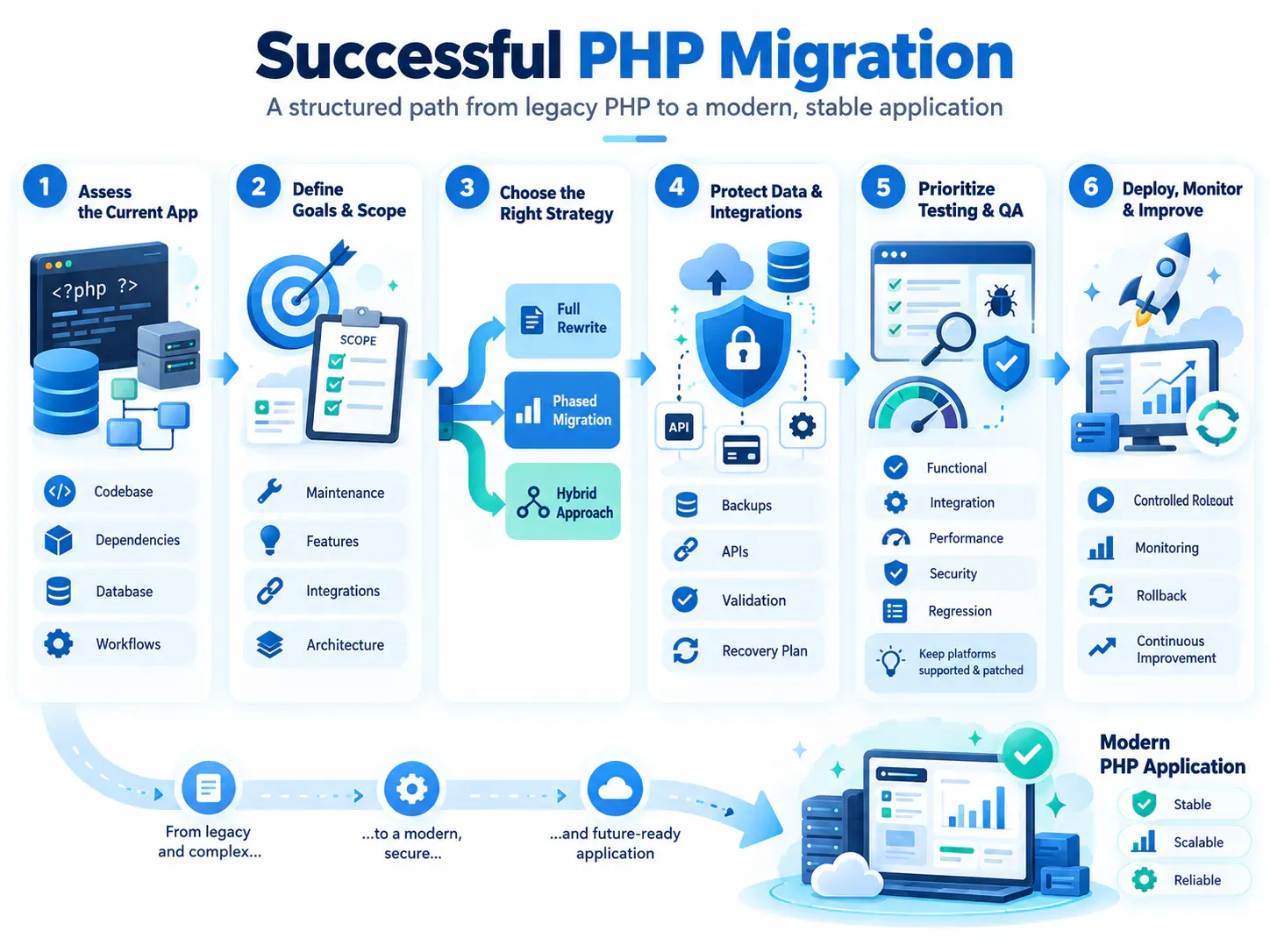
1. Assess the Existing Application
Review the current PHP version, codebase, dependencies, database structure, infrastructure, and third-party integrations. Identify the components that are hardest to maintain and document the business workflows that must continue working after migration.
This assessment helps determine whether a complete rewrite, a partial migration, or an upgrade within PHP is the most appropriate approach.
2. Define Clear Objectives and Scope
Establish measurable goals before development begins. These might include reducing maintenance effort, improving integration capabilities, supporting new product features, or addressing architectural limitations.
A clear scope also helps prevent unnecessary changes that increase project costs without delivering meaningful business value.
3. Choose a Migration Strategy
Businesses generally have three options:
- Full rewrite: Rebuild the application in a new language. This offers greater freedom to redesign the system but can require more time and resources.
- Phased migration: Replace selected components gradually. This can reduce disruption and allow teams to validate each stage.
- Hybrid approach: Retain suitable PHP components while introducing new technologies where they provide clear benefits.
The right strategy depends on application complexity, available resources, operational risk, and the urgency of the business requirements.
4. Protect Data and Integrations
Identify how the application interacts with databases, payment services, customer platforms, and internal systems. Plan data transfers, backup procedures, integration validation, and recovery options before changing production systems.
Businesses should also assign clear responsibilities to developers, project managers, and quality assurance teams.
5. Prioritize Testing and Quality Assurance
Testing is essential because even a technically successful migration can disrupt business operations if important workflows behave differently in the new application.
Key testing activities include:
- Functional testing: Verify that essential features continue to work correctly.
- Integration testing: Confirm that databases and connected services communicate as expected.
- Performance testing: Evaluate responsiveness and stability under anticipated workloads.
- Security testing: Check for vulnerabilities and verify that security controls remain effective.
- Regression testing: Ensure that changes have not broken existing functionality.
The PHP2Shell incident also demonstrates the importance of testing and maintaining the underlying technology, not just application code. Businesses should verify that PHP installations and other dependencies are supported and patched appropriately, even when planning a broader migration.
6. Deploy, Monitor, and Improve
Where possible, release the new application through a controlled rollout. Monitor errors, performance, integrations, and user feedback after deployment. A rollback plan can help teams respond quickly if critical problems emerge.
Migration should not be treated as a one-time activity. Ongoing monitoring, maintenance, and periodic reviews help ensure that the new technology continues to support business objectives.
How FIX Partner Supports Your PHP Migration Journey
PHP migration requires reliable testing and careful risk management to maintain application quality. FIX Partner supports businesses through software testing and quality assurance services, helping teams validate changes and reduce the risk of disruption.
- Quality Assurance and Testing: Verify critical functionality and identify defects before they affect users.
- Migration Risk Management: Help identify compatibility issues and integration risks throughout the transition.
- Application Reliability: Test important business workflows to support consistent application behavior.
- Business-Aligned Quality: Prioritize testing based on business requirements and the functionality customers depend on.
- Long-Term Software Quality: Support a quality-focused approach to application modernization and ongoing development.
Guided by its success fulfillment philosophy, FIX Partner focuses on helping customers achieve their goals and realize their potential for lasting fulfillment and satisfaction.
Conclusion
PHP migration can help businesses address legacy system limitations and prepare their applications for future requirements. Choosing the right programming language, however, requires more than comparing technical features. Organizations must consider business goals, migration costs, team capabilities, security, and long-term maintenance.
With a clear strategy and comprehensive testing, businesses can make informed modernization decisions and build applications that are better aligned with their future growth.
Planning your PHP migration?
Contact FIX Partner to explore software testing and quality assurance solutions that support a smooth, reliable transition.
Written by
Hannah Huynh
Published by
FIX Partner
FIX Partner helps organizations design, build, test, and modernize software products with engineering, AI, data, and QA expertise.
About FIX Partner →Ask FIX Partner
Have a question about this topic?
Leave your details and a short note. Our team can help you identify a practical next step.
Related articles
FIX Partner Showcases SEO-Ready Website Development
Hannah HuynhOct 17, 20267 min read
Explore FIX Partner’s web development showcase featuring SEO-ready websites built with SEO, AIO, AEO, and GEO to support visibility and user experience.
Read more →
AI Agent Systems: How Business Software Is Evolving
Hannah HuynhSep 26, 2026
Explore AI agent systems and how they transform business software through intelligent automation, dynamic decision-making, software development, and workflow orchestration.
Read more →
Enterprise Asset Management Solutions by FIX Partner
Hannah HuynhSep 24, 2026
Discover how FIX Partner delivers enterprise asset management solutions to streamline procurement, asset lifecycle management, testing, and compliance.
Read more →