EU Software Outsourcing: A Data Protection Due Diligence Checklist
Protect your EU business when outsourcing software development. Use this GDPR checklist to assess vendors, security, contracts, and data transfers.
Outsourcing software development can help your business access skilled teams, reduce costs, and accelerate delivery. However, when external developers handle customer records, employee information, or other personal data, data protection becomes an important part of vendor selection.
On this page
For EU businesses, choosing an outsourcing partner means understanding who can access your data, where it is processed, and how it will be protected.
This software outsourcing data protection checklist outlines the questions to ask, documents to request, and safeguards to review before signing a contract.
Understand Data Roles and Flows
Before evaluating a vendor, your business needs to understand how it will handle personal data throughout the project.
Identify Data Controllers and Processors
Under the General Data Protection Regulation (GDPR), a data controller determines the purposes and means of processing personal data, while a data processor processes that information on the controller's behalf.
For example, if your business hires an external team to maintain a customer management platform, your company may act as the controller and the outsourcing provider as the processor. Their actual responsibilities determine these roles.
Questions to ask your vendor:
- What personal data will your development team access?
- What processing activities will your team perform?
- Can development and testing use synthetic or anonymised data?
Documents to request: Data processing inventory and documentation defining each party's responsibilities.
Map Where Your Data Travels
Data protection involves more than identifying server locations. Developers outside the European Economic Area (EEA) may remotely access personal data stored within the EU.
Consider a business outsourcing the development and maintenance of its customer management platform.
Example: Data Flow in a Software Outsourcing Project
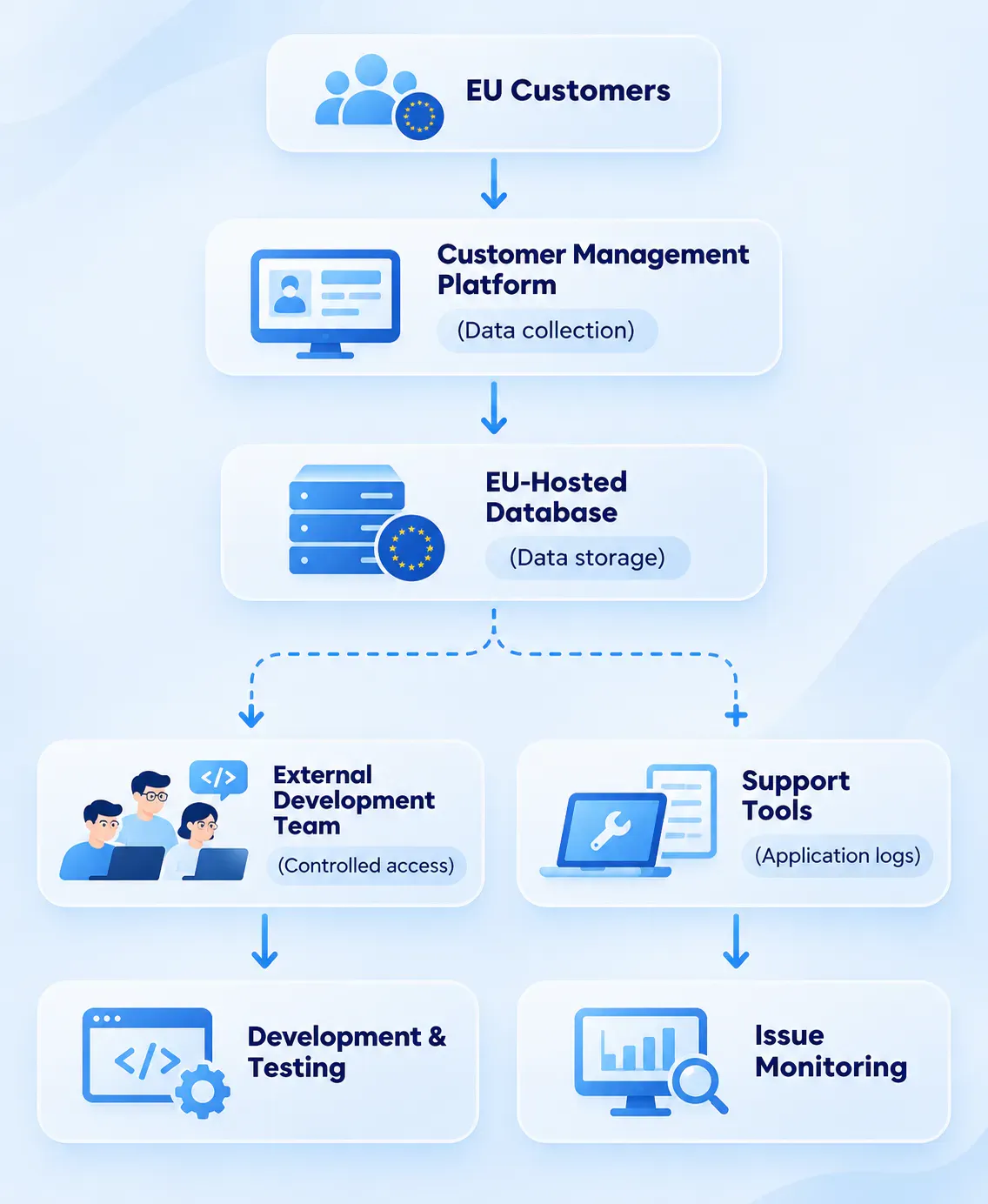
Illustrative example only. Actual data flows and international transfer requirements depend on the project, involved parties, and access arrangements.
This example helps your business identify potential access points and third-party involvement.
Documents to request: Data-flow diagram, hosting information, and system access overview.
Review Data Processing Agreements and International Transfers
Your contractual arrangements should reflect how the outsourcing provider processes and accesses personal data.
Check the Data Processing Agreement (DPA)
A Data Processing Agreement establishes obligations between a controller and processor where GDPR Article 28 applies.
Your procurement team should verify that the agreement addresses the project's actual processing activities.
Key DPA questions:
- Does the agreement define the purpose, duration, and nature of processing?
- Is personal data processed only under documented instructions?
- Are confidentiality and security obligations established?
- How will the vendor support breach notifications and data subject requests?
- What audit rights and compliance evidence are available?
Documents to request: Draft DPA, security measures annex, and incident response procedures.
Review International Data Transfer Mechanisms
Not every outsourcing project requires the same international transfer mechanism.
Where an arrangement involves a restricted transfer of personal data outside the EEA, GDPR Chapter V may require an applicable transfer mechanism or safeguard.
Depending on the circumstances, this could involve a European Commission adequacy decision, Standard Contractual Clauses (SCCs), or another legally available mechanism.
Questions to review:
- Does the delivery model involve a restricted international transfer?
- Which countries and organisations receive or access personal data?
- Is an applicable adequacy decision available?
- Are SCCs, a transfer impact assessment, or supplementary safeguards needed?
Documents to request: Relevant transfer assessment, adequacy documentation, and SCCs where applicable.
Your legal team should confirm the appropriate arrangements based on the actual data flows and applicable requirements.
Verify Subprocessors and Data Access Controls
An outsourcing provider may use additional companies or tools to deliver your project. Your business should verify their involvement and the controls governing access to personal data.
Review Subprocessor Arrangements
Subprocessors may include cloud hosting providers, monitoring platforms, support services, or subcontracted development teams.
Under GDPR Article 28, processors must obtain prior specific or general written authorisation before engaging subprocessors.
Questions to ask:
- Which subprocessors will handle our personal data?
- What services will they provide, and where will processing occur?
- How will we be informed about new subprocessors?
- Can we object to changes under the agreed terms?
Documents to request: Subprocessor register, processing locations, and authorisation terms.
Assess Security and Access Permissions
Developers may need access to application logs to resolve errors without requiring unrestricted access to customer records.
Your review should cover:
- Access control: Is access limited to authorised personnel?
- Authentication: Is multi-factor authentication used for sensitive systems?
- Monitoring: Are access activities recorded and reviewed?
- Testing: Is production data restricted or replaced with safer test data where possible?
- Incident response: Are security incidents reported through defined procedures?
Documents to request: Access control policies, relevant security assessment reports, and incident response plans.
Confirm Data Retention, Deletion, and Procurement Readiness
Data protection obligations continue throughout the outsourcing relationship, including when the contract ends.
Establish Data Return and Deletion Requirements
During development, personal data may appear in databases, backups, testing environments, or support records. Your agreement should define how this information will be handled after the project ends.
Questions to ask before signing:
- How will our data be returned?
- When will remaining copies be deleted?
- How will backups and legally required retention be handled?
- Can the vendor provide confirmation of deletion?
Where Article 28 applies, processor contracts must address returning or deleting personal data after services end, subject to applicable legal retention requirements.
Documents to request: Data retention policy, deletion procedures, and exit plan.
Software Outsourcing Data Protection Checklist
Use the following checklist to verify key requirements before approving an outsourcing vendor.
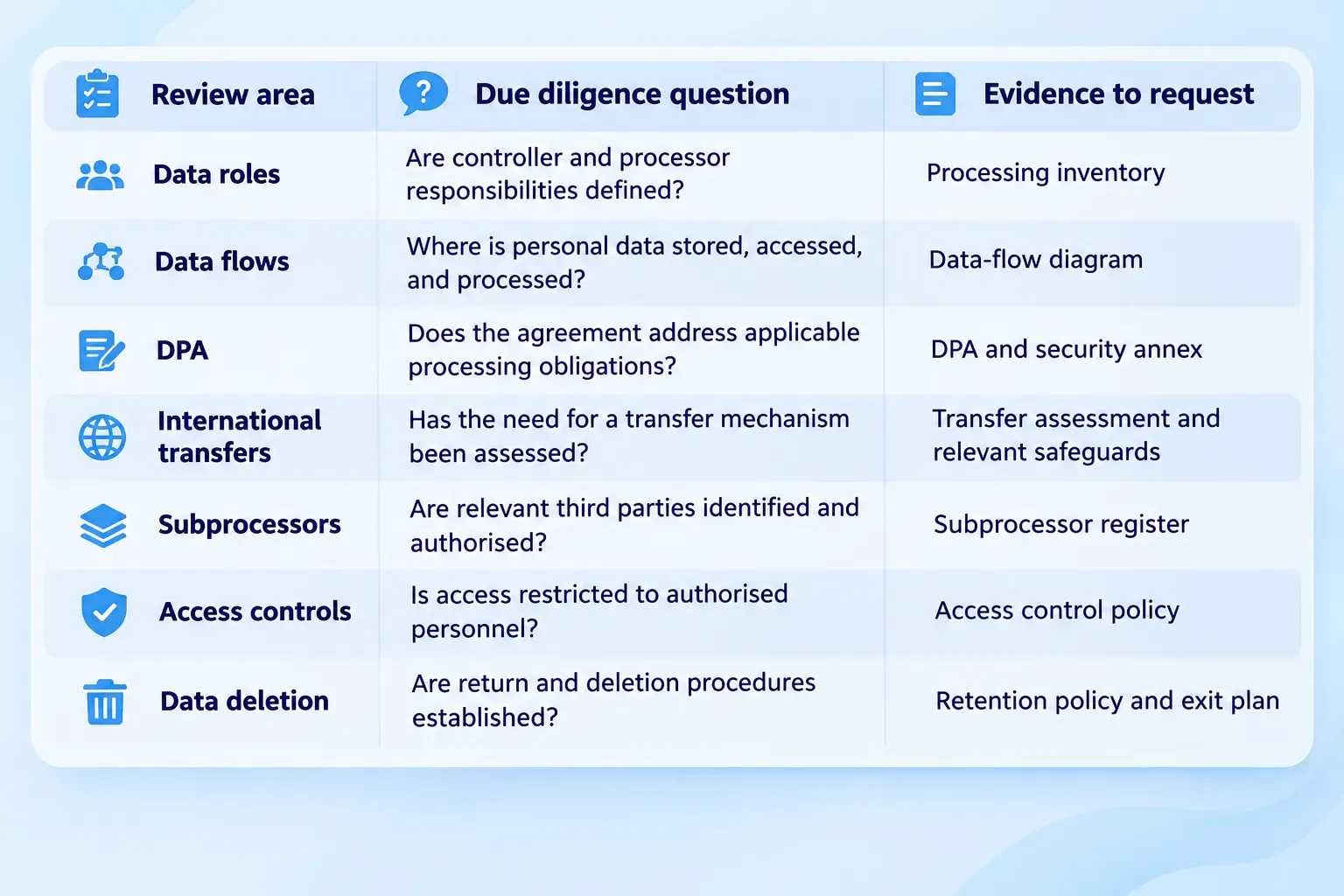
For each item, mark the evidence as Verified, Needs Clarification, or Outstanding. Resolve significant gaps before vendor approval.
The checklist should reflect your project's actual processing activities and risks rather than applying identical requirements to every outsourcing arrangement.
How FIX Partner Supports Your Software Outsourcing Requirements
Choosing an outsourcing partner involves more than technical expertise. Your business also needs clear delivery responsibilities and an understanding of how data requirements affect project execution.
Aligning Software Delivery With Your Data Requirements
Every outsourcing project has different operational needs. A team developing with synthetic test data may require different safeguards from one accessing live customer information.
At FIX Partner, we work with your business to clarify project requirements, define delivery responsibilities, and identify data protection considerations before development begins.
This includes understanding how data requirements may affect different aspects of project delivery:
- System access: Identify which systems external developers need to access and whether access to production data is necessary.
- Data handling: Determine whether synthetic or anonymised data can be used for development and testing instead of real customer information.
- Delivery responsibilities: Clarify who manages access permissions, coordinates data-related requests, and communicates changes during the project.
- Compliance coordination: Identify contractual and data protection requirements for your legal or compliance team to review.
Addressing these considerations early helps your business establish clearer expectations, reduce unnecessary data exposure, and coordinate more effectively with external development teams.
You can also explore our security and data protection practices to understand our approach to access controls, secure software development, and information protection.
Conclusion
A structured software outsourcing data protection checklist helps your business evaluate vendor responsibilities, contractual safeguards, security controls, and data handling procedures before making an outsourcing decision.
By reviewing the relevant documents and resolving outstanding concerns, your business can select a delivery approach that reflects its operational needs and data protection risks.
Review your delivery and data requirements with FIX Partner to discuss an outsourcing approach aligned with your business priorities.
How FIX Partner can help
- Dedicated Development TeamA long-term offshore team aligned to your roadmap.Explore Dedicated Development Team
- Digital ConsultingProcess, platform and product decisions.Explore Digital Consulting
- Custom Software DevelopmentSoftware built around your workflows and data.Explore Custom Software Development
Written by
Hannah Huynh
Published by
FIX Partner
FIX Partner helps organizations design, build, test, and modernize software products with engineering, AI, data, and QA expertise.
About FIX Partner →Ask FIX Partner
Have a question about this topic?
Leave your details and a short note. Our team can help you identify a practical next step.
Related articles
Why Human Resource Software Matters for Business Growth
Hannah HuynhOct 9, 2026
Discover how human resource software helps businesses streamline HR processes, improve workforce decisions, and support sustainable business growth.
Read more →
AI Speeds Up Development for Digital Product Delivery
Hannah HuynhAug 30, 2026
AI speeds up development by accelerating software delivery, boosting productivity, reducing repetitive tasks, and enabling smarter digital product development.
Read more →
Warehouse Management Software Benefits for Efficiency
Hannah HuynhNov 13, 20268 min read
Discover warehouse management software benefits beyond daily operations, including better business decisions, risk management, scalability, and growth.
Read more →