MVP for SaaS: From Idea to Scalable Business
Explore MVP for SaaS, from product validation and MVP development to scalable SaaS solutions that turn business ideas into market-ready products.
A promising software idea can be exciting, but turning that idea into a viable product requires more than software development. Businesses need to understand the customer problem, test assumptions, control investment, and create a product that can evolve as demand becomes clearer.
This is where an MVP for SaaS becomes valuable. A Minimum Viable Product gives businesses a practical way to test a SaaS product idea with real users before committing significant resources to a fully developed solution.
For companies planning to build a SaaS product, however, an MVP is only the starting point. As the customer base grows, the product may need subscription management, user permissions, integrations, analytics, security, and reliable cloud operations.
That makes SaaS Consulting & Development an important part of the journey. The right approach connects business validation with product strategy, UX design, software development, and long-term SaaS scalability.
Why an MVP for SaaS Matters Before Development
Many businesses try to build everything they believe customers might need. More features, however, do not necessarily create more value.
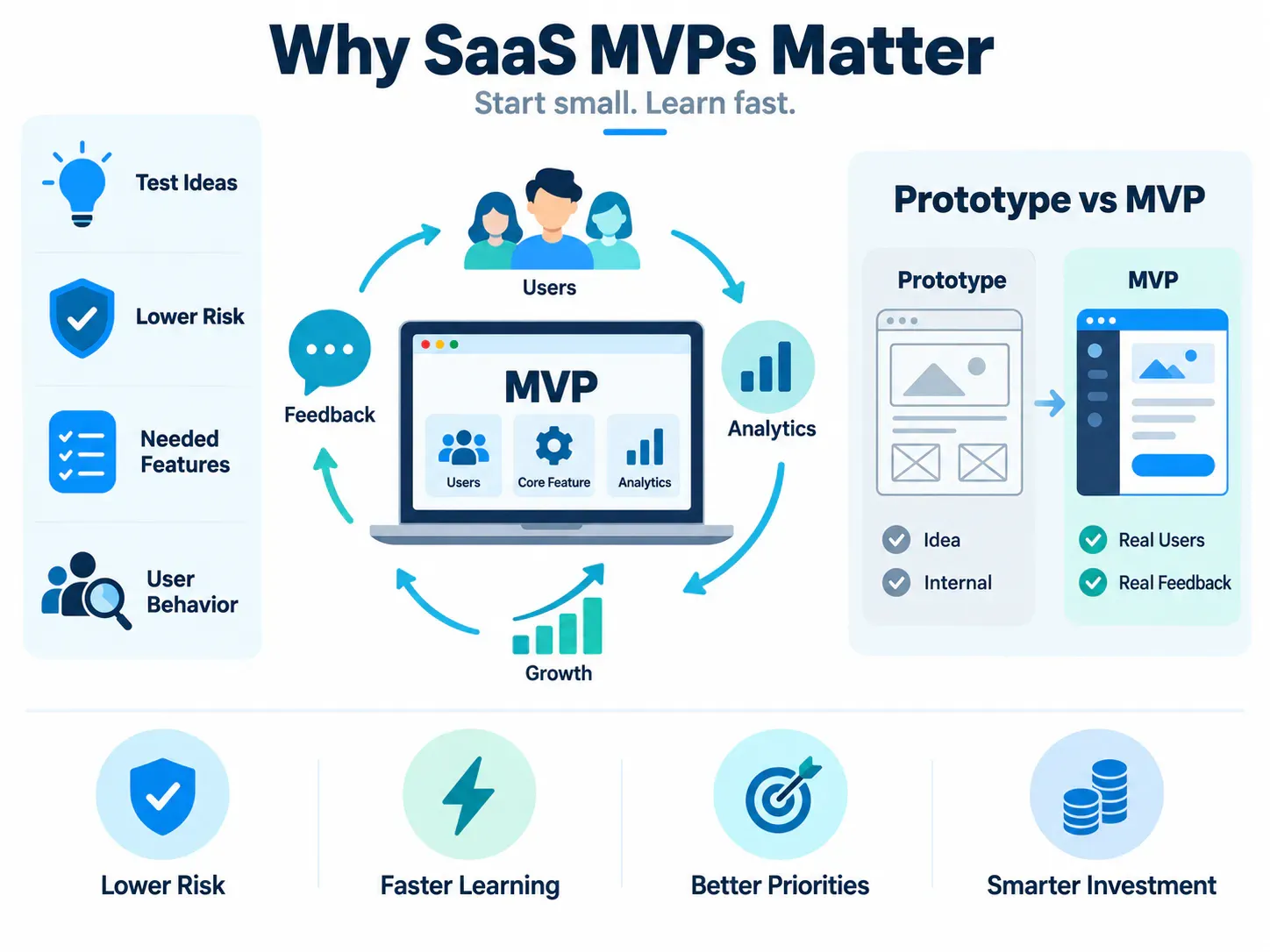
The purpose of an MVP for SaaS is to identify the smallest set of capabilities that can solve a meaningful customer problem and generate useful business insights.
Reduce uncertainty before increasing investment
Every new SaaS product starts with assumptions about customers, their problems, the proposed solution, and the business model.
MVP development allows these assumptions to be tested progressively instead of turning them into a large upfront investment.
Businesses can use the first release to understand:
- Whether the problem is important enough for customers to solve
- Which features customers actually need
- How users interact with the product
- Whether the solution delivers measurable value
- What should be prioritized in the next release
This evidence provides a stronger foundation for SaaS product development and future investment decisions.
An MVP is more than a prototype
A prototype demonstrates an idea or user experience. An MVP is a usable product that can reach real users and generate meaningful feedback.
This distinction is important because actual customer behavior may differ from internal expectations. Users may struggle with a workflow, ignore a feature, or find greater value in another part of the product.
A well-planned SaaS MVP development process makes those insights visible before the business invests heavily in additional functionality.
What SaaS Consulting & Development Should Cover
Once the business opportunity is clearer, the next challenge is turning the idea into a product that can be delivered, maintained, and improved.
SaaS Consulting & Development should therefore connect business objectives with product and technology decisions rather than focusing only on coding.
Define the product before defining the technology
Product discovery helps clarify the target audience, customer problem, value proposition, workflows, and constraints.
For non-technical business teams, this process translates broad requirements into practical product decisions.
The focus should be on:
- Target users and their critical needs
- Core customer journeys
- Business and product objectives
- Technical and operational constraints
- Risks that need early validation
This creates a clearer foundation for defining the MVP scope and planning the SaaS development roadmap.
Prioritize the MVP scope
A strong MVP for SaaS is not simply a product with fewer features. It is the smallest coherent solution capable of delivering value and generating useful learning.
Feature prioritization should consider customer impact, business value, development effort, dependencies, and the likely product roadmap.
A practical MVP plan should establish:
- Essential features and workflows
- Features for future releases
- Delivery milestones and budget
- Success metrics
- Key assumptions to validate
This helps prevent scope from expanding before the product has demonstrated sufficient market value.
Validate UX before development
UX/UI prototyping allows stakeholders and potential users to review important workflows before full SaaS development begins.
Wireframes, user flows, and interactive prototypes can reveal usability problems early, when changes are easier and less costly.
The goal is not to perfect every screen. It is to ensure that users can understand the product and complete the actions that matter.
Build a foundation that can evolve
An MVP should avoid unnecessary technical complexity while still providing a reliable foundation for future SaaS product development.
Depending on the product, this may include:
- Frontend and backend development
- APIs and third-party integrations
- Automated testing
- Security practices
- CI/CD and deployment
- Maintainable application and data structures
The principle is to prepare for realistic growth without building infrastructure for a scale the business has not yet demonstrated.
From SaaS MVP to a Scalable Product
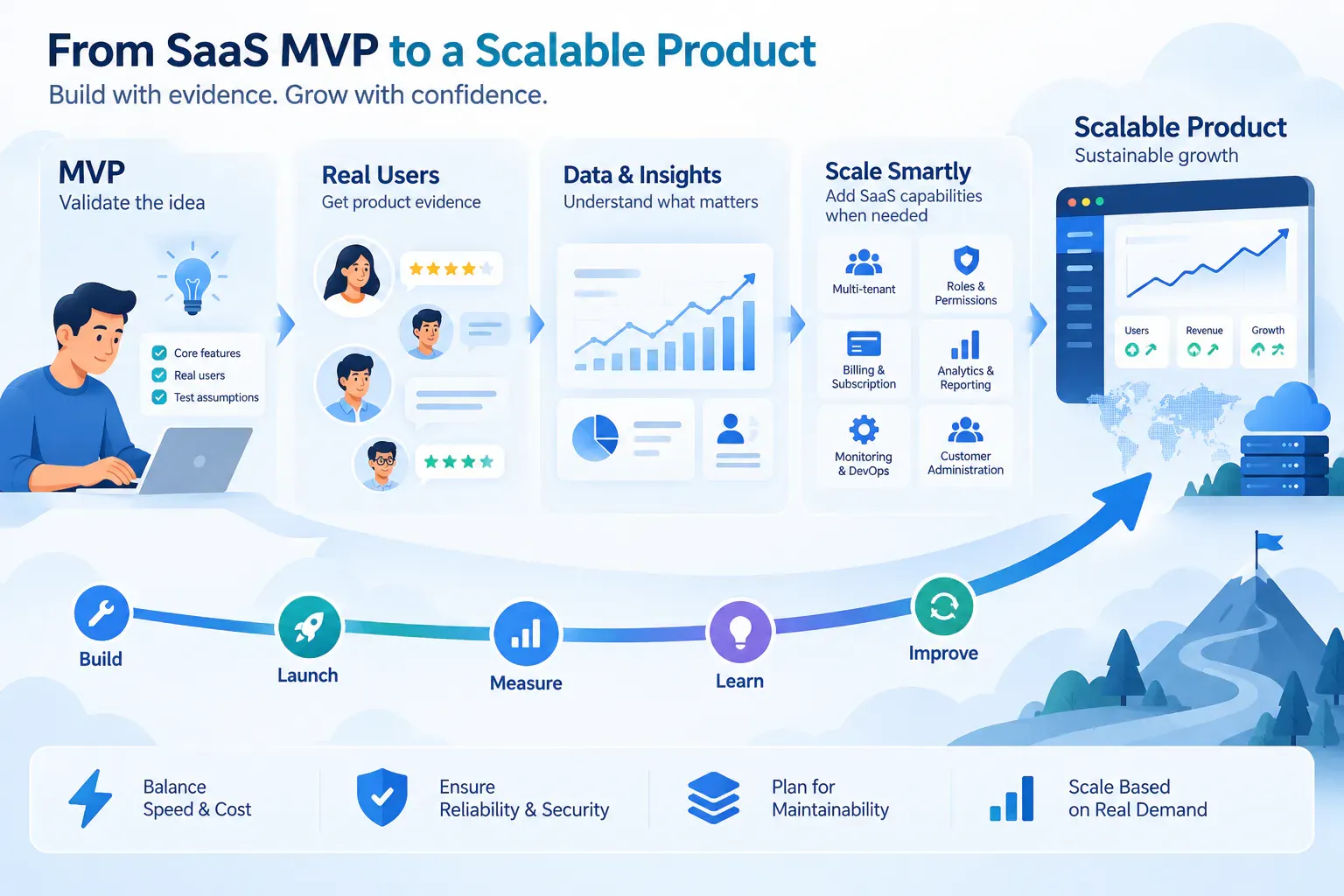
Once an MVP reaches real users, the business gains something it cannot get from planning alone: product evidence.
Customer feedback, usage patterns, feature adoption, and operational data can help determine where further investment should go.
When does an MVP need SaaS capabilities?
The transition from an MVP to a broader SaaS platform depends on the product's business model and customer requirements.
As more customers use the product, common requirements may include:
- Multi-tenant architecture
- User roles and permissions
- Subscription and billing management
- Customer administration
- Analytics and reporting
- Monitoring and automated deployment
These capabilities should be introduced when they support genuine business needs rather than simply because they are standard SaaS features.
Scale according to real demand
SaaS businesses need to balance growth expectations with development and infrastructure costs.
Building for an enormous customer base before demand exists can create unnecessary complexity. At the same time, ignoring future requirements entirely can make later expansion more difficult.
A practical SaaS development strategy makes growth assumptions explicit and evolves the platform as customer demand becomes measurable.
This helps businesses balance:
- Development speed
- Infrastructure cost
- Reliability
- Security
- Maintainability
Turn product data into the next roadmap
After launch, analytics can provide insight into activation, adoption, retention, feature usage, and customer behavior.
When combined with direct customer feedback, these signals can guide product priorities more effectively than assumptions alone.
The process becomes:
Build → Launch → Measure → Learn → Improve.
This creates a continuous product development cycle rather than treating the MVP as a one-time project.
Choosing the Right SaaS Development Approach
Not every business needs the same level of product support. The right approach depends on the product's maturity, business goals, and immediate development requirements.
Discovery Sprint
A Discovery Sprint is suitable when an idea still needs validation or clearer definition.
It can focus on product discovery, market assumptions, technical feasibility, MVP scope, risks, and an actionable development plan.
MVP Project
An MVP Project is appropriate when the business has a defined direction and needs to move toward a production-ready first release.
A typical MVP development engagement can combine product definition, UX/UI design, engineering, quality assurance, deployment, and initial support.
Dedicated Product Team
A Dedicated Product Team can support businesses with an evolving roadmap and ongoing product requirements.
Instead of treating each release as a separate project, the team can continuously develop and improve the SaaS product around longer-term business objectives.
SaaS Scale-Up
For an existing SaaS platform, priorities may shift toward reliability, security, architecture, integrations, cloud costs, analytics, or operational efficiency.
At this stage, SaaS Consulting & Development can focus on strengthening the platform while continuing to support existing customers.
How FIX Partner Supports MVP and SaaS Development
FIX Partner provides MVP & SaaS Consulting & Development across the product lifecycle, from product discovery and MVP strategy through UX/UI, engineering, SaaS development, and continuous improvement.
Its approach connects business objectives with practical product delivery rather than treating software development as an isolated technical activity.
From product idea to working product
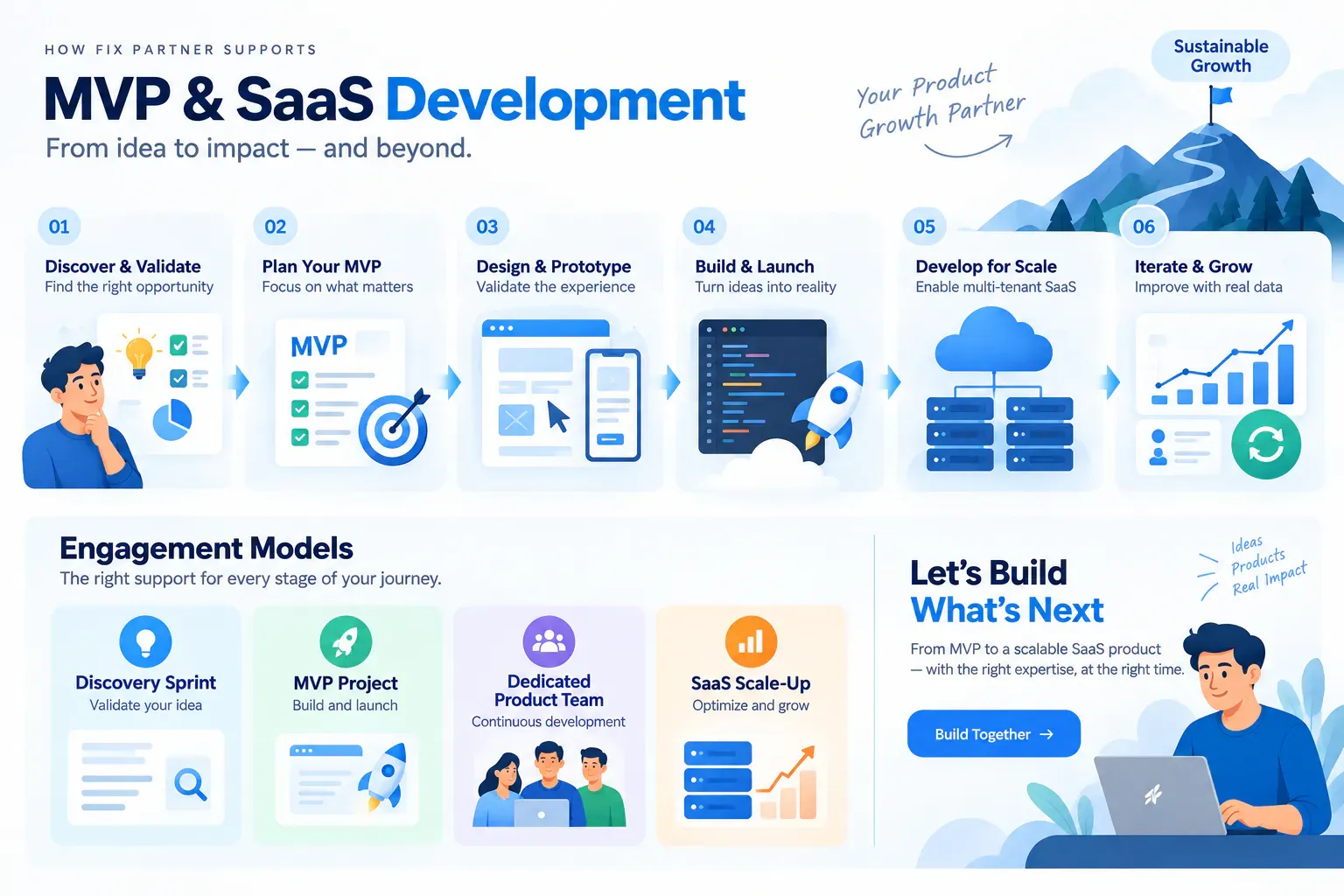
The service covers key stages such as:
- Product Discovery & Validation: clarify the opportunity, target audience, value proposition, feasibility, and risks.
- MVP Strategy & Scope: prioritize functionality, define the roadmap, and establish success criteria.
- UX/UI Prototyping: test important customer journeys before full development.
- MVP Engineering: develop and validate the first production-ready solution.
- SaaS Platform Development: introduce capabilities needed to support multiple customers and ongoing operations.
- Scale & Continuous Improvement: improve the product based on customer feedback and operational data.
This structure gives businesses a clearer path from an initial SaaS concept to a product that can evolve with market demand.
Engagement models for different product stages
FIX Partner offers several engagement options, including a Discovery Sprint, MVP Project, Dedicated Product Team, and SaaS Scale-Up.
The appropriate model depends on where the business is today:
- Idea stage: validate the opportunity and define the MVP.
- Ready to build: develop and launch the first product.
- Growing product: establish a team for continuous development.
- Existing SaaS: improve scalability, reliability, security, and operations.
This allows the development approach to evolve alongside the product instead of forcing every business into the same delivery model.
Conclusion
An MVP for SaaS gives businesses a practical way to validate an idea, learn from real users, and make informed product decisions before scaling their investment. With the right SaaS Consulting & Development approach, that initial product can evolve into a reliable and scalable SaaS solution.
Ready to turn your SaaS idea into a validated product?
Talk to FIX Partner about your MVP and SaaS development roadmap.