
Data Analytics Consulting in Singapore: From Data to Growth
Learn how Singapore businesses use data analytics consulting to improve decisions, automate reporting, manage risk, and build AI-ready data foundations.
Singapore businesses rarely suffer from a lack of data. The more common problem is that useful information remains divided among finance systems, CRM platforms, spreadsheets, operational tools, and customer applications.
Reports arrive late. Teams spend hours reconciling different numbers. Business leaders may have access to hundreds of metrics but still struggle to answer a simple question: What should we do next?
This is where data analytics consulting in Singapore can create meaningful business value.
Data analytics consulting connects business priorities with data strategy, engineering, business intelligence, governance, and advanced analytics. The objective is not to create more dashboards simply for the sake of reporting. It is to help decision-makers access trusted information, identify meaningful patterns, and turn insights into measurable business outcomes.
For organizations operating in Singapore and across APAC, the right approach must also account for system integration, data protection, cross-border operations, governance, and responsible AI adoption.
This guide explains what data analytics consulting involves, which services businesses typically need, where analytics can create value, and how to choose the right consulting partner.
What Is Data Analytics Consulting?
Data analytics consulting is a professional service that helps organizations turn fragmented business data into actionable insights and measurable outcomes.
A data analytics consultant looks beyond individual datasets or reporting tools. The engagement typically examines how information is collected, stored, integrated, governed, analyzed, and used in everyday decision-making.
Depending on the organization's goals and data maturity, a consulting engagement may include:
- Assessing data maturity and identifying high-value use cases
- Developing a data strategy and analytics roadmap
- Integrating data from CRM, ERP, finance, marketing, and operational systems
- Building data warehouses, lakes, pipelines, and reporting layers
- Creating executive dashboards and self-service business intelligence
- Improving data quality, ownership, lineage, access, and governance
- Developing forecasting, segmentation, anomaly detection, or recommendation models
- Preparing reliable data foundations for AI and automation
- Defining KPIs and measuring whether analytics initiatives create business value
The distinction between different analytics capabilities is also important.
Business intelligence generally helps organizations understand current and historical performance through dashboards, reports, and KPIs.
Data analytics goes further by examining patterns, relationships, trends, and potential causes within datasets.
Predictive analytics uses historical and current data to estimate what may happen next.
AI and machine learning can extend these capabilities into intelligent recommendations, anomaly detection, automation, and other advanced use cases.
A data analytics consulting partner helps determine which capabilities are actually appropriate instead of recommending technology simply because it is available.
Why Singapore Businesses Invest in Data Analytics Consulting
As organizations grow, spreadsheets and disconnected reports often become difficult to maintain. A business may have a CRM for customer information, an ERP for financial operations, separate marketing platforms, operational databases, and multiple spreadsheets used by different teams.
The result can be data silos, inconsistent KPIs, manual reporting, and slow decision-making.
Data analytics consulting can address these problems by creating a more connected approach to business information.
Make Faster Decisions With Trusted Information
Executives should not have to reconcile several versions of revenue, margin, inventory, or customer performance before making an important decision.
A governed analytics environment can establish consistent definitions for key metrics and make current information easier for decision-makers to access.
Instead of asking: "Which report is correct?" leadership teams can focus on: "What does the data tell us, and what should we do about it?"
Reduce Manual Reporting and Operational Friction
Many teams still spend significant time exporting files, cleaning spreadsheets, matching records, and preparing recurring reports.
Data integration and reporting automation can reduce repetitive work and allow employees to spend more time interpreting information and taking action.
The objective is not to eliminate human decision-making. It is to remove unnecessary manual work around collecting and preparing information.
Identify Revenue and Customer Opportunities
When customer, sales, product, and transaction data can be analyzed together, businesses can identify patterns that may not be visible in individual systems.
Analytics can support:
- Customer segmentation
- Churn analysis
- Cross-sell opportunities
- Product performance analysis
- Customer journey analysis
- Demand forecasting
These insights can help sales, marketing, product, and service teams prioritize opportunities based on evidence.
Improve Forecasting and Risk Visibility
Historical and real-time data can support forecasting, scenario analysis, operational monitoring, anomaly detection, and risk management.
For example, organizations may use analytics to identify unusual transaction patterns, forecast demand, monitor operational performance, or detect potential problems before they become larger issues.
Predictive analytics should support accountable human decisions rather than operate as unexplained recommendations.
Build a Reliable Foundation for AI
AI initiatives depend heavily on the quality and accessibility of the underlying data.
Before launching an AI project, organizations need to understand whether their data is relevant, accurate, accessible, appropriately governed, and suitable for the intended use case.
Singapore's PDPC Model AI Governance Framework emphasizes areas such as data quality, accountability, transparency, robustness, and security when organizations develop and deploy AI systems.
This means that data analytics and AI readiness should often be considered together, rather than as completely separate technology projects.
Core Data Analytics Consulting Services
An effective engagement connects strategy with implementation. The exact combination of services depends on the organization's business priorities, existing systems, data maturity, and technical capabilities.
Data Strategy and Maturity Assessment
A data analytics project should start with business objectives rather than technology.
A consultant can assess:
- Business goals
- Existing data sources
- Reporting processes
- Technology systems
- Data quality
- Governance practices
- Team capabilities
- Current analytics maturity
The result should be a prioritized roadmap rather than a generic list of technologies.
A practical roadmap should define use cases, dependencies, owners, risks, KPIs, implementation priorities, and expected business outcomes.
Data Engineering and Integration
Data engineering makes information usable at scale.
Businesses may need to connect cloud applications, databases, ERP and CRM platforms, APIs, legacy systems, and operational applications.
Depending on the environment, data engineering can involve:
- Data pipelines
- APIs
- ETL/ELT processes
- Data warehouses
- Data lakes
- Lakehouse architectures
- Data transformation
- Data quality processes
The architecture should reflect actual requirements for data volume, latency, resilience, security, and cost. Not every organization needs a complex big-data platform.
Business Intelligence and Dashboard Development
Business intelligence consulting in Singapore can help organizations transform governed datasets into practical dashboards and reporting systems.
Effective dashboards should be designed around decisions rather than simply displaying as many metrics as possible.
A useful dashboard should help users answer:
- Which metric changed?
- Why did it change?
- Who owns the response?
- What action should follow?
Typical BI applications include:
- Executive performance dashboards
- Sales and marketing analytics
- Financial reporting
- Operational monitoring
- Inventory visibility
- Customer-service analytics
Data Quality and Governance
Analytics cannot be trusted when records are incomplete, definitions conflict, or access is poorly controlled.
Data governance establishes processes around:
- Data ownership
- Data quality
- Metadata
- Data lineage
- Access policies
- Retention
- Accountability
- Security
For Singapore businesses, governance should be considered alongside privacy and security requirements from the beginning rather than added after implementation.
Advanced Analytics, AI, and Automation
Once the data foundation is reliable, organizations can evaluate higher-value use cases such as:
- Demand forecasting
- Customer churn prediction
- Anomaly detection
- Recommendation systems
- Intelligent document processing
- Workflow automation
- Predictive maintenance
Every advanced analytics or AI use case should have a clear business owner, measurable success criteria, monitoring process, and appropriate human oversight.
Data Governance, PDPA, and Responsible AI in Singapore
Data analytics can create significant value, but organizations also need to consider how personal and sensitive information is collected, used, stored, shared, and protected.
Singapore's Personal Data Protection Act (PDPA) establishes a framework for organizations handling personal data. PDPC guidance covers areas including notification, consent, purpose limitation, accuracy, protection, retention limitation, transfer limitation, access and correction, and data breach notification.
For a data analytics project, practical controls may include:
- Data classification and inventory of sensitive fields
- Role-based access and least-privilege permissions
- Encryption in transit and at rest
- Audit logs and data lineage
- Data-quality monitoring
- Defined data ownership
- Retention and deletion workflows
- Controls for data shared across systems or borders
- Monitoring processes for AI-supported decisions
The important point is that compliance should not be treated as a separate activity that happens after the technology has been built.
Privacy, security, governance, and data architecture should be considered together during solution design.
Organizations can also use PDPC's PDPA Assessment Tool for Organisations to identify potential gaps in their data protection policies and practices.
Note: This section provides general information about data governance and Singapore's PDPA. It is not legal advice. Organizations should refer to current PDPC guidance and obtain qualified professional advice for their specific obligations.
High-Value Data Analytics Use Cases in Singapore
The strongest analytics use case is not necessarily the most advanced one.
It is the use case that solves an important business problem, has usable data, can be adopted by employees, and produces a measurable outcome.
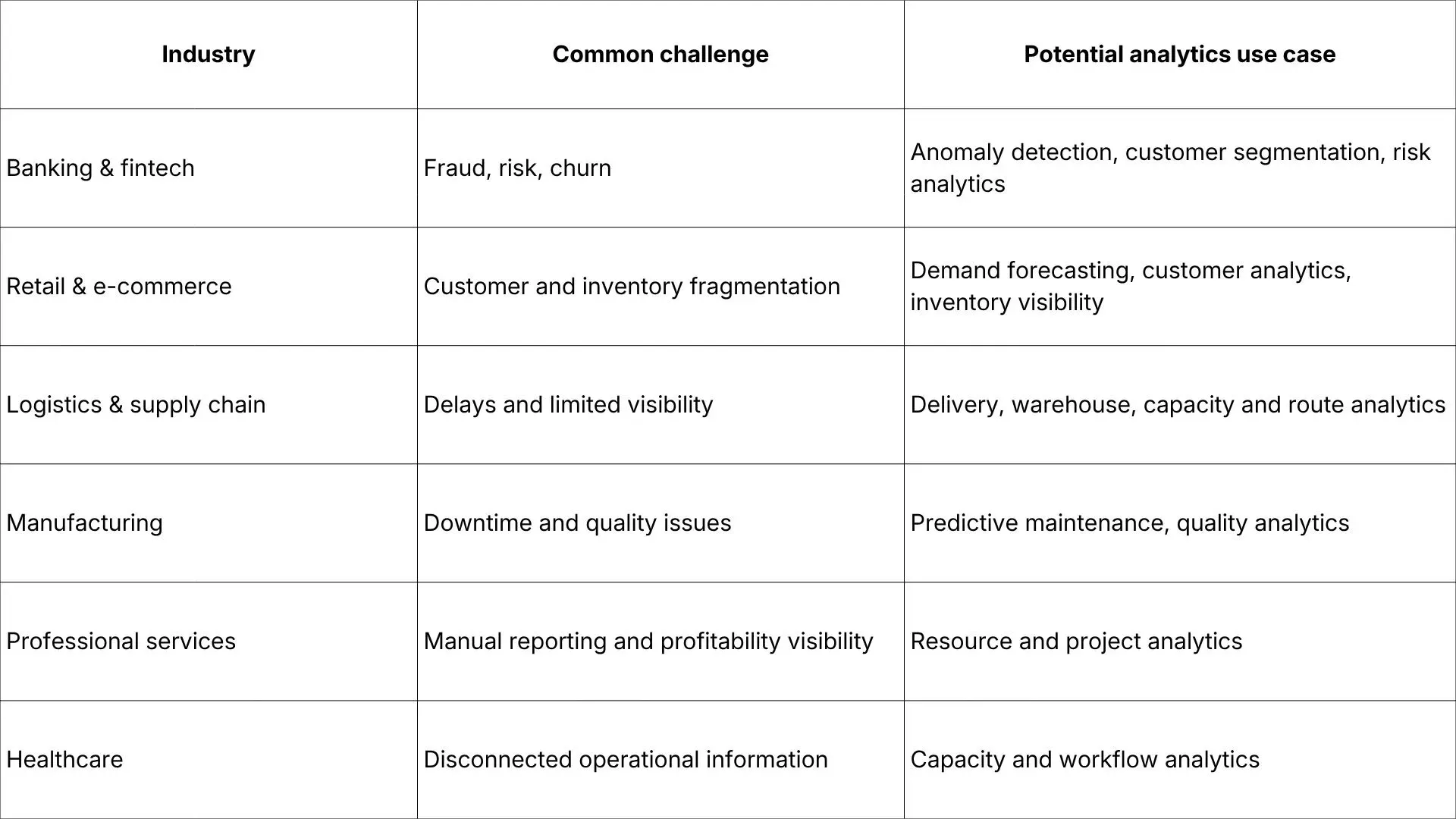
Banking and Fintech
Financial institutions manage large volumes of transaction, customer, risk, and operational data.
Analytics can help identify unusual patterns, analyze customer behavior, monitor performance, and support risk management.
For example, predictive analytics may be applied to fraud detection or customer churn, while BI dashboards can provide leadership with a clearer view of operational KPIs.
FIX Partner also has published content around banking technology, including AI and digital process automation use cases.
Retail and E-commerce
Retail businesses can combine sales, inventory, customer, and digital engagement data to understand demand and customer behavior.
Potential use cases include:
- Demand forecasting
- Customer segmentation
- Inventory optimization
- Product performance analysis
- Customer journey analytics
These types of applications are also reflected in Singapore's government-supported data-driven business initiatives.
Logistics and Supply Chain
Singapore's position as a regional trade and logistics hub creates significant opportunities for supply chain analytics.
Organizations can analyze:
- Inventory levels
- Delivery performance
- Supplier performance
- Demand patterns
- Warehouse utilization
- Operational bottlenecks
Predictive analytics can then help businesses anticipate demand and allocate resources more effectively.
Technology and Digital Businesses
Technology companies generate data across applications, customer interactions, product usage, and internal operations.
Analytics can help product and business teams understand:
- Feature adoption
- User engagement
- Customer behavior
- Product performance
- Conversion patterns
A scalable data foundation can also make it easier to introduce advanced analytics and AI as the business grows.
A Practical Data Analytics Consulting Process
A successful project does not start with selecting a dashboard platform or AI model.
It starts with a business problem.
1. Define the Business Decision
Start with the decision or process that needs improvement.
"Build an AI dashboard" is not a business goal.
"Reduce weekly reporting time by eliminating manual consolidation" is a measurable objective.
2. Assess Data and Systems
Map the relevant data sources, owners, formats, quality issues, integrations, privacy requirements, and reporting workflows.
This prevents organizations from selecting technology before understanding the underlying problem.
3. Prioritize Use Cases
Evaluate opportunities according to:
- Expected business value
- Data readiness
- Implementation effort
- Risk
- Adoption requirements
Start with use cases where value can be demonstrated.
4. Design and Validate the Solution
The consulting team can then define the target architecture, data model, governance controls, dashboard or analytical method, and measurement framework.
The design should be validated with the people who will actually use the solution.
5. Deliver an Outcome-Focused Pilot
A contained pilot using real data allows organizations to test both technical performance and business adoption before making a larger investment.
6. Scale, Govern, and Improve
After validation, the solution can be expanded, integrated into more workflows, and supported with monitoring, documentation, training, and governance.
Analytics should be treated as an ongoing business capability, not a one-time reporting project.

How to Choose a Data Analytics Consulting Partner
Choosing a data analytics consulting partner is not simply about selecting a company with the right tools.
The right partner should understand your business objectives, work with your existing technology environment, and connect technical delivery to measurable business outcomes.
Before choosing a provider, ask:
Does the partner understand your business problem?
A strong consultant should be able to explain the business problem before recommending a technology solution.
Does the team have data engineering capabilities?
Analytics depends on reliable data. Look for experience with databases, APIs, cloud platforms, ERP/CRM integration, pipelines, and data architecture.
Can the partner support BI and AI?
If your long-term roadmap includes advanced analytics or AI, a partner with broader capabilities can help you evolve beyond basic reporting.
How does the partner approach governance and security?
Ask how data access, security, privacy, quality, lineage, and governance will be addressed.
Can the partner support implementation?
A strategy document alone does not create business value.
Consider whether the partner can support integration, development, testing, deployment, user adoption, and ongoing optimization.
How are outcomes measured?
A credible engagement should define success through business outcomes rather than technical deliverables alone.
Potential KPIs include:
- Reporting time
- Forecast accuracy
- Operational cost
- Customer retention
- Resource utilization
- Processing time
- Revenue opportunities
Why Work With FIX Partner for Data Analytics?
FIX Partner combines technology consulting with hands-on software, AI, data, and QA capabilities.
The company's current service portfolio includes AI & Data Intelligence, with capabilities covering data lakes, lakehouses, warehouses, data engineering and integration, business intelligence, and analytics. FIX also provides AI/ML services and custom software development.
Explore FIX Partner's AI & Data Intelligence capabilities
For organizations that need more than a reporting layer, this broader capability can help connect analytics with the systems and applications where business decisions actually happen.
FIX Partner's approach follows five principles:
1. Business Outcome First
Define the business decision, KPI, and expected value before selecting technology.
2. Reliable Data Foundation
Address integration, quality, ownership, and access before scaling analytics or AI.
3. Governance by Design
Consider privacy, security, lineage, and accountability as part of the solution architecture.
4. Incremental Delivery
Validate value through a focused pilot before expanding the scope.
5. Knowledge Transfer
Document the solution and enable internal teams to use and maintain it confidently.
FIX's broader delivery methodology begins with discovery and consultation, followed by strategy and planning, development and QA, and delivery and support.
For businesses considering a broader digital transformation initiative, FIX also provides capabilities across technology implementation, system integration, modernization, security, compliance, and QA.
Turn Your Data Into an Actionable Roadmap
If your teams are working with fragmented data, manual reporting, inconsistent KPIs, or AI initiatives that lack a reliable foundation, the next step does not need to be a large transformation program.
Start with a focused data analytics assessment.
FIX Partner can help you identify priority use cases, evaluate data readiness, define the target architecture, and create a practical implementation roadmap for your Singapore or APAC operations.
Ready to turn your business data into actionable insights?