
Neobank Software Development in 2026: Launch Guide
Explore neobank software development in 2026, from core features and compliance to AI integration and digital banking launch strategies.
The banking industry is entering a new phase of digital transformation. Digital-only banks are evolving from niche financial alternatives into established competitors. Behind their growth is more than an attractive mobile application. It is a technology infrastructure capable of processing transactions, managing sensitive financial data, connecting external services, and meeting complex regulatory requirements.
On this page
In 2026, neobank software development is fundamentally about building this infrastructure. Financial institutions need platforms that can scale with business growth, integrate with an expanding financial ecosystem, and remain secure and reliable under demanding operating conditions.
This requires a strategic approach to software architecture, cloud infrastructure, API management, system integration, and compliance. Rather than treating these elements as separate technical decisions, businesses must bring them together in a unified development strategy.
This guide examines the technology foundations of modern neobanks, the architectural decisions that influence long-term performance, and how businesses can build digital banking platforms prepared for sustainable growth.
1. Market Context: Why 2026 Is a Turning Point
The growth of digital banking is changing the competitive landscape. Financial institutions are expected to deliver services continuously, process transactions efficiently, and connect with an increasingly diverse range of financial providers.
However, meeting these expectations requires more than adding new features. Banks must modernize the systems supporting their operations.
Legacy Infrastructure Is Reaching Its Limits
Many traditional banking systems were designed around centralized databases, tightly connected applications, and processes that depend on manual intervention. Although these systems may remain reliable for established operations, they can become difficult to adapt as transaction volumes and integration requirements increase.
Common challenges include:
- Limited flexibility when introducing new services
- High maintenance costs for outdated systems
- Difficulties integrating third-party financial platforms
- Slow development and deployment cycles
- Restricted capacity to scale individual services
For growing digital banks, these limitations can slow innovation and increase operational complexity.
Compliance Is Becoming an Architectural Requirement
Financial regulations continue to evolve across markets. Requirements involving data privacy, cybersecurity, anti-money laundering (AML), and consumer protection influence how banking platforms collect, process, store, and share information.
Compliance therefore needs to be considered during system design, not added after development. Data access, transaction records, identity verification, and reporting capabilities should be supported by the platform's underlying architecture.
Businesses exploring neobank app development should recognize this distinction: while the application delivers the customer-facing experience, the software infrastructure determines whether the bank can operate securely and reliably at scale.
Technology Flexibility Is a Competitive Advantage
Digital banks compete in an environment where partnerships, financial products, and regulatory expectations can change quickly. A rigid technology stack makes it harder to respond.
A flexible software foundation allows businesses to introduce new services, connect additional providers, and improve internal processes without repeatedly rebuilding the entire platform.
2. Cloud-Native Architecture: The Foundation of Modern Neobanks
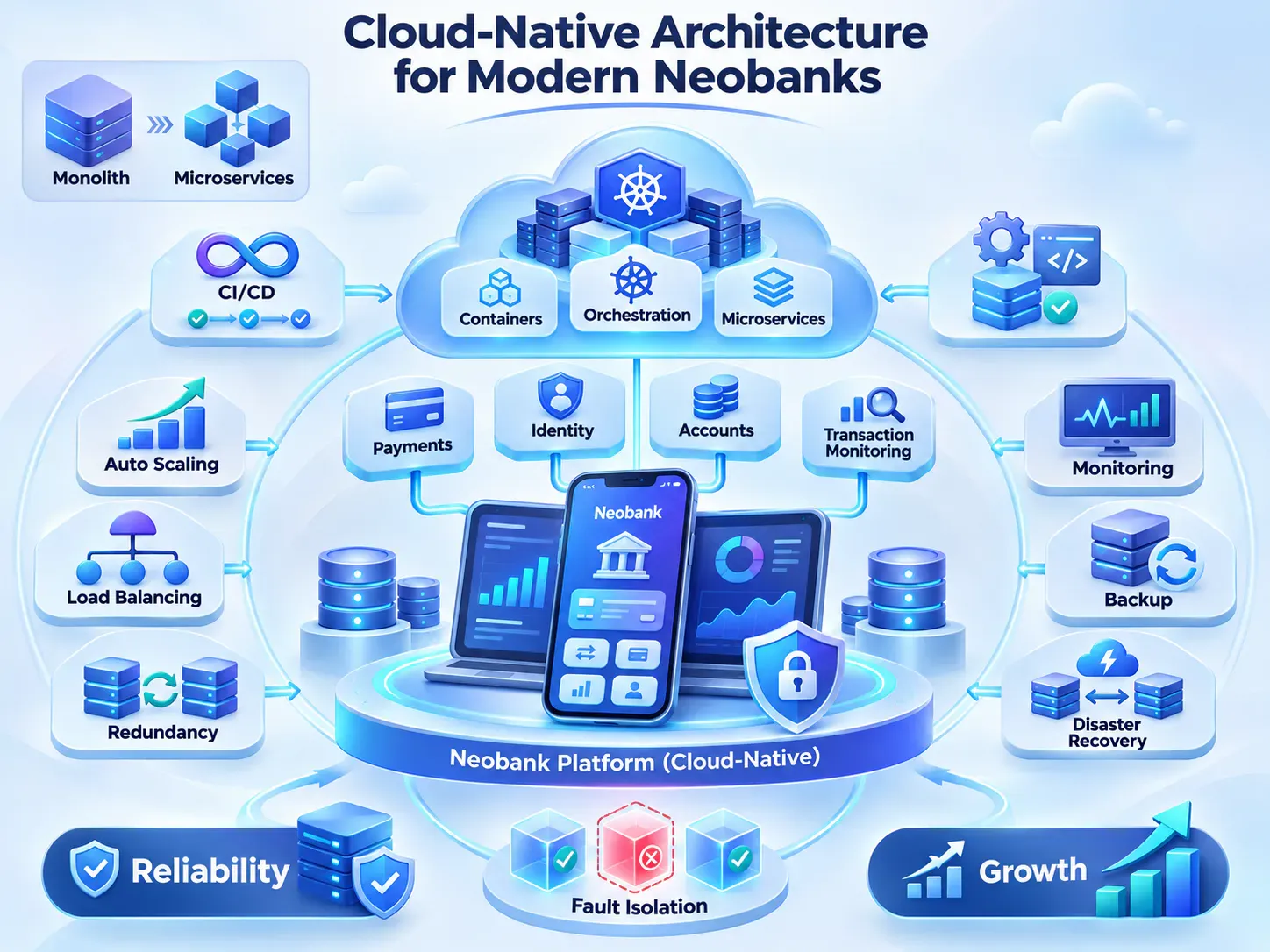
Architecture determines how a neobank operates, grows, and responds to technical challenges. Cloud-native development provides a foundation for building systems that are adaptable, resilient, and easier to maintain.
Moving Beyond Traditional Infrastructure
Cloud-native architecture involves designing applications specifically to take advantage of cloud environments. It goes beyond moving existing software to cloud servers.
A modern cloud-native banking platform may incorporate:
- Microservices-based application architecture
- Containerization and orchestration
- Automated infrastructure provisioning
- Continuous integration and deployment (CI/CD)
- Monitoring, backup, and disaster recovery capabilities
Together, these components support more flexible software development and infrastructure management.
Why Microservices Matter
In a traditional monolithic system, multiple business functions are packaged into a single application. Changes to one component may affect other parts of the system, making updates more complicated and increasing the potential impact of failures.
Microservices divide an application into smaller, independently managed services. For example, payment processing, customer identity, account management, and transaction monitoring can operate as separate components.
This approach offers several advantages:
- Independent development: Teams can update individual services without redeploying the entire platform.
- Targeted scalability: Resources can be allocated to services experiencing higher demand.
- Improved fault isolation: Problems in one service are less likely to affect unrelated functions.
- Greater flexibility: Technologies and deployment schedules can be selected according to each service's requirements.
Microservices are not automatically the best solution for every project. They introduce additional complexity in service communication, monitoring, and data management. Architecture decisions should reflect the bank's business scale, technical capabilities, and long-term roadmap.
Designing for Reliability and Growth
A neobank may experience significant increases in transaction volume as its customer base expands. Its infrastructure must handle these changes without compromising availability or processing performance.
Cloud platforms support this through resource scaling, load balancing, redundancy, and automated recovery mechanisms.
However, scalability should be planned across the entire system. Database performance, network capacity, service dependencies, and transaction processing must all be considered.
A well-designed architecture helps financial institutions expand their operations while maintaining predictable performance and manageable infrastructure costs.
3. API Architecture and Integration Governance
APIs are essential to modern banking infrastructure because they allow independent software systems to exchange information and execute operations through standardized interfaces.
However, building API connections is only one part of the challenge. A neobank must also manage interface consistency, service dependencies, data exchange, version changes, and access permissions across its technology environment.
A structured API architecture helps maintain these connections as the platform grows.
Establishing an API-First Architecture
APIs (Application Programming Interfaces) define how software components communicate with one another.
In neobank software development, an API-first approach means designing these interfaces as part of the initial system architecture rather than adding integrations after individual services have been developed.
This approach helps establish consistent communication between core banking modules, payment services, customer data systems, and external providers.
Important architectural considerations include:
- Clearly defined API contracts and data formats
- Consistent naming and response structures
- Standardized authentication and authorization
- API documentation and version control
- Error handling and request validation
A well-defined API architecture reduces inconsistencies between services and makes the platform easier to extend and maintain.
Managing Integration Complexity
As a neobank expands, the number of internal and external system connections can increase significantly.
Without clear integration standards, changes to one service may affect dependent applications. Inconsistent data formats and undocumented interfaces can also make troubleshooting more difficult.
An effective integration strategy should address service dependencies, interface versioning, data transformation, and failure handling.
For example, when an external payment provider changes its API, the neobank should be able to manage that change without unnecessarily disrupting unrelated banking functions.
Integration layers and well-defined service boundaries can help isolate dependencies and improve long-term maintainability.
API Security and Governance
APIs create communication channels between systems, so they require consistent security and governance controls.
Depending on the platform's architecture and regulatory requirements, important measures may include:
- OAuth-based authorization and secure authentication
- Role-based access control and permission management
- Encryption for sensitive information
- Rate limiting and request validation
- API gateway policies and traffic monitoring
- Audit logs and security event monitoring
Governance is equally important. Businesses should define who can access each interface, how changes are approved, and how deprecated API versions are managed.
These practices help maintain controlled communication between services while supporting the confidentiality, integrity, and availability of banking systems.
4. Supporting Open Banking Interoperability
Open banking creates opportunities for financial institutions to exchange data and connect with external providers through standardized and authorized interfaces.
As discussed in our article on open banking and API ecosystems, this model can support a more connected financial environment.
From a software architecture perspective, interoperability requires consistent data structures, secure authorization, reliable communication, and clear integration responsibilities.
A neobank should therefore consider not only which external services it needs to connect with, but also how those connections will be maintained as technical standards and business requirements evolve.
A scalable API strategy creates a foundation for future integrations without allowing growing system complexity to undermine platform reliability.
4. Core Banking Capabilities: Engineering Beyond the Interface
A modern neobank needs a reliable operational foundation. Its software must coordinate financial transactions, manage accounts, maintain accurate records, and support the services customers and business teams depend on.
Core Banking and Transaction Processing
Core banking capabilities form the operational center of a digital bank. They typically cover:
- Customer and account management
- Deposits and withdrawals
- Payment processing
- Transaction records and reconciliation
- Interest and fee calculations
- Financial reporting
These functions must work together consistently. In particular, transaction processing requires reliable validation, accurate recordkeeping, and appropriate handling of failed or repeated requests.
Data Management and System Integration
Banking platforms process sensitive information across multiple services. A clear data management strategy helps ensure that information remains accurate, accessible to authorized users, and consistent across the system.
Businesses should consider database design, data synchronization, backup policies, audit trails, and data retention requirements early in development.
The choice of database technology should depend on the nature of the data and workload. Transactional records, analytical workloads, and operational monitoring may require different storage and processing approaches.
Security, Monitoring, and Operational Resilience
Security must extend beyond login authentication. A complete banking platform needs controls across application services, infrastructure, databases, APIs, and internal operations.
Important capabilities include:
- Encryption for data in transit and at rest
- Identity and access management
- Transaction monitoring and fraud detection
- Audit logging and security event monitoring
- Vulnerability assessment and security testing
- Backup and disaster recovery procedures
Operational monitoring is equally important. Teams need visibility into system performance, service availability, transaction failures, and unusual activity.
Combining these capabilities helps financial institutions identify issues earlier, respond more effectively, and maintain confidence in their technology infrastructure.
5. How FIX Partner Can Help Accelerate Your Neobank Vision
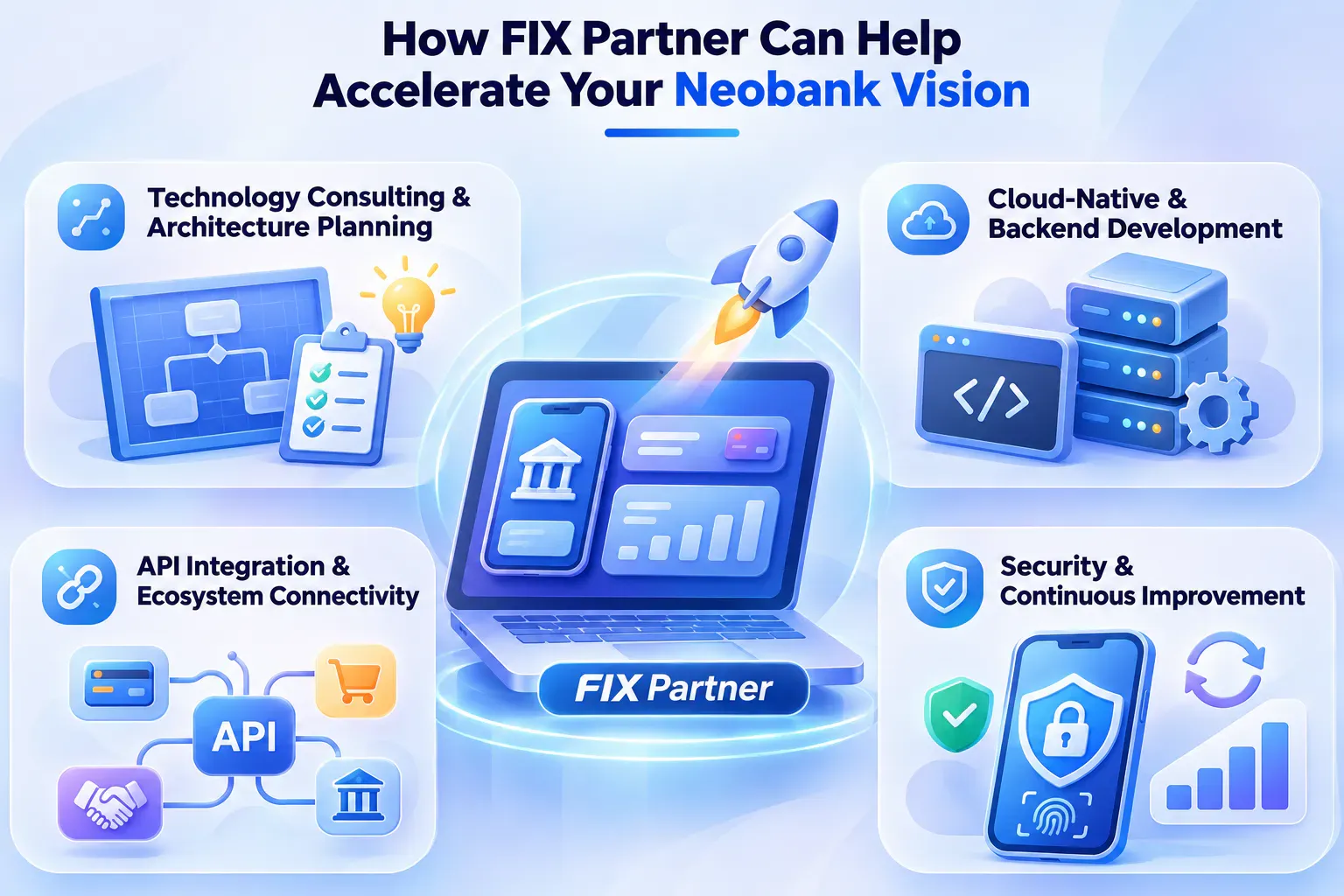
Building a digital banking platform requires more than software development capacity. Businesses need a technology partner that understands how architecture, integration, security, and business objectives influence one another.
FIX Partner works with financial institutions, fintech startups, and enterprises to develop software solutions aligned with their operational requirements and growth ambitions.
Technology Consulting and Architecture Planning
Every neobank has different business priorities, target markets, and regulatory responsibilities. FIX Partner begins by understanding these requirements before defining a suitable technical direction.
Our planning process considers:
- Business model and service scope
- Expected transaction volumes and growth
- Existing systems and integration requirements
- Security and compliance considerations
- Infrastructure and technology choices
Through our consulting and development services, we help align technical decisions with business objectives and long-term platform requirements.
Cloud-Native and Backend Development
A scalable digital banking platform depends on a well-structured backend. FIX Partner supports the development of cloud-native systems, including microservices, backend applications, and infrastructure automation.
Our engineering approach focuses on maintainability, system reliability, and the flexibility to support future enhancements.
API Integration and Ecosystem Connectivity
We help businesses connect banking platforms with payment providers, external financial services, and third-party applications through structured API integrations.
This creates a foundation for expanding partnerships and introducing new capabilities without unnecessary changes to the existing system.
Security and Continuous Improvement
Security and reliability remain essential throughout the software lifecycle. FIX Partner incorporates quality assurance and testing practices into development to help identify technical issues and improve software performance.
After deployment, ongoing optimization can address changing business needs, integration updates, and infrastructure improvements.
Our goal is to help partners build technology that supports meaningful business outcomes and lasting customer satisfaction.
Conclusion
Neobank software development in 2026 is ultimately an infrastructure and architecture challenge. A successful digital bank needs more than a functional application. It requires a reliable core banking foundation, scalable cloud architecture, secure API integrations, effective data management, and continuous operational monitoring.
These capabilities allow financial institutions to adapt to market changes, introduce new services, and manage growth without being constrained by inflexible legacy systems.
The right technology strategy connects these technical foundations with a clear business vision. With a structured development roadmap and an experienced technology partner, businesses can build digital banking platforms designed for long-term resilience and sustainable growth.
Connect with FIX Partner to explore how we can help turn your neobank vision into a secure, scalable, and future-ready software platform.
Written by
Hannah Huynh
Published by
FIX Partner
FIX Partner helps organizations design, build, test, and modernize software products with engineering, AI, data, and QA expertise.
About FIX Partner →Ask FIX Partner
Have a question about this topic?
Leave your details and a short note. Our team can help you identify a practical next step.
Related articles

Warehouse Management Software Benefits for Efficiency
Hannah HuynhNov 13, 20268 min read
Discover warehouse management software benefits beyond daily operations, including better business decisions, risk management, scalability, and growth.
Read more →
Why Human Resource Software Matters for Business Growth
Hannah HuynhOct 9, 2026
Discover how human resource software helps businesses streamline HR processes, improve workforce decisions, and support sustainable business growth.
Read more →
Native vs Hybrid vs Cross-Platform: Cost & Performance
Hannah HuynhSep 3, 202613 min read
Compare native, hybrid, and cross-platform app development by cost, performance, speed, and scalability to choose the right approach for your business.
Read more →