Dedicated Team vs Staff Augmentation: Which Is Better?
Compare dedicated team vs staff augmentation by cost, management, flexibility, and delivery ownership to choose the right model for your business.
Your business needs more software development capacity, but hiring full-time employees may not be the most practical solution. Perhaps your internal team is struggling with a growing backlog, or you need additional expertise to launch a new product.
On this page
Two common outsourcing options are a dedicated development team and IT staff augmentation. Both provide access to external professionals without requiring your business to recruit every role internally. However, they differ significantly in how work is managed, responsibilities are divided, and costs are structured.
Understanding dedicated team vs staff augmentation is essential before choosing an engagement model. The wrong arrangement can create management gaps, unexpected costs, or confusion over who is responsible for delivering results.
This guide explains how each model works, compares their costs and operational requirements, and helps your business determine which approach best fits its goals.
1. Understanding Dedicated Teams and Staff Augmentation
Both models provide external development expertise, but their working structures serve different business needs.
What Is a Dedicated Development Team?
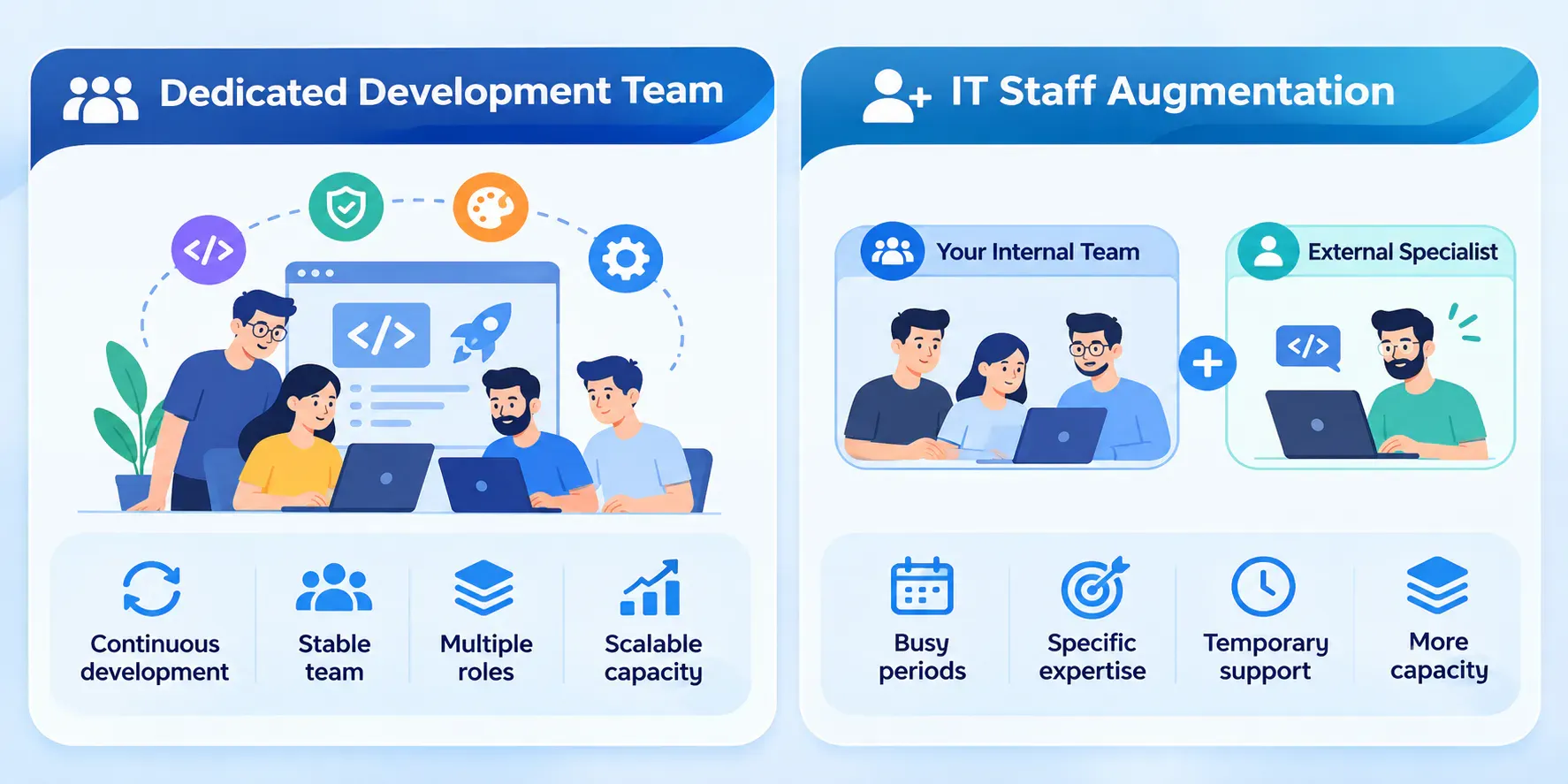
A dedicated development team is a group of external professionals assigned to work on your product or project over an agreed period.
Depending on your requirements, the team may include software developers, quality assurance specialists, designers, and technical or delivery leads.
The team works toward your product roadmap while coordinating responsibilities with your internal stakeholders.
Your business typically retains control over product vision, commercial priorities, and final acceptance decisions. The outsourcing provider may manage broader engineering activities, team coordination, and delivery processes, depending on the agreement.
A dedicated team is particularly useful when your business needs:
- Continuous development across multiple product releases.
- A stable engineering team that understands your product.
- Several technical roles working together.
- Capacity that can evolve alongside your roadmap.
For example, imagine your business operates a customer management platform requiring new features, ongoing improvements, and regular maintenance.
A dedicated team can maintain product knowledge across releases instead of requiring a new group of developers for every project.
The primary advantage is continuity. However, your business must still establish clear priorities, review progress, and maintain effective communication with the team.
What Is IT Staff Augmentation?
IT staff augmentation allows your business to add individual external specialists to an existing internal team.
These professionals work within your established processes, management structure, and development tools.
For example, your internal team may already have a project manager and several developers but lack a specialist in mobile development or automated testing.
Rather than creating a separate development team, you can bring in the required professional to work alongside your employees.
Staff augmentation is most suitable when your business needs:
- Additional developers during a busy development period.
- Specific technical expertise unavailable internally.
- Temporary support for a project or product release.
- More capacity without changing existing delivery processes.
Your business generally retains responsibility for daily task assignments, technical direction, and overall project coordination.
The external provider focuses on supplying suitable professionals and supporting the staffing arrangement.
This approach offers direct operational control but requires sufficient internal management capacity.
2. Dedicated Team vs Staff Augmentation: Key Differences
The most important difference is not the number of developers involved. It is how your business manages delivery and shares responsibilities with the outsourcing provider.
Comparing Management, Control, and Delivery Ownership
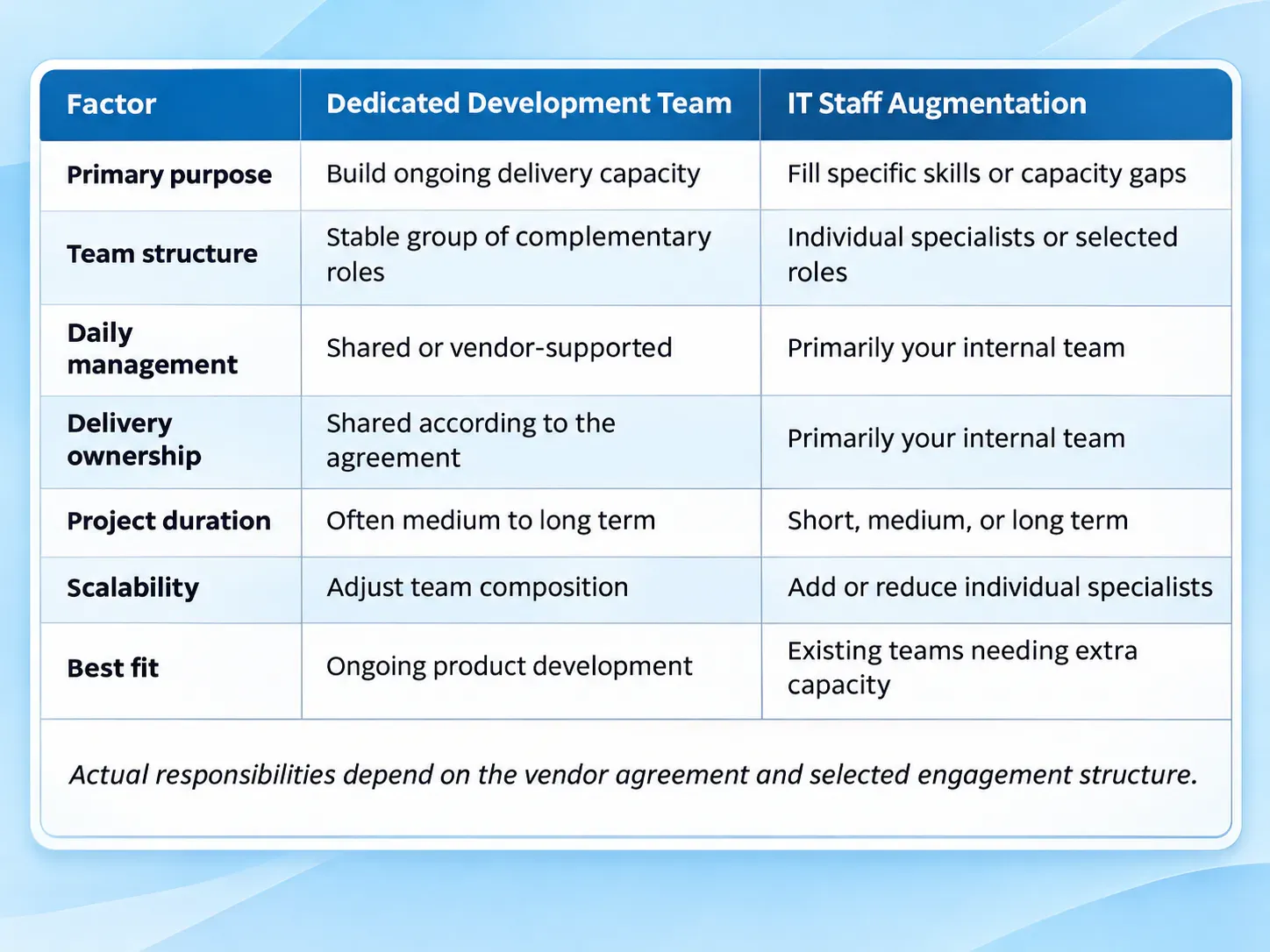
A dedicated team can provide a more complete development function, while staff augmentation extends the team and management structure you already have.
For non-technical business owners, understanding this distinction is essential. Clear team accountability helps define who is responsible for decisions, daily activities, and delivery outcomes.
If your business lacks an experienced engineering manager, hiring external developers through staff augmentation does not automatically solve that gap. Someone must still assign tasks, review technical decisions, and coordinate delivery.
A dedicated team may provide more structured management support, but the exact responsibilities should be clearly defined in the agreement before development begins.
How Do Communication and Accountability Differ?
With staff augmentation, external professionals usually follow your internal communication practices. Your project manager assigns work, monitors progress, and ensures that individual contributions fit the broader project.
A dedicated team may establish its own delivery rhythm, including planning sessions, progress reviews, testing activities, and release coordination.
Neither model removes the need for business involvement. Established project management practices provide useful guidance on planning, defining responsibilities, and coordinating work across different delivery approaches.
Before choosing either model, confirm:
- Who assigns and prioritises development tasks?
- Who manages technical blockers and missed deadlines?
- Who reviews software quality?
- Who approves scope changes?
- Who is accountable when a deliverable does not meet expectations?
Clear answers prevent misunderstandings during project execution.
Which Model Offers More Flexibility?
Staff augmentation often provides greater flexibility when your business needs one or two specific specialists.
For example, you might add a quality assurance engineer before a major release and reduce that capacity afterward, subject to contractual terms.
Dedicated teams are better suited to maintaining continuity across changing product requirements.
Rather than repeatedly introducing new developers, the same team can build knowledge of your software, customers, and business processes.
However, resizing a dedicated team may involve notice periods, minimum commitments, or changes to the agreed team structure.
Your business should review these conditions before assuming either model offers unrestricted flexibility.
3. Cost Comparison: Which Engagement Model Provides Better Value?
Cost is an important factor when comparing dedicated teams and staff augmentation, but the cheapest hourly rate does not always result in the lowest total development expense.
The financial difference depends on how many specialists you need, how long they will work, and which management responsibilities your business can handle internally.
How Does Staff Augmentation Pricing Work?
Staff augmentation is commonly priced according to the number of professionals assigned and their agreed working hours or monthly capacity.
For example, if your business needs one additional developer for three months, the engagement may be calculated using that person's hourly or monthly rate.
This makes budgeting relatively straightforward when the required role and workload are clear.
However, your internal team may still need to handle:
- Project planning and task allocation.
- Technical supervision and code reviews.
- Testing coordination and acceptance.
- Team communication and performance monitoring.
These internal responsibilities represent real costs, even when they are not included in the vendor's invoice.
How Does Dedicated Team Pricing Work?
Dedicated teams are commonly priced based on the agreed team composition, capacity, and commercial terms.
For example, your business might require two developers, one quality assurance specialist, and delivery coordination.
The monthly investment depends on the roles, seniority, allocation, and management services included.
Consider this illustrative comparison:
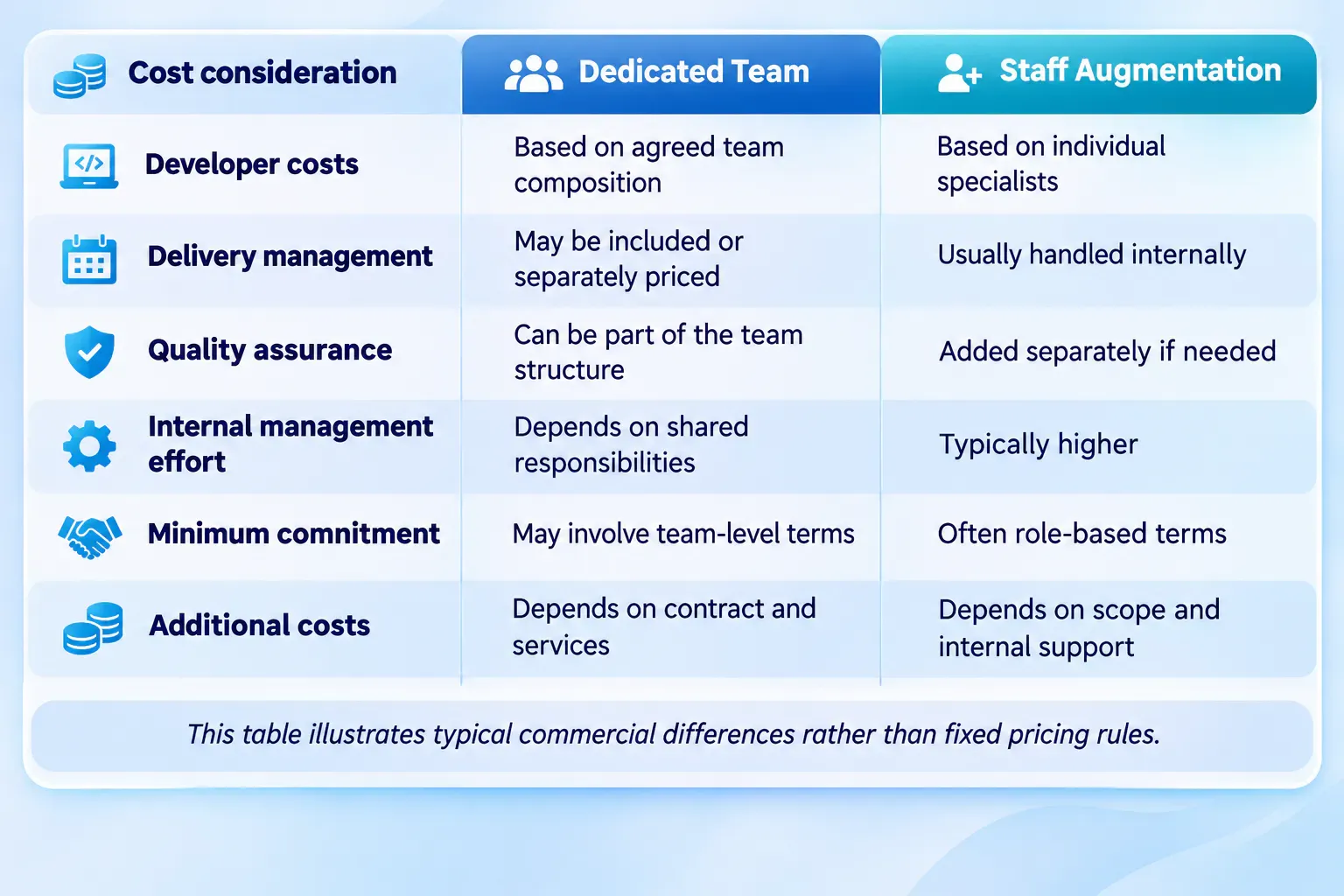
A dedicated team may cost more in total because it includes more people or delivery functions. However, it could provide better value if your business needs those functions and lacks internal resources to manage them.
Compare Total Delivery Cost
The practical question is not simply, "Which model has cheaper developers?"
Instead, ask: What will your business spend to deliver and maintain the required software?
Consider a project requiring two developers and regular software testing.
Under staff augmentation, your business might pay only for the external specialists while using its internal project manager and technical lead.
Under a dedicated team arrangement, the proposal may include developers, testing capacity, and delivery coordination.
To compare the two fairly, include both vendor fees and your internal management costs.
Also review onboarding, knowledge transfer, additional support, and potential changes in team capacity.
For current role-based pricing references, you can review the FIX Partner Rate Card. Final costs should always be confirmed against your project's actual requirements.
4. How to Choose the Right Model for Your Business
Choosing between a dedicated development team and staff augmentation requires an assessment of your existing capabilities, delivery expectations, and product roadmap.
When Should Your Business Choose a Dedicated Team?
A dedicated team may be the better option when your business needs continuous engineering capacity rather than temporary support.
Consider this model when:
- Your software product has an ongoing development roadmap.
- Several technical specialists must collaborate regularly.
- Maintaining product knowledge across releases is important.
- Your internal team needs support with engineering coordination.
- You want an established team structure that can evolve with the product.
For example, a growing SaaS business may need continuous feature development, testing, and maintenance.
A dedicated team can support these activities while building familiarity with the product over time.
When Is Staff Augmentation the Better Choice?
Staff augmentation is generally more appropriate when your business already manages software development effectively but needs additional expertise or capacity.
Choose this model when:
- You have an internal project manager or engineering lead.
- Your existing team needs one or several specific specialists.
- You want direct control over daily development activities.
- Your capacity requirements may change between project phases.
- You need external professionals to follow your established processes.
For instance, if your development team needs an automation testing specialist for an upcoming release, staff augmentation may be more practical than assembling a separate team.
How FIX Partner Helps You Select the Right Engagement Model
Choosing the right structure begins with understanding which responsibilities your business can manage internally and which should be supported by an external partner.
At FIX Partner, we offer both Dedicated Development Team and IT Staff Augmentation services to accommodate different delivery requirements.
Our approach focuses on clarifying:
- Business requirements: What product or capability does your business need?
- Internal resources: Which management and technical roles are already available?
- Delivery responsibilities: Who will coordinate development, testing, and progress reviews?
- Team structure: Which specialists and seniority levels are required?
- Flexibility: How might your resource needs change as the project develops?
You can also explore our engagement models to compare delivery structures, responsibilities, and potential working arrangements.
These discussions help establish clearer expectations before committing to an outsourcing agreement.
Conclusion
The choice between a dedicated team and staff augmentation depends on your business's internal management capacity, technical requirements, and long-term development plans.
A dedicated development team is often more suitable for ongoing product development that requires coordinated engineering capacity and continuity.
Staff augmentation works well when your business already manages delivery and needs additional specialists without changing its existing processes.
Neither approach is universally better. The right model is the one that provides the skills, accountability, and flexibility your business actually needs.
Contact FIX Partner to discuss a development structure aligned with your project requirements, budget, and business priorities.
How FIX Partner can help
- Mobile App DevelopmentiOS, Android and cross-platform apps built to scale.Explore Mobile App Development
- Web App DevelopmentSecure, fast web applications and portals.Explore Web App Development
- Dedicated Development TeamA long-term offshore team aligned to your roadmap.Explore Dedicated Development Team
Written by
Hannah Huynh
Published by
FIX Partner
FIX Partner helps organizations design, build, test, and modernize software products with engineering, AI, data, and QA expertise.
About FIX Partner →Ask FIX Partner
Have a question about this topic?
Leave your details and a short note. Our team can help you identify a practical next step.
Related articles

Vietnam vs India vs Philippines: Offshore Cost Comparison
Hannah HuynhNov 22, 20269 min read
Compare Vietnam, India, and the Philippines for offshore software development, including costs, technical skills, communication, and vendor selection.
Read more →
EU Software Outsourcing: A Data Protection Due Diligence Checklist
Hannah HuynhNov 20, 20266 min read
Protect your EU business when outsourcing software development. Use this GDPR checklist to assess vendors, security, contracts, and data transfers.
Read more →
Warehouse Management Software Benefits for Efficiency
Hannah HuynhNov 13, 20268 min read
Discover warehouse management software benefits beyond daily operations, including better business decisions, risk management, scalability, and growth.
Read more →