
Neobank App Development 2026: Smarter Banking Experiences
Explore neobank app development in 2026, from intelligent onboarding and personalization to scalable digital banking experiences and automation.
Banking has evolved from physical branches and paperwork into digital financial ecosystems accessible through smartphones. Today, customers expect banking applications to deliver intuitive interfaces, fast transactions, personalized services, and transparent communication.
On this page
As a result, neobank app development has become a strategic business decision. According to the International Monetary Fund (IMF), digital transactions involving mobile money, mobile banking, and internet banking increased from 55 per adult in 2017 to 251 in 2024, highlighting the growing importance of digital financial services.
However, advanced features alone cannot create competitive advantages. Neobanks must deliver seamless customer journeys that build trust, simplify financial activities, and encourage long-term engagement.
At FIX Partner, we connect business objectives with customer needs through connected financial ecosystems and customer experiences. This article explores the key considerations for developing competitive neobank applications in 2026.
Understanding Digital Journeys in Neobank App Development
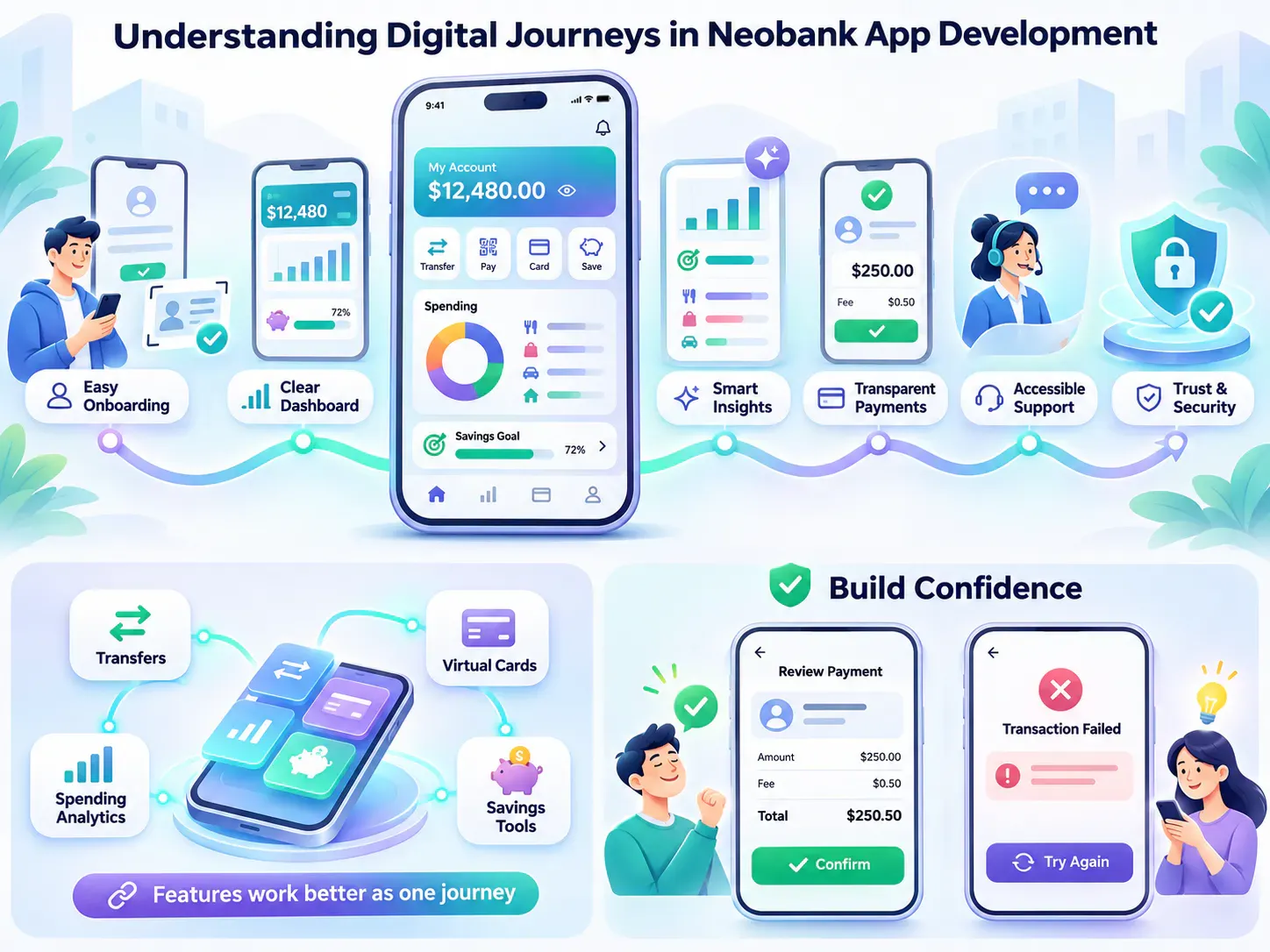
A digital journey covers every interaction between a customer and a neobank, from account registration and identity verification to daily payments, savings, and financial management.
Each interaction influences customer confidence and engagement. A complicated onboarding process can discourage registration, while unclear transaction information can reduce trust.
1. Moving Beyond Individual Features
Many neobanks offer similar capabilities, including instant transfers, virtual cards, spending analytics, and account management. However, having these features does not automatically create a competitive product.
The real difference comes from how effectively they work together.
For example, spending analytics become more useful when customers can connect transaction information with budgeting goals. Similarly, savings tools provide greater value when users can monitor progress and understand how their financial behavior affects their goals.
Businesses should therefore organize features around meaningful customer activities rather than develop disconnected functions.
Important priorities include:
- Simplifying onboarding and account registration.
- Providing clear financial dashboards.
- Offering relevant recommendations.
- Explaining transaction details and fees.
- Making customer support accessible.
The objective is to reduce friction throughout the customer journey, not simply increase the number of available features.
2. Understanding Customer Emotions
Financial activities involve sensitive decisions. Customers may worry about unexpected fees, transaction errors, or account security.
Consequently, effective digital journeys must address both functional requirements and emotional concerns.
For example, a payment screen should clearly display the recipient, amount, and applicable fees before confirmation. If a transaction fails, the application should explain the reason and provide a practical next step.
Customer journey mapping helps businesses identify these moments and improve the overall experience.
By understanding what customers need to accomplish and where uncertainty occurs, product teams can design applications that encourage confidence and long-term engagement.
UX as the Core of Neobank App Development
User experience directly influences how customers perceive and interact with digital banking services.
As neobanks expand their product offerings, interfaces must make financial information easier to understand without overwhelming users. This requires balancing simplicity, accessibility, and functionality.
1. Simplifying Complex Financial Services
Modern neobanks may provide multi-currency accounts, digital cards, savings tools, investment services, and automated financial insights.
Presenting everything simultaneously can create unnecessary complexity.
A more effective approach is to prioritize essential information, such as account balances, recent transactions, and frequently used actions. Advanced services can remain accessible through dedicated sections.
Three UX principles are particularly important:
- Progressive disclosure: Display essential information first and introduce more complex details when needed.
- Consistent navigation: Maintain familiar interaction patterns across application features.
- Contextual guidance: Explain unfamiliar financial concepts and actions at the appropriate moment.
These principles help customers navigate sophisticated financial services without requiring extensive financial or technical knowledge.
2. Personalization Without Intruding on Privacy
Personalization can make banking applications more relevant by adapting information and recommendations to customer behavior.
Examples include spending summaries, upcoming payment reminders, and savings suggestions based on established goals.
However, personalization should provide meaningful assistance rather than generate excessive notifications or recommendations.
Businesses must also communicate how customer information is used and provide appropriate control over data and preferences.
AI-powered recommendations should remain understandable and explainable. Customers need to know why a suggestion appears and should retain control over their financial decisions.
3. Accessibility Expands Market Reach
An accessible application can serve a broader range of customers, including older users and people with limited experience using digital financial services.
Important considerations include readable typography, sufficient color contrast, clear navigation, screen-reader compatibility, and straightforward instructions.
Accessibility should be included from the beginning of UX design rather than treated as a final-stage improvement.
By reducing barriers to digital banking, businesses can improve usability while reaching customer segments that might otherwise struggle with complex interfaces.
Automation and Intelligence in 2026
Automation is changing how customers interact with financial applications and how neobanks manage everyday services.
Its value comes from reducing repetitive activities, improving information accessibility, and helping users make more informed financial decisions.
However, automation should solve identifiable problems rather than introduce technology without a clear purpose.
1. Smart Onboarding and Verification
Onboarding is one of the most important stages in customer acquisition. Lengthy forms, unclear instructions, and repeated information requests can discourage potential users.
Automated document processing and identity verification workflows can help simplify registration while supporting necessary verification requirements.
From a customer experience perspective, businesses should prioritize clear instructions, transparent verification progress, and understandable explanations when additional information is required.
The objective is to improve onboarding completion without compromising applicable compliance controls.
2. Predictive Financial Assistance
Traditional banking applications mainly display completed transactions. More advanced applications can also help customers anticipate upcoming financial activities.
For example, they may provide subscription reminders, identify spending patterns, highlight potential cash-flow concerns, or suggest savings adjustments.
These capabilities can transform a basic banking interface into a more useful financial management tool.
However, recommendations must be relevant and reliable. Poorly timed or unexplained suggestions can reduce customer confidence.
Businesses should prioritize explainability, data quality, and customer control when implementing predictive features.
3. Automation That Improves Everyday Experiences
Automation also supports activities that customers may not directly see, such as transaction categorization, payment notifications, and customer support routing.
For example, automatically categorizing transactions helps users understand spending patterns without manually organizing every payment.
Nevertheless, automated processes need appropriate monitoring. Incorrect information or poorly designed notifications can create additional frustration.
The best approach combines automation with clear communication and accessible human assistance when necessary.
Strategic Neobank App Development with FIX Partner
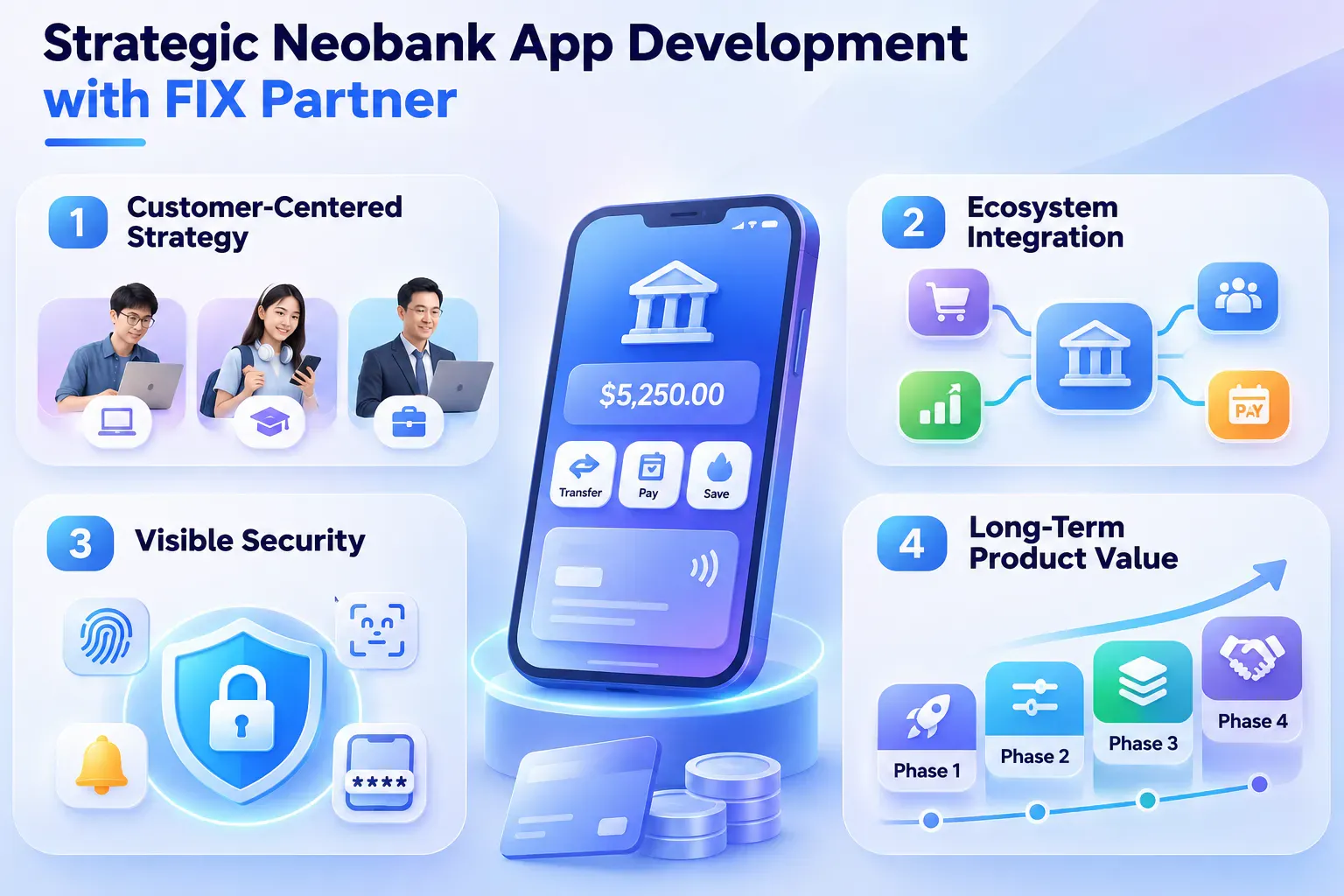
Building a competitive neobank application requires a clear understanding of customer needs, market positioning, and product priorities. Businesses should avoid developing features simply because competitors offer them. Instead, every product decision should contribute to a specific customer or business objective.
At FIX Partner, we help businesses translate their product vision into practical digital solutions through customer-focused software development and quality assurance.
1. Differentiation Through Customer-Centered Strategy
Neobanks may provide similar financial services, but their target customers often have different expectations.
Freelancers may need convenient ways to monitor irregular income and recurring expenses. Students may prioritize simple budgeting tools, while small business owners may value clear financial summaries and convenient account management.
These differences should influence application structure, feature selection, navigation, and communication.
FIX Partner works with stakeholders to understand their target audiences and translate customer requirements into product development priorities.
A focused product strategy helps businesses create applications that address specific financial needs instead of building generic products with too many disconnected features.
2. Designing Meaningful Digital Interactions
A successful neobank application should make important financial activities easy to understand and complete.
Product teams should evaluate how customers move between key functions, where they may become confused, and which interactions require clearer guidance.
For example, a transfer confirmation screen should present essential information in a straightforward format. A financial dashboard should help users identify important account information without overwhelming them with unnecessary details.
Usability testing and customer feedback can reveal these issues before they affect a wider audience.
The objective is to make each interaction purposeful, consistent, and easy to understand.
3. Building Trust Through Transparent Experiences
Trust is essential when customers manage their finances through a digital application.
Beyond technical protection, the application should communicate clearly about important financial activities and account-related decisions.
Useful product-level considerations include:
- Clear explanations of fees and transaction statuses
- Understandable notifications for important account activities
- Accessible account and privacy settings
- Transparent explanations of financial recommendations
- Convenient access to customer support
These details help customers understand what is happening and what actions they can take.
A trustworthy application does not simply provide financial functions. It gives users the information and control they need to use those functions confidently.
4. Prioritizing Long-Term Product Value
A neobank application should evolve according to customer feedback, product performance, and changing business priorities.
A phased product roadmap can help businesses manage development effectively:
- Phase 1: Essential banking experience – Establish the main customer journeys, account overview, and frequently used application functions.
- Phase 2: Usability optimization – Improve navigation, accessibility, content clarity, and interaction design.
- Phase 3: Personalized experiences – Introduce relevant financial insights, budgeting assistance, and contextual recommendations.
- Phase 4: Product expansion – Add new customer-facing services based on validated demand and product performance.
Each phase should have measurable objectives, such as feature adoption, customer satisfaction, task completion, and user engagement.
FIX Partner supports businesses throughout the product development lifecycle through software engineering and quality assurance, helping align application improvements with business goals and long-term customer value.
Why 2026 Is a Strategic Turning Point
Several developments are influencing digital banking strategies in 2026.
First, customers increasingly expect convenient digital services that simplify everyday financial activities. Applications that create unnecessary friction risk losing engagement.
Second, AI and automation are expanding opportunities for personalized financial assistance. However, businesses must balance innovation with transparency, reliability, and responsible data usage.
Third, growing attention to privacy and digital security makes customer trust an essential part of product differentiation.
Finally, different customer segments have increasingly specific financial requirements. Freelancers, SMEs, students, and internationally mobile customers may need different experiences and service priorities.
These developments make 2026 an important opportunity for businesses to review their neobank product strategies.
The organizations best positioned for sustainable growth will be those that apply technology to meaningful customer problems rather than adopt every emerging trend.
Final Thoughts: Designing for Trust, Simplicity, and Growth
Neobank app development in 2026 is about creating financial experiences that customers can understand, trust, and use consistently.
Competitive applications must combine intuitive journeys, accessible UX, relevant personalization, and responsible automation.
For business leaders, the most important question is not simply which features to build, but how the application can solve customer problems and contribute to long-term business objectives.
At FIX Partner, we help businesses translate these objectives into practical digital solutions through product development, engineering, and quality assurance.
Our focus is on helping clients achieve their goals and realize the long-term potential of their technology investments.
If you are planning a new digital banking application or improving an existing product, contact FIX Partner to discuss your neobank app development strategy for 2026 and beyond.
Written by
Hannah Huynh
Published by
FIX Partner
FIX Partner helps organizations design, build, test, and modernize software products with engineering, AI, data, and QA expertise.
About FIX Partner →Ask FIX Partner
Have a question about this topic?
Leave your details and a short note. Our team can help you identify a practical next step.
Related articles

Native vs Hybrid vs Cross-Platform: Cost & Performance
Hannah HuynhSep 3, 202613 min read
Compare native, hybrid, and cross-platform app development by cost, performance, speed, and scalability to choose the right approach for your business.
Read more →
Warehouse Management Software Benefits for Efficiency
Hannah HuynhNov 13, 20268 min read
Discover warehouse management software benefits beyond daily operations, including better business decisions, risk management, scalability, and growth.
Read more →
AML Outsourcing Services for Financial Crime Prevention
Hannah HuynhNov 1, 20266 min read
Strengthen fraud detection with AML outsourcing. Reduce compliance burdens and improve investigation accuracy.
Read more →