Fixed Price vs T&M: Compare Software Outsourcing Models
Compare fixed price vs T&M contracts and three software outsourcing models by cost, flexibility, delivery ownership, and business needs.
Your business is planning a software project, but choosing an outsourcing partner involves more than agreeing on a development budget. You also need to decide how the project will be managed, who controls daily work, and what happens when requirements change.
On this page
Two common pricing approaches are Fixed Price and Time and Materials (T&M). At the same time, software outsourcing providers may offer different engagement models, including Dedicated Development Teams, IT Staff Augmentation, and Project-Based Outsourcing.
These decisions are connected, but they are not interchangeable.
Understanding Fixed price vs T&M helps your business choose how to pay for development. Comparing engagement models helps determine how your team and outsourcing partner will work together.
This guide explains both decisions, compares their costs and responsibilities, and helps your business select a suitable software delivery arrangement.
1. Understanding the Pricing Models
Before choosing an outsourcing arrangement, your business should understand how each pricing model handles costs, project requirements, and changes during development.
What Is a Fixed Price Contract?
A Fixed Price contract establishes an agreed total cost for a defined project scope.
The FAR guidance on fixed price contracts provides a useful reference for understanding when this pricing approach is appropriate, particularly when requirements can be defined clearly and costs can be estimated with reasonable confidence.
Before development begins, your business and the outsourcing provider typically agree on deliverables, milestones, acceptance criteria, and payment terms.
For example, your business may need an employee management system with clearly specified features, such as employee profiles, leave requests, approval workflows, and reporting.
If these requirements are sufficiently documented, the vendor can estimate the development effort and propose a fixed contract price.
Fixed Price is generally suitable when:
- Project requirements are clearly defined.
- Deliverables and acceptance criteria can be agreed upfront.
- Major changes are unlikely during development.
- Your business needs a predictable contractual budget.
However, additional features or significant requirement changes may require a formal change request, potentially increasing costs or extending timelines.
What Is a Time and Materials Contract?
A Time and Materials (T&M) contract charges your business according to the time worked and applicable resources used during development.
The FAR guidance on Time and Materials contracts explains a pricing structure based on agreed hourly labour rates and applicable material costs, particularly when the extent or duration of work is difficult to estimate in advance.
Rather than agreeing on one total project price, both parties establish rates, billing procedures, resource requirements, and delivery expectations.
For example, your business may be developing a customer platform while continuing to gather feedback on its features.
Under T&M, the development team can work on approved priorities while your business adjusts future requirements as new information becomes available.
T&M is commonly suitable for:
- Products with evolving requirements.
- Ongoing development and maintenance.
- Projects involving technical uncertainty.
- Long-term product improvement.
This flexibility requires regular progress reviews, spending visibility, and clear approval procedures.
The FAR references describe U.S. federal procurement practices. They are useful explanations of contract structures, not mandatory rules for private software outsourcing agreements.
2. Costs, Flexibility, and Delivery Risks
The most important difference between Fixed Price and T&M is how each approach manages uncertainty.
Fixed Price focuses on delivering an agreed scope for a defined amount. T&M provides more flexibility in the work performed, with costs reflecting the resources used.
Comparing Pricing and Project Control
The following table highlights the main differences your business should consider.
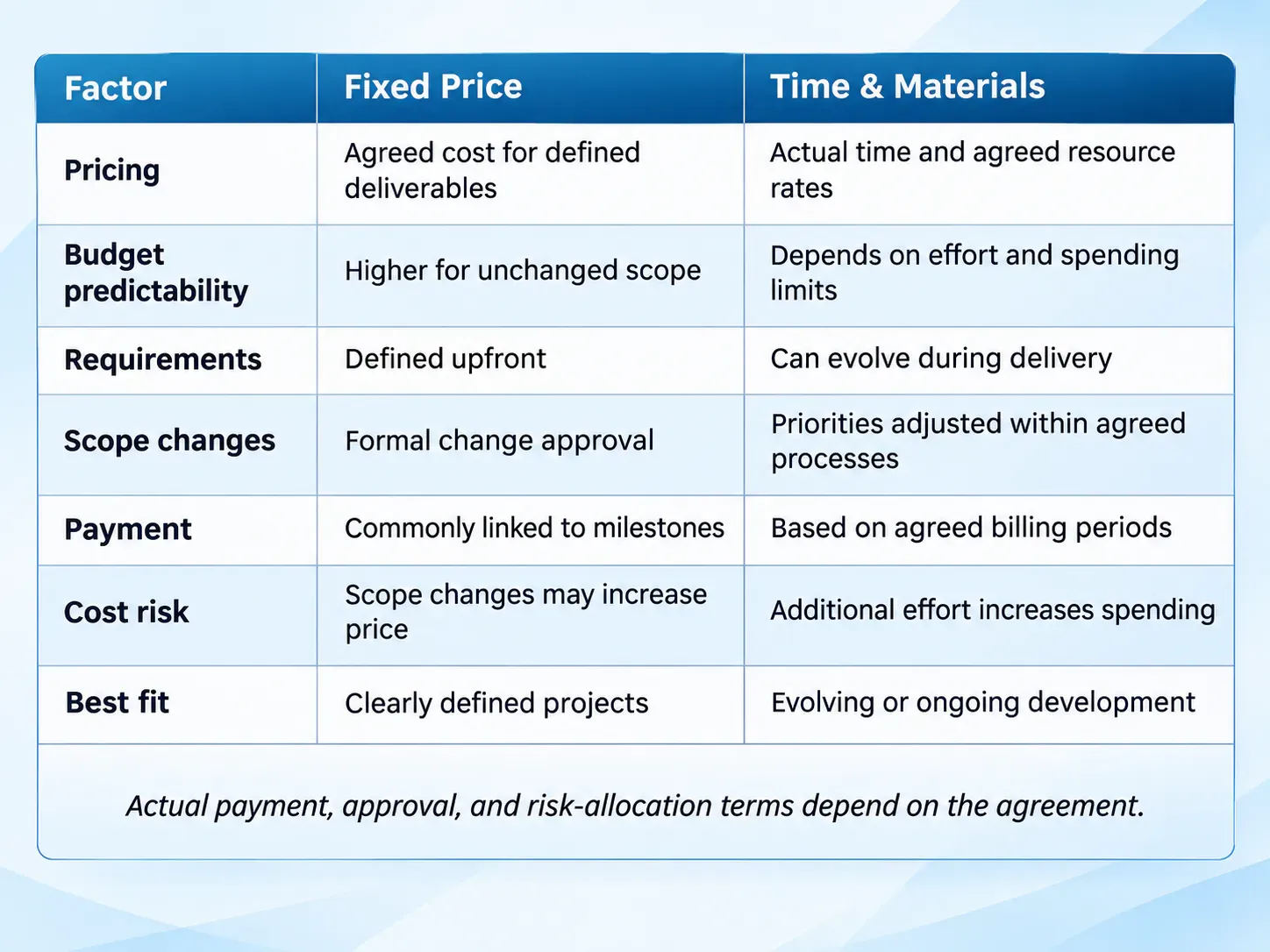
For example, a company commissioning a clearly specified reporting dashboard may prefer Fixed Price because the expected outcome is known.
A business developing a new digital product may prefer T&M because features could change following customer feedback.
How Do These Models Affect Your Budget?
Fixed Price helps your business plan an agreed investment, but it does not guarantee that every requested feature is included.
A vendor may charge separately for work outside the approved scope.
T&M allows greater flexibility, but your business must monitor the effort used.
Consider a hypothetical development engagement:
A developer charges $25 per hour and works 160 hours during a month.
The development cost would be $4,000. If the project requires an additional 40 hours, another $1,000 would be charged under the same rate.
These figures are illustrative, not FIX Partner quotations.
Under either model, cost control depends on clearly defined responsibilities.
Your business should confirm who approves changes, how additional work is estimated, and when financial approval is required.
Can Fixed Price and T&M Be Combined?
Yes. Some projects benefit from different pricing arrangements across development phases.
For example, your business may agree on a fixed-price technical assessment before moving into T&M development as requirements evolve.
A later, clearly defined module could also be delivered under a separate fixed-price agreement.
This approach can balance initial budget certainty with flexibility during implementation.
However, the transition between phases should be documented, including deliverables, approval requirements, and commercial terms.
3. Comparing Three Software Outsourcing Engagement Models
Pricing determines how your business pays for development. An engagement model determines how the external team works with your organisation.
At FIX Partner, businesses can explore three main engagement models: Dedicated Development Team, IT Staff Augmentation, and Project-Based Outsourcing.
Each provides a different structure for project management, delivery ownership, and collaboration.
Dedicated Development Team
A Dedicated Development Team is a stable group of external professionals assigned to support your product roadmap over an agreed period.
The team may include developers, quality assurance specialists, designers, and technical or delivery leads.
Your business typically retains control over product priorities and acceptance decisions, while the outsourcing provider supports engineering coordination and agreed delivery activities.
This model is particularly relevant when your business needs continuous development across multiple product releases.
For example, a SaaS company may require ongoing feature development, testing, maintenance, and technical improvements.
A dedicated team can maintain product knowledge and provide consistent engineering capacity as requirements evolve.
The pricing arrangement depends on the agreed team composition, capacity, and commercial terms. A dedicated team does not automatically require one specific pricing model.
IT Staff Augmentation
IT Staff Augmentation adds external technical specialists to your existing internal team.
Your business generally remains responsible for daily task allocation, technical direction, and project coordination.
For example, your internal development team may need two additional engineers to accelerate a product release.
Instead of outsourcing the entire project, you can add specialists who work within your established processes.
Staff augmentation is useful when your business has an existing management structure but lacks sufficient development capacity or specific expertise.
Commercial arrangements commonly reflect the agreed specialists and their working capacity. However, the exact billing terms must be confirmed in the contract.
Project-Based Outsourcing
Project-Based Outsourcing focuses on delivering an agreed project outcome.
Your business defines the objectives, approves the scope, and accepts the deliverables. The outsourcing provider takes responsibility for agreed delivery activities, which may include planning, engineering, testing, and handover.
For example, your business may outsource the development of an internal reporting platform with specific requirements and milestones.
This model is suitable when the required outcome can be planned as a defined project.
Project-Based Outsourcing may use Fixed Price when requirements are sufficiently clear. However, other pricing arrangements can also be considered when the scope involves uncertainty.
Dedicated Team vs Staff Augmentation vs Project-Based Outsourcing
The table below compares how the three models typically organise responsibilities.
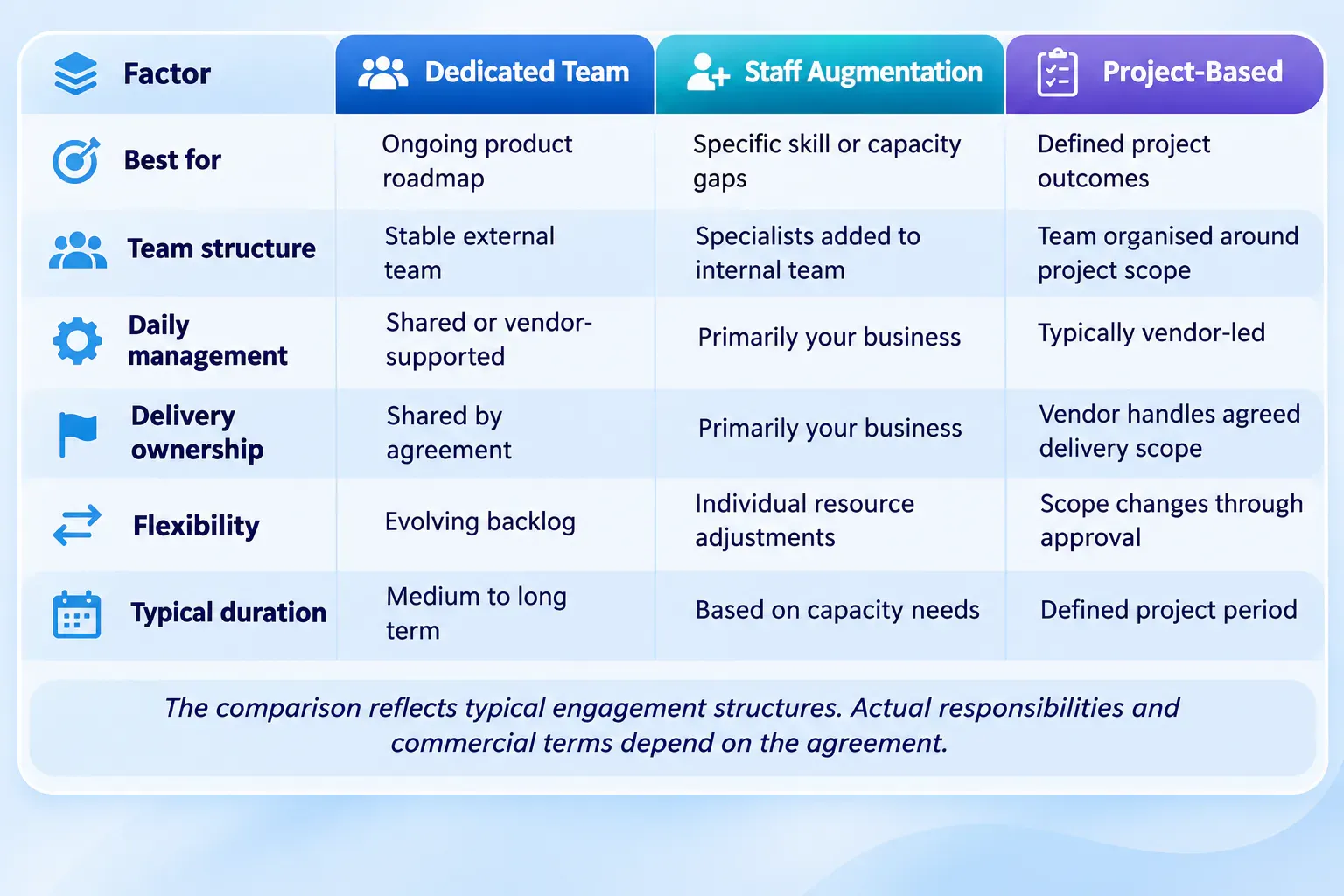
The distinction matters because selecting a pricing model does not automatically establish who manages developers or owns delivery outcomes.
For example, agreeing to T&M billing does not mean your business must directly manage every developer. Similarly, Project-Based Outsourcing does not automatically guarantee a fixed total price.
Both decisions should be reviewed separately.
4. How to Choose the Right Pricing and Engagement Model
Selecting an outsourcing structure begins with understanding your requirements, internal resources, and preferred level of delivery involvement.
Match Your Business Needs to the Right Model
Your business can use the following questions to guide its decision.
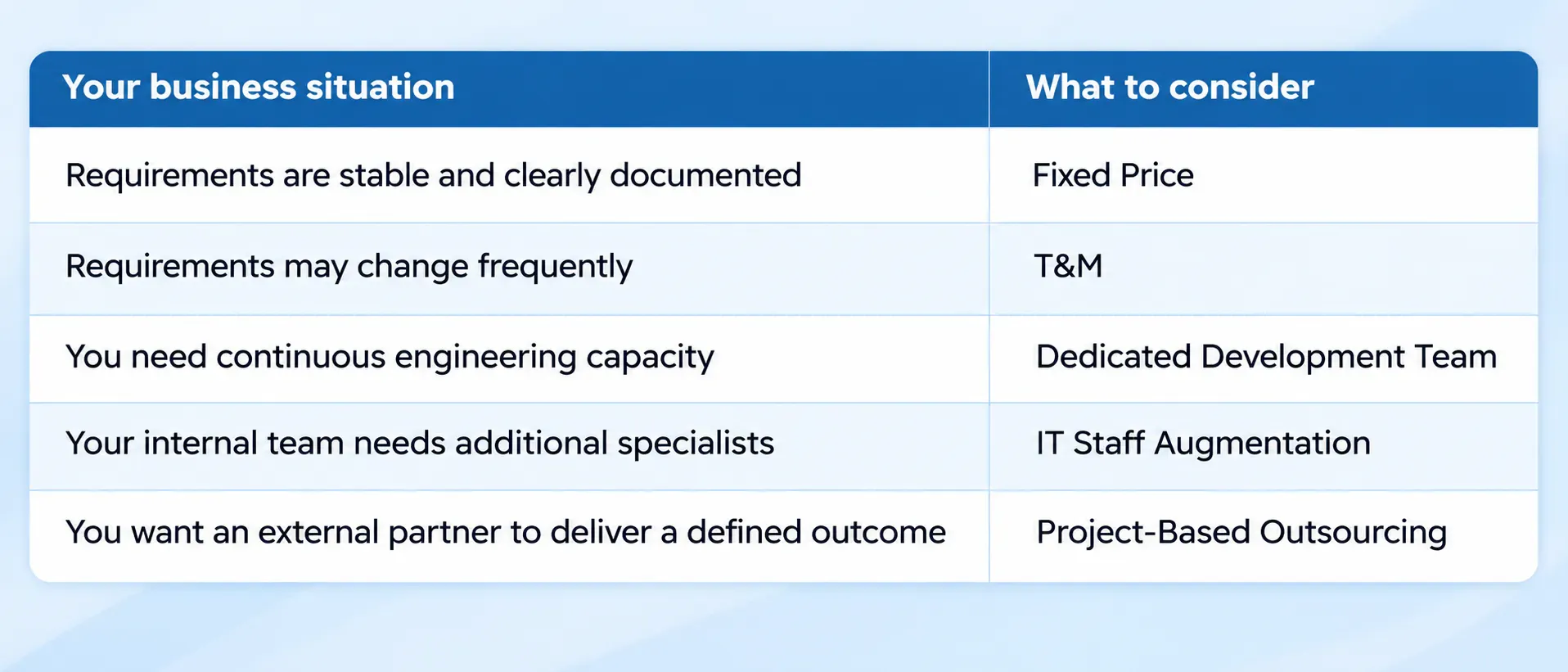
These are starting points rather than fixed rules.
For example, your business could choose a Dedicated Development Team with a time-based commercial arrangement for ongoing product development.
Alternatively, a Project-Based Outsourcing engagement could use Fixed Price for clearly defined deliverables.
The appropriate combination depends on the work involved and the responsibilities each party agrees to undertake.
What Should Your Business Confirm Before Signing?
Before committing to an outsourcing agreement, clarify five areas:
- Scope: What work is included, and how will changes be approved?
- Budget: Is payment based on deliverables, time, resources, or an agreed combination?
- Management: Who assigns tasks and coordinates daily development?
- Quality: Who performs testing, reviews deliverables, and approves acceptance?
- Continuity: How will documentation, handover, and ongoing support be managed?
These questions help your business compare proposals based on total delivery expectations rather than contract price alone.
How FIX Partner Supports Your Engagement Model Selection
At FIX Partner, we help businesses clarify software development requirements and evaluate suitable delivery structures before project execution.
Our engagement models allow your business to compare Dedicated Development Teams, IT Staff Augmentation, and Project-Based Outsourcing based on management responsibilities, scope, and delivery expectations.
You can also review the FIX Partner Rate Card for indicative engineering rates and project starting prices.
Published rates provide an initial budgeting reference. Final pricing, team composition, deliverables, and commercial arrangements are confirmed through an agreed proposal.
This allows your business to evaluate both the financial commitment and the operational support required for successful delivery.
Conclusion
Understanding Fixed price vs T&M helps your business select a suitable payment structure, while comparing engagement models clarifies how software development responsibilities will be managed.
Fixed Price offers greater predictability for clearly defined requirements. T&M provides flexibility when priorities evolve.
Dedicated Development Teams, IT Staff Augmentation, and Project-Based Outsourcing address a different decision: how your business organises external engineering capacity and delivery ownership.
The right arrangement combines a suitable pricing model with an engagement structure that reflects your project requirements, internal capabilities, and budget.
Contact FIX Partner to explore a delivery approach aligned with your business priorities.
How FIX Partner can help
Written by
Hannah Huynh
Published by
FIX Partner
FIX Partner helps organizations design, build, test, and modernize software products with engineering, AI, data, and QA expertise.
About FIX Partner →Ask FIX Partner
Have a question about this topic?
Leave your details and a short note. Our team can help you identify a practical next step.
Related articles
Dedicated Team vs Staff Augmentation: Which Is Better?
Hannah HuynhNov 23, 20268 min read
Compare dedicated team vs staff augmentation by cost, management, flexibility, and delivery ownership to choose the right model for your business.
Read more →
EU Software Outsourcing: A Data Protection Due Diligence Checklist
Hannah HuynhNov 20, 20266 min read
Protect your EU business when outsourcing software development. Use this GDPR checklist to assess vendors, security, contracts, and data transfers.
Read more →
Vietnam vs India vs Philippines: Offshore Cost Comparison
Hannah HuynhNov 22, 20269 min read
Compare Vietnam, India, and the Philippines for offshore software development, including costs, technical skills, communication, and vendor selection.
Read more →