IT Services Market Trends Every Business Should Understand
Explore IT services market trends, including cloud computing, cybersecurity, and outsourcing, to make smarter technology decisions and drive business growth.
On this page
Businesses increasingly rely on technology to improve operations, serve customers, and remain competitive. From managing data to delivering digital products, technology influences how organizations work and grow. As a result, the IT services market has become an important part of business strategy rather than simply a technical function.
However, adopting new technology does not automatically lead to better results. Businesses must understand which services meet their needs, how to manage risks, and how to ensure their investments deliver measurable value.
By exploring the major developments in the IT services market, business leaders can make more informed decisions, choose suitable technology partners, and build strategies that support long-term growth.
Understanding the IT Services Market and Its Business Impact
The IT services market covers a broad range of services that help organizations plan, develop, implement, maintain, and improve their technology systems. These services enable businesses to address technical challenges without necessarily building every capability internally.
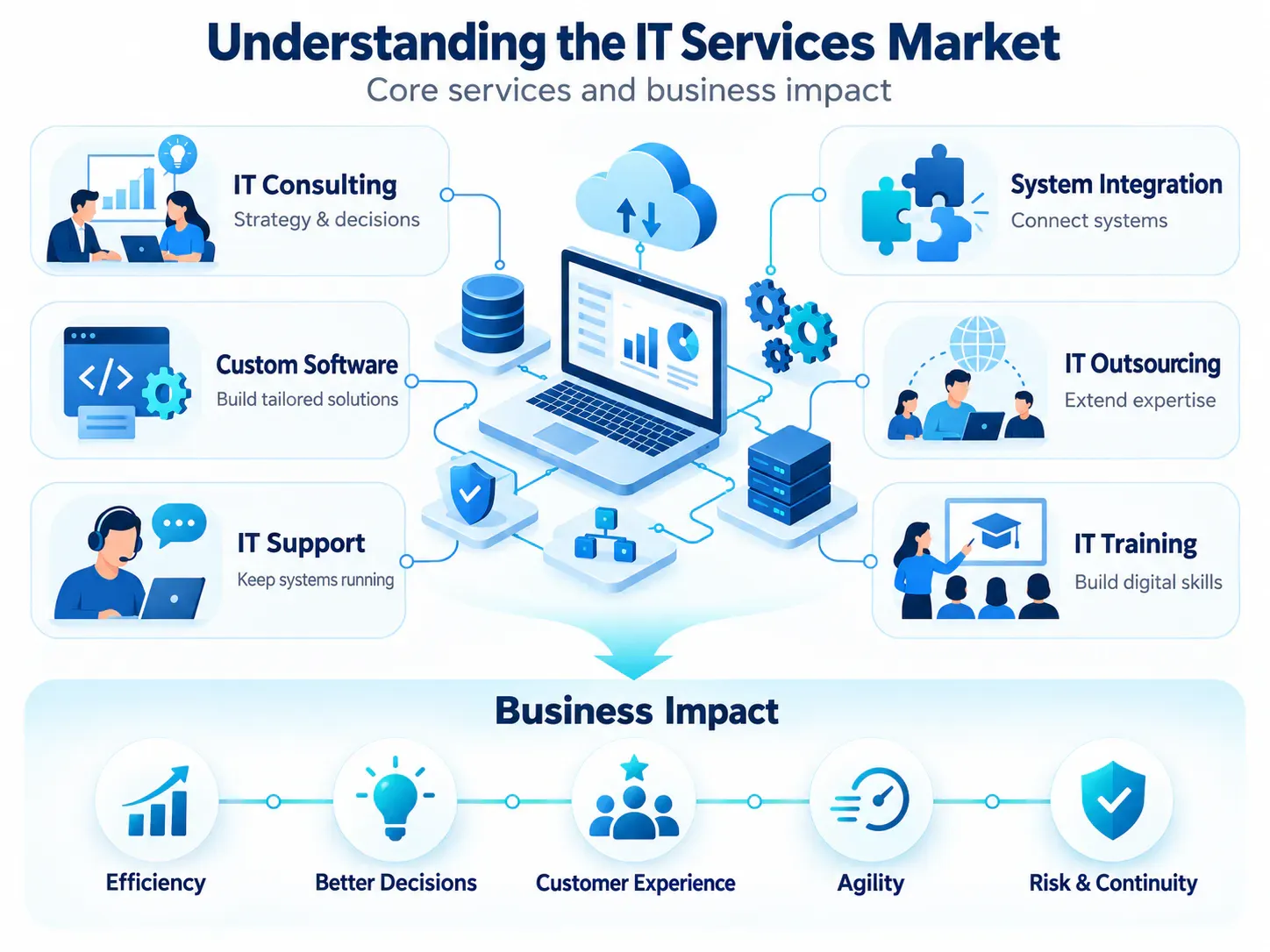
Six Core Segments of the IT Services Market
The research paper Current Trends in the IT Services Market by Vera Krasavina identifies six major segments:
- IT consulting: Helps businesses assess technology needs, develop strategies, and make informed investment decisions.
- System integration: Connects applications, databases, and platforms so that different business systems can work together.
- Custom software development: Creates software tailored to specific operational processes and customer requirements.
- IT outsourcing: Provides access to external expertise and resources for selected technology functions or projects.
- IT support: Maintains technology systems, resolves technical issues, and supports operational continuity.
- IT education and training: Helps employees develop the knowledge and skills needed to work with new technologies.
These services often work together. For example, a business introducing a new digital platform may need consulting to define its requirements, custom development to build the solution, integration to connect existing systems, and ongoing support to maintain performance.
Understanding these service categories helps business leaders identify where investment or external expertise could make the greatest difference.
Why IT Services Matter to Business Performance
Technology decisions can affect productivity, customer satisfaction, operating costs, and business continuity. Outdated systems may slow down employees, while disconnected applications can create unnecessary manual work.
A well-planned IT strategy can help businesses:
- Improve operational efficiency by reducing repetitive tasks.
- Make information more accessible for better decision-making.
- Deliver more consistent digital experiences to customers.
- Respond more effectively to changing business requirements.
- Manage technology risks and protect business continuity.
The priority should not be adopting the latest technology simply because it is popular. Businesses should first identify the problem they need to solve and then evaluate which IT services can deliver the most relevant benefits.
Technology Trends Reshaping Business Operations
Technology developments continue to influence how IT services are delivered and used. The research highlights areas such as cloud computing, artificial intelligence, open-source software, and cybersecurity. Each offers opportunities, but businesses must also consider its practical limitations.
Cloud Computing: Improving Flexibility and Scalability
Cloud computing allows businesses to access computing resources, applications, and infrastructure through cloud service providers instead of relying entirely on locally managed systems.
This model can help organizations adjust resources as demand changes, support distributed teams, and reduce the need to manage all infrastructure internally.
Businesses may consider several approaches:
- Public cloud: Uses infrastructure and services provided by an external cloud provider.
- Private cloud: Provides a dedicated cloud environment for a particular organization.
- Hybrid cloud: Combines cloud environments with other infrastructure to meet different operational requirements.
- Multi-cloud: Uses services from multiple cloud providers.
Each approach involves trade-offs in cost, control, security, and management complexity. A successful cloud strategy therefore requires clear business objectives, careful planning, and an understanding of long-term operating costs.
AI and Open-Source Software: Supporting Innovation
Artificial intelligence (AI) and machine learning can help businesses analyze information, automate suitable tasks, and enhance digital services. Depending on the application, these technologies may support customer service, operational planning, or software functionality.
Open-source software also gives development teams access to tools and technologies that can accelerate implementation and reduce dependence on certain proprietary solutions.
Before adopting these technologies, businesses should evaluate:
- Whether the solution addresses a genuine business need.
- How well it integrates with existing systems.
- The cost of implementation, maintenance, and employee training.
- Potential security, privacy, and reliability concerns.
The value comes from applying technology to the right problem, not from adopting it for its own sake.
Cybersecurity: Protecting Business Continuity
As businesses become more dependent on digital systems, cybersecurity becomes an essential part of technology planning. Security incidents can disrupt operations, expose sensitive information, and undermine customer trust.
One approach discussed in modern software operations is DevSecOps, which integrates security practices into development and operational workflows. Instead of treating security as a final checkpoint, teams consider it throughout the software lifecycle.
Businesses should prioritize:
- Incorporating security checks into development and testing.
- Reviewing access to systems and sensitive information.
- Identifying potential weaknesses before software is released.
- Maintaining clear processes for handling security issues.
Innovation and security should progress together. Technology investments are more sustainable when risks are considered from the beginning.
IT Outsourcing: Moving from Cost Savings to Business Value
IT outsourcing enables businesses to work with external providers for selected technology services, projects, or specialist skills. It can be particularly useful when internal teams lack the capacity or expertise required for a specific task.
However, outsourcing should not be viewed only as a way to reduce costs. A well-managed partnership can also help businesses access specialist knowledge, increase delivery capacity, and allow internal employees to focus on core priorities.
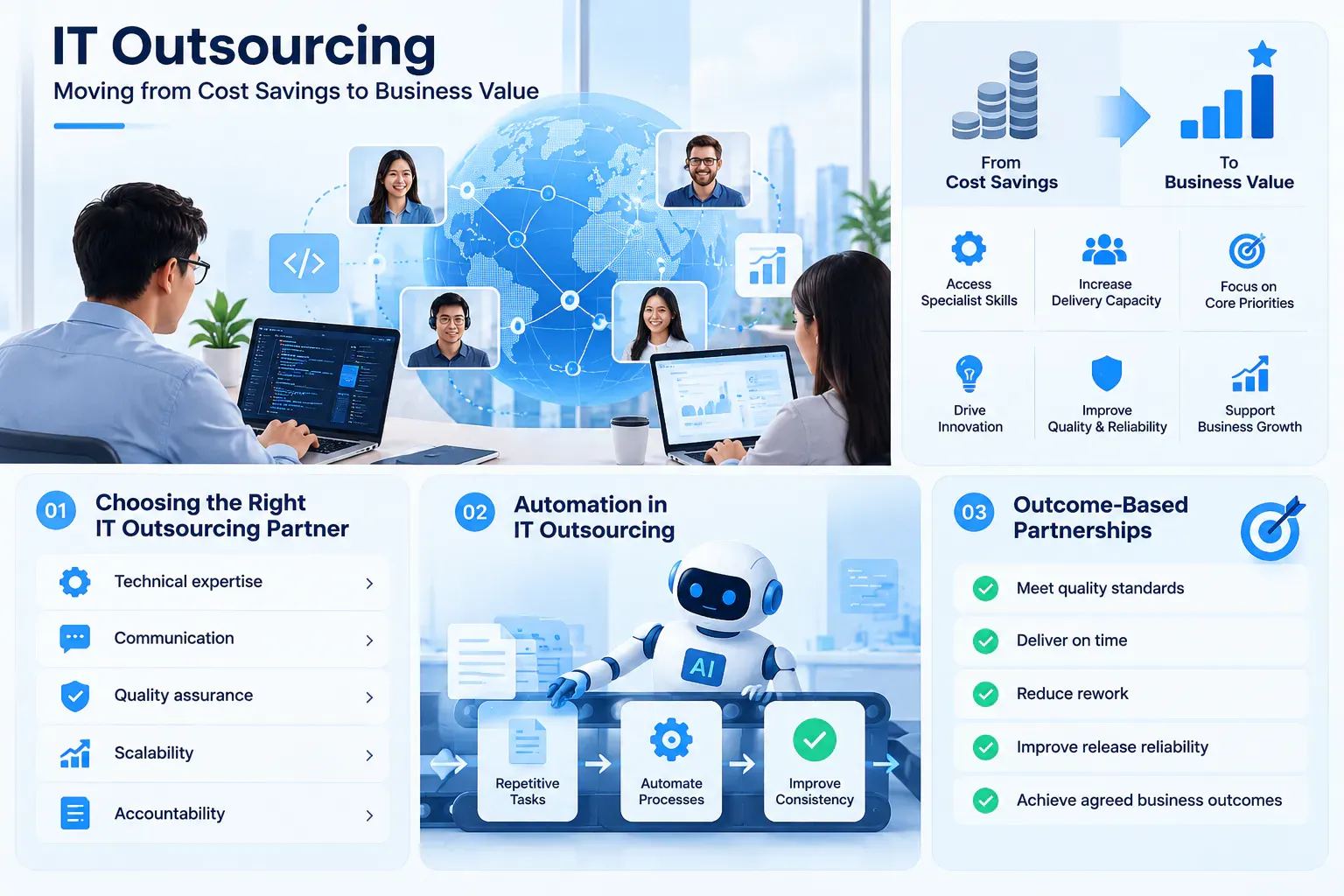
Choosing the Right IT Outsourcing Partner
Selecting a provider requires more than comparing prices. Businesses should evaluate whether a potential partner can understand their objectives, communicate effectively, and deliver work that meets agreed requirements.
Key considerations include:
- Technical expertise: Relevant experience with the required technologies and project scope.
- Communication: Clear updates, timely feedback, and effective collaboration.
- Quality assurance: Defined testing procedures and consistent quality controls.
- Scalability: The ability to adapt resources as project needs change.
- Accountability: Clear responsibilities, milestones, and performance expectations.
The right provider should fit the business's requirements and working practices. A lower initial price may not offer the best value if it leads to quality issues, delays, or additional rework.
Automation and Outcome-Based Partnerships
Automation is changing how some IT services are delivered. Technologies such as robotic process automation can reduce repetitive manual work in suitable processes, helping teams improve consistency and allocate their time more effectively.
At the same time, businesses increasingly benefit from defining outsourcing success in terms of outcomes rather than activities alone.
Depending on the project, useful measures may include:
- Meeting agreed software quality standards.
- Completing milestones within the planned timeframe.
- Reducing repetitive work or avoidable rework.
- Improving the reliability of software releases.
- Meeting clearly defined acceptance criteria.
These measures should be agreed upon before work begins. Clear expectations and regular communication help both the business and its provider understand progress and address problems early.
Ultimately, successful outsourcing depends on collaboration, accountability, and a shared understanding of what the project is expected to achieve.
Building a Future-Ready IT Services Strategy
Businesses do not need to adopt every emerging technology to remain competitive. A future-ready strategy focuses on selecting the capabilities that address real challenges while allowing the organization to adapt as its needs evolve.
Aligning Technology Investments with Business Goals
The first step is to identify where technology can create practical improvements. Leaders should review operational bottlenecks, customer expectations, existing systems, and potential risks before selecting a solution.
For example:
- A business struggling with disconnected applications may benefit from system integration.
- A team spending too much time on repetitive tasks may consider appropriate automation.
- An organization developing a mobile application may prioritize software quality and testing.
- A company expanding its digital operations may need to review its cloud infrastructure and security practices.
This approach helps decision-makers prioritize investments based on business needs rather than technology trends alone.
Developing Skills and Maintaining Flexibility
Technology strategies also depend on people. Employees need opportunities to develop relevant skills, understand new processes, and collaborate effectively with technical teams.
Businesses can support this through ongoing training, digital learning resources, and knowledge-sharing across departments.
Flexibility is equally important when choosing infrastructure and service providers. Organizations should consider the benefits and trade-offs of different approaches, including:
- Adjusting cloud resources as operational needs change.
- Working with specialist providers when internal expertise is limited.
- Reviewing service arrangements as business priorities evolve.
- Balancing flexibility with security, cost control, and management complexity.
A strong IT services strategy combines suitable technology, capable people, reliable partners, and clearly defined objectives. Its success should be measured by the improvements it delivers, not by the number of technologies implemented.
How FIX Partner Helps Businesses Turn IT Trends into Value
Choosing the right IT services partner can help businesses translate technology requirements into practical outcomes. FIX Partner focuses on supporting software quality and business objectives through services tailored to customer needs.
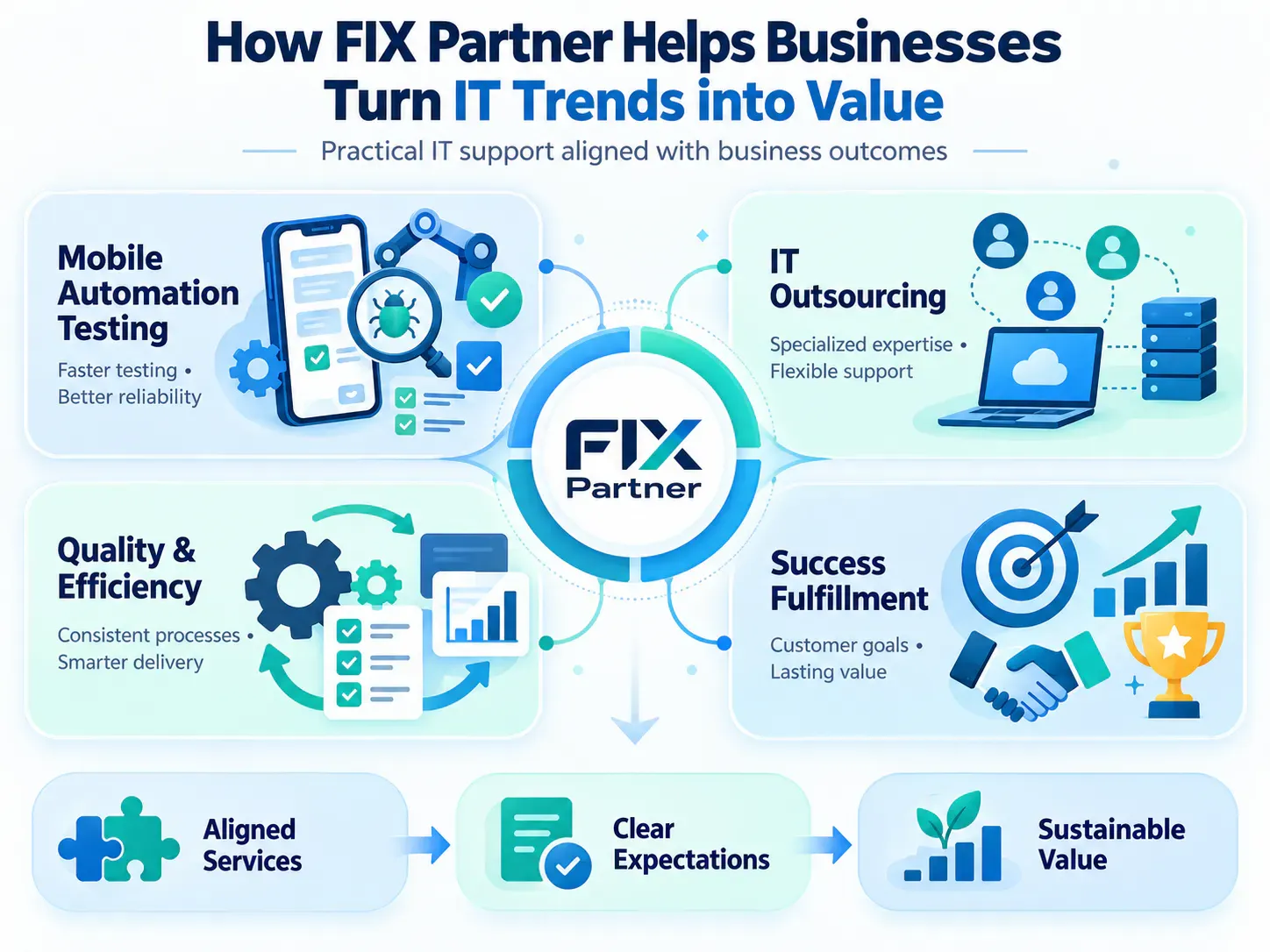
Our key areas of support include:
- Mobile Automation Testing: Helps streamline repetitive testing activities, identify defects earlier, and improve mobile application reliability.
- IT Outsourcing: Gives businesses access to specialized expertise and additional resources to support software development and testing requirements.
- Quality and Efficiency: Supports more consistent testing processes, helping businesses improve delivery workflows and make better use of their resources.
- Success Fulfillment: Reflects our commitment to helping customers achieve their goals and realize their potential for lasting fulfillment and satisfaction.
For businesses navigating the evolving IT services market, the right partnership should go beyond completing technical tasks. It should align services with business priorities, establish clear expectations, and focus on outcomes that matter to customers.
Through this approach, FIX Partner aims to help businesses strengthen their software delivery processes and create sustainable value from their technology investments.
Conclusion
The IT services market encompasses a wide range of capabilities, from consulting and software development to cloud computing, cybersecurity, and outsourcing. These services give businesses opportunities to improve efficiency, respond to changing requirements, and strengthen their digital operations.
To make the most of these opportunities, business leaders should focus on three priorities:
- Choose technology strategically: Invest in solutions that address clearly identified business needs.
- Build effective partnerships: Evaluate providers based on expertise, communication, quality, and accountability.
- Measure meaningful outcomes: Connect technology initiatives with defined business objectives and performance indicators.
Understanding market trends is an important starting point, but successful implementation depends on making informed choices and working with the right people.
Ready to make your IT strategy more effective?
Contact FIX Partner to help your business achieve its goals.
Written by
Hannah Huynh
Published by
FIX Partner
FIX Partner helps organizations design, build, test, and modernize software products with engineering, AI, data, and QA expertise.
About FIX Partner →Ask FIX Partner
Have a question about this topic?
Leave your details and a short note. Our team can help you identify a practical next step.
Related articles
SEO, AIO, AEO & GEO: Search in the AI Era
Hannah HuynhSep 12, 2026
SEO, AIO, AEO, and GEO are reshaping search in the AI era. Learn how businesses can build websites ready for modern search and AI-powered visibility.
Read more →
IoT Mobile App Development Services: Business Impact
Hannah HuynhAug 23, 2026
Discover how IoT mobile app development services help businesses connect devices, improve customer experiences, automate operations, and drive growth.
Read more →
AI Transparency Obligations: What Businesses Must Know
Hannah HuynhJul 22, 2026
Learn how AI transparency obligations under the EU AI Act affect businesses and discover practical steps to build compliant, trustworthy AI solutions.
Read more →